23 Best WhatsApp API Providers for Business (2026)
Compare best WhatsApp API providers, including Zixflow, Twilio, Wati, Interakt, Gupshup, 360Dialog and Infobip on aspects like pricing model, best use case, strengths & limitations.
 by Sahil Tyagi
You need a provider to use the WhatsApp Business API, and providers differ mostly in three areas:
- How do they charge for messages?
- Whether you get a no-code inbox or only an API?
- What do they add on top, like AI agents or other channels?
This guide compares 23 providers on those points so you can shortlist two or three to trial.
- Best for multichannel messaging with fallback: Zixflow, MSG91, Infobip
- Best for SMB teams that want a no-code inbox: Wati, Interakt, DoubleTick, BotSpace
- Best for Shopify and D2C brands: Zoko, DelightChat, LimeChat
- Best for developers: Twilio, 360Dialog, Bird, Vonage
- Best for AI-led customer support: Yellow ai, Verloop, Gupshup
- Best for regulated enterprises and contact centers: tyntec
- Best for B2B sales teams: Rasayel, DashCX
- Best for omnichannel team inboxes and marketing suites: Trengo, CM, Brevo
WhatsApp has become a standard channel for business conversations. The WhatsApp Business app alone crossed 200 million monthly active users, and companies reach customers through the WhatsApp Business API instead.
WhatsApp marketing has become a common marketing type used by brands around the globe to connect with their customers to promote their products or services. However, to make the most of this marketing strategy, companies leverage something called WhatsApp Business API.
The WhatsApp Business API is a robust cloud-based communication platform that enables you to take advantage of WhatsApp’s communication features to send marketing, utility, or authentication messages to your customers over WhatsApp.
The catch with using the API is that it doesn’t have a native frontend dashboard. To use it, you have to partner with a WhatsApp API provider that can give you access to the API and track the effectiveness of your WhatsApp outreach.
That brings us to this post. Here, I have curated a list of top WhatsApp API Providers along with their features and pricing plans to help you choose the right one for your business’s WhatsApp marketing needs. But before diving into that, let’s see what WhatsApp Business API is.
What is a WhatsApp Business API provider?
WhatsApp Business API providers are third-party vendors that act as middlemen between your business and WhatsApp. These providers specialize in the WhatsApp Business Platform and assist you in your WhatsApp marketing efforts.
Using these vendors, you can utilize WhatsApp’s marketing capabilities without worrying about setting up the channel by yourself or spending time figuring out what to do if you run into a problem.
Although having a WhatsApp Business API provider can help you get started with integrating WhatsApp into your current marketing infrastructure, it will cost you more money as these vendors have their monthly or on-time plans.
How did we evaluate these WhatsApp API providers?
I compared every provider on the same criteria, using the following information that you need to know before making a decision:
- Pricing model: subscription price, how WhatsApp messages are billed, markups and add-on costs, taken from each provider’s official pricing page or documentation.
- Product type and setup effort: whether the product is a developer API, a no-code app, or an enterprise platform that needs a sales-led rollout.
- Team features: shared inbox, user limits, and automation limits per plan.
- Recent changes: product launches, pricing changes, and ownership changes to 2026.
- User feedback: ratings and the most common complaints on review platforms.
Pricing and features were checked in November 2026. Prices change often, so confirm them on the provider’s pricing page before you buy. Where a provider does not publish prices, I mentioned that.
As Zixflow, we are among the 23 providers listed below. I have rated the platform on the same criteria as the competitors.
Best WhatsApp API providers for businesses
There are many WhatsApp API providers present in the market and choosing one out of many can be difficult. So, to make it easy for you, I have curated a list of top WhatsApp API providers below. You can go through them and choose the one suitable for your business needs.
| Tool | Features Summary | Entry Price | Best Suited For | Free plan or trial |
|---|---|---|---|---|
| Zixflow | Official WhatsApp BSP with no-code automation & and API support | Entry price starts from $49/month | B2C, e-commerce, and consumer apps with behavior-based sends | Free plan for broadcasts only + 7-day free trial |
| Twilio | Developer API (CPaaS) | No monthly fee | Developer-first CPaaS with powerful APIs | Free trial, no card |
| Interakt | No-code WhatsApp inbox and marketing | Growth $55/month | WhatsApp sales & support tool built for D2C brands | Free trial |
| Wati | No-code WhatsApp inbox and automation | Growth $59/month, billed annually | No-code WhatsApp inbox and automation for SMBs | 7-day trial |
| Zoko | WhatsApp CRM for Shopify | Starter $49.99/month | WhatsApp commerce tool with catalog and multi-agent support | 7-day trial |
| Infobip | Enterprise omnichannel CPaaS | Custom | Enterprise omnichannel platform with global WhatsApp API | Free trial |
| Brevo | Email-first marketing suite | Professional $499/month | Marketing platform with WhatsApp, email, and SMS campaigns. | Free plan, but WhatsApp needs Professional subscription |
| BotSpace | Chatbot-led WhatsApp platform | Free; Pro from ₹999/month | WhatsApp chatbot builder with broadcast campaign tools | Free plan |
| tyntec | Enterprise messaging API | Custom quote | Carrier-grade WhatsApp API with strong compliance focus | Not listed |
| DelightChat | Shopify helpdesk with WhatsApp marketing | Startup $29/month | Unified support inbox for D2C brands across WhatsApp | 14-day trial, no card |
| 360Dialog | Direct API gateway | €49 per number/month | Direct WhatsApp API access, popular with agencies | Not listed |
| Bird | Developer API with marketing tools | No deposit on pay as you go | Omnichannel CRM with powerful WhatsApp marketing automation | Pay as you go |
| DashCX | WhatsApp sales CRM | $10/user/month (min. 3 users) | WhatsApp team inbox for fast-growing teams | Free trial |
| DoubleTick | Mobile-first WhatsApp CRM | Starter ₹3,000/month | Mobile-first WhatsApp CRM for field sales and SMBs | 7-day free trial on the Pro plan. |
| Yellow ai | Enterprise AI agent platform | Free; Enterprise custom | AI-powered WhatsApp bots for enterprise customer experience | Free plan |
| Vonage | Developer API (CPaaS) | No monthly fee | Global communications API with enterprise WhatsApp solutions | Free trial |
| MSG91 | Multichannel CPaaS for India | ₹500 per number/month | India-focused multichannel CPaaS | First 2 months of platform fee free |
| LimeChat | AI commerce and support suites | Custom quote | AI-driven WhatsApp commerce for e-commerce brands | Not listed |
| Verloop | AI support automation | Not published | Conversational AI on WhatsApp for mid-to-large business support | Not listed |
| Trengo | Omnichannel team inbox | Base €119/month, billed annually | Team inbox unifying WhatsApp and other channels for collaboration | Free trial |
| CM | Omnichannel CPaaS | Go €49/month, billed annually | Omnichannel tool with WhatsApp and payments integration | Not listed |
| Rasayel | WhatsApp for B2B sales | $30/user/month (min. 5 users) | WhatsApp-first B2B sales platform for pipeline and team management | 7-day trial, no card |
| Gupshup | CPaaS with AI agents | Per message | Conversational messaging platform with WhatsApp API and AI bots | Not listed |
Zixflow
Zixflow is a WhatsApp-first API provider that runs WhatsApp alongside RCS, push notifications, SMS, email. Its WhatsApp tools are split into four products:
- Sendflow for automated and transactional flows
- Broadcast for sending campaigns at scale
- Threads for AI agents and the shared inbox where teams answer replies
- Native CDP to manage WhatsApp contacts within the platform and run various operations directly
Best for: Mid-market businesses that send both marketing campaigns and time-sensitive messages, like OTPs and want a backup channel when WhatsApp delivery fails.
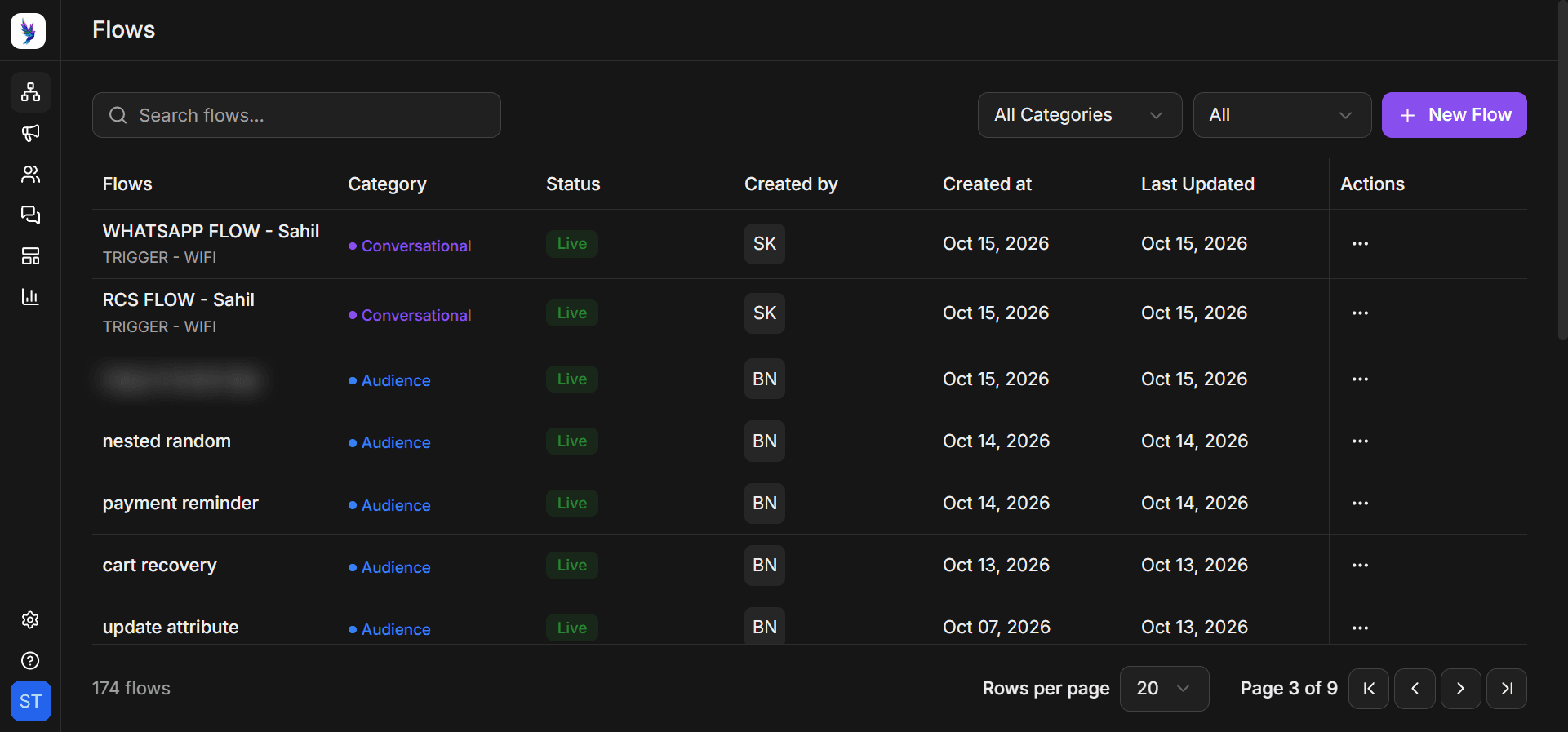
What sets it apart: Fallback to other channels is built into the flow builder. If a WhatsApp message fails or times out, Sendflow can retry over SMS, RCS or email, with a timeout you set for each step. WhatsApp-first tools such as Wati, Interakt and Zoko don’t offer SMS or RCS fallback in the same flow.
Zixflow also shows agents whether the 24-hour window is open before they send, so they know if a free-form reply is allowed or a template is needed. Like MSG91 and Infobip, it suits teams that want one vendor for several channels, while API-only providers such as Twilio need developers to build the same logic.
How it works day to day: Templates for WhatsApp, SMS, RCS and email are managed in one place plus the flows can be tested on test numbers before going live. Developers can send messages directly through the API or trigger a flow built by the marketing team.
Messages are paid from a prepaid wallet, and only delivered messages are charged. WhatsApp Flows let you collect form responses inside the chat, and e-commerce capabilities like WhatsApp Catalog are supported for efficient outreach.
Pros
- SMS, RCS and email fallback for failed WhatsApp messages in the same flow
- Only delivered messages are charged
- Both a no-code flow builder and a developer API
- AI agents and the team inbox in one dashboard
Cons
- The Free plan only sends outgoing broadcasts. The inbox and automation need a paid plan
- Can have a learning curve for new users when setting up APIs or linking campaign accounts for the first time
- Lesser known platform than larger providers, so there is less independent feedback to judge it by
Recent changes: Zixflow has reorganized its platform into Broadcast, Sendflow, Threads, Engage+ and AudienceIQ. Additionally, push notifications and SNA are being implemented into the platform alongside existing outreach channels.
Pricing
Zixflow’s pricing starts at $49 per month. WhatsApp messages are charged from a wallet based on country and the type of messages.
The 7-day free trial lets you test out the platform without any credit card information. Bulk discounts are available for large scale sends. You can book a demo for a quote that fits your WhatsApp outreach needs.
Reviews
- 4.9 out of 5 (29 reviews) by G2
- 4.6 out of 5 (80 reviews) by Capterra
- 4.6 out of 5 (80 reviews) by Software Advice
Twilio
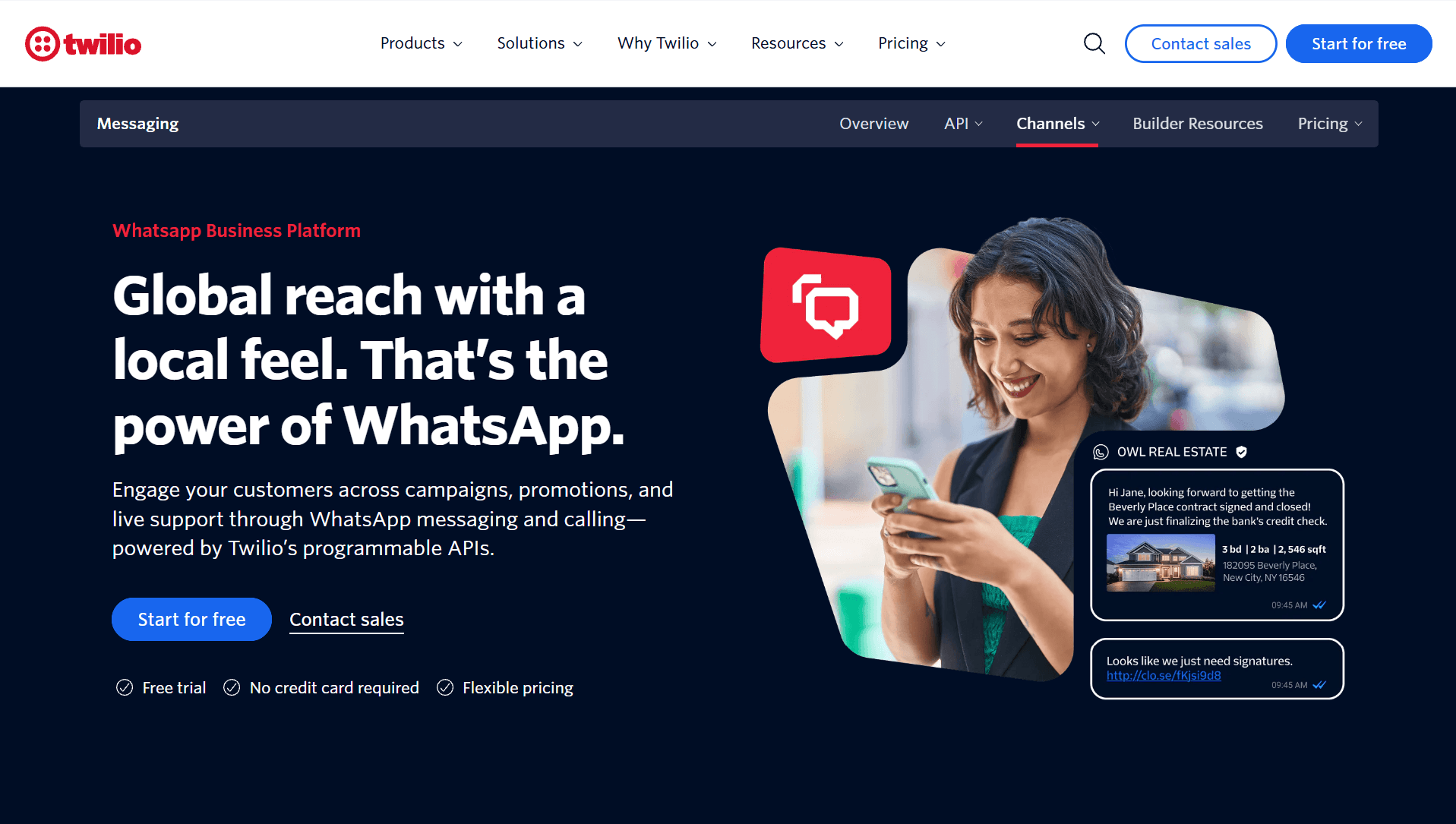
Twilio is a developer platform that gives you WhatsApp through the same Messaging API it uses for SMS. It doesn’t include a ready-made campaign dashboard or team inbox for WhatsApp, so you have to build your own sending logic using Twilio’s flow builder.
You can also connect it to a CRM or helpdesk to manage your outreach through those platforms. That makes it a good fit for sales engagement and support messaging that runs inside your own product.
Best for: Product and engineering teams that want to add WhatsApp notifications for OTPs or support messaging to their own infrastructure.
What sets it apart: Pricing is public plus Meta’s fee passed through at cost with no monthly subscription. Because WhatsApp and SMS share one API, fallback logic stays in one codebase. Unlike Zixflow or Wati, it has no no-code interface for marketers, so how much you get out of it depends on your technical expertise.
Pros
- Fully published pay-as-you-go pricing
- Free trial without a credit card
- Mature documentation and one API for WhatsApp and SMS
Cons
- Needs developers to build campaigns, inboxes, and reporting
- Inbound messages are also charged $0.005, so support-heavy use costs more than with providers that bill outbound only
- A $0.001 fee applies to messages that fail
- Its perceived cost is in the highest price band among the WhatsApp API providers in this list
Recent changes: Twilio moved to Meta’s per-message pricing in July 2025. From October 2026, it passes through Meta’s new fees for service messages and in-window utility messages, while its own $0.005 fee stays the same.
Pricing
Twilio charges $0.005 per WhatsApp message sent or received, plus Meta’s per-message fee by category and country. There is no monthly fee to use the platform for WhatsApp outreach.
Reviews
- 4.1 out of 5 (543 reviews) by G2
- 4.4 out of 5 (501 reviews) by Capterra
- 7.7 out of 10 (243 reviews) by TrustRadius
Supercharge Your Business Growth with WhatsApp Business API
Experience the Zixflow advantages and achieve your business growth with WhatsApp Business API
Contact UsInterakt
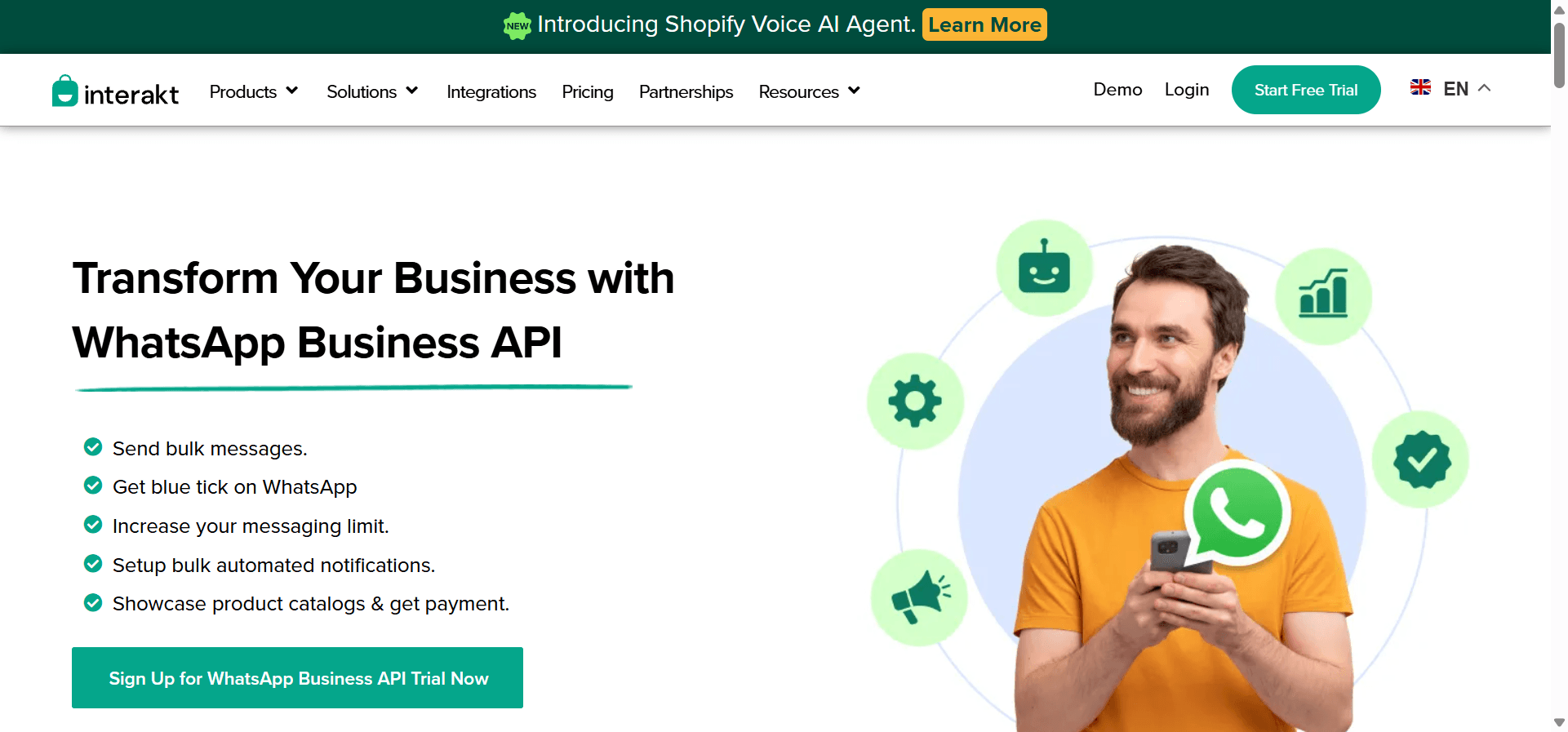
Interakt comes from Jio Haptik with more than 50,000 small businesses using it for their WhatsApp outreach. The platform consists of separate capabilities for marketing and support. A Sales CRM for tracking deals is also available on its own.
Campaigns on Interakt are sent with approved WhatsApp message templates. It supports richer template formats, like carousels and in-chat forms. From the Growth plan upward, it also lets you track link clicks and retries messages that fail to deliver.
Automation grows with each plan as well. The entry plan covers welcome and away replies, while Growth adds a simple step-by-step WhatsApp chatbot. Branching flows and automatic chat assignment need the Advanced plan, which also comes with assisted setup.
Best for: SMBs and D2C brands that want a ready-made WhatsApp inbox and campaign tool without developers.
What sets it apart: Plans are tiered by data limits (custom fields, tags, and custom events) rather than by number of users, and the Growth and Advanced plans include Instagram alongside WhatsApp. Only the Enterprise plan drops Interakt’s markup on template messages, so lower plans pay a charge on top of Meta’s rates.
Pros
- Quick to set up for non-technical teams
- WhatsApp and Instagram on the same plan from Growth upward
- AI agents available as an add-on
Cons
- Plans below Enterprise add a charge on top of Meta’s message rates
- Lower plans cap custom fields and tags (25 fields and 30 tags on Growth), which limits segmentation as your contact data grows
- Slow performance and customer support can be a bit better
Recent changes: In September 2025, Jio Haptik launched WhatsApp AI agents for small businesses.
Pricing
Interakt’s USD pricing lists Growth at $55/month and Advanced at $69/month, with Enterprise available on request. Quarterly billing saves 8% and yearly billing saves 20%. Template message charges are added on top.
Reviews
Wati
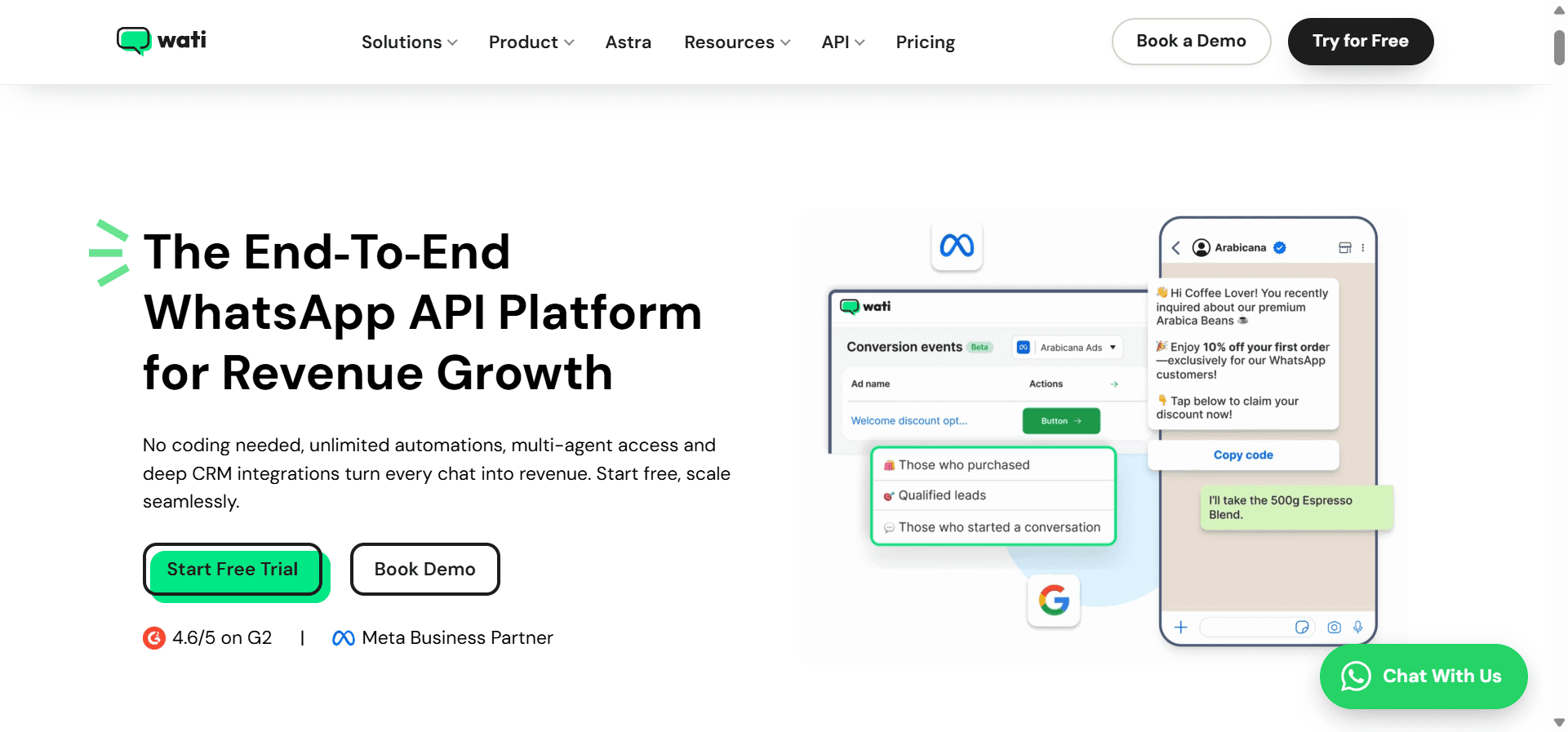
Wati is built around a team inbox where agents assign chats, add tags and follow up with customers. Messages from Instagram and Facebook can arrive in that inbox as well. For outbound engagement, you can run WhatsApp broadcasts and drip sequences that match your sales engagement model.
If your number is already registered with the WhatsApp app, you have to delete that account first because the old chat backups can’t be moved over. If you want help, you can pay a one-time fee for guided onboarding, which includes business verification and a product walkthrough.
Best for: Support or sales teams that want a polished inbox and broadcast tool with moderate automation.
What sets it apart: Plans are capped by automation triggers and API calls rather than only by users. Growth includes 1,000 automation triggers and 10,000 API calls a month with no webhooks. Pro includes 2,000 triggers and the HubSpot integration. Businesses that automate heavily buy extra triggers, from $40 a month. Wati also sells Astra, a separate AI agent product.
Pros
- 7-day free trial with no setup fee
- Unlimited broadcasts from the Pro plan
- AI Co-pilot credits included on every plan
Cons
- Messages are billed on Wati’s own rate card, and the markup over Meta isn’t published
- The Growth plan includes 3 users and can’t add more
Recent changes: Wati’s current plans are priced in USD with annual discounts of up to about 25%. It now offers AI Co-pilot credits on every plan and Astra as a separate AI agent product.
Pricing
Wati’s Growth plan costs $59/month and Pro costs $119/month, both billed annually. Growth includes 3 users while the Pro and Business include 5, with extra users at $39 and $89 per month. Additional WhatsApp numbers cost $29/month.
Reviews
Zoko
Zoko installs directly from the Shopify App Store, so store owners don’t need a separate signup process. You can use your own number after verifying it with a one-time code. Any WhatsApp account already on that number has to be deleted first.
Team members are invited by email and reply from the same official number. Chats can be split into custom inboxes, and the panel handles Instagram and Messenger conversations too.
Its ready-made store flows cover everyday e-commerce tasks. For example, one flow confirms cash-on-delivery orders before dispatch. Another nudges COD buyers to pay online instead.
Best for: Shopify and D2C brands that want cart recovery, catalog orders, and support on WhatsApp in one tool.
What sets it apart: Every feature is included in every plan, and plans differ only by markup and number of free agents. WhatsApp fees are paid directly to Meta, not through Zoko. It includes 11 pre-built e-commerce flows for free with AI add-ons for FAQs, order tracking, and in-chat ordering that are priced per resolution or per order.
Pros
- Clear pricing with all features on every plan
- WhatsApp calling and catalog included
- Free pre-built e-commerce flows
Cons
- Catalog, widget, and pop-ups carry Zoko branding
- Edited flows and AI agents are paid add-ons, so costs rise with automation
- Its strongest fit is Shopify. Other store platforms get less out of it
Recent changes: Zoko replaced its earlier four-plan lineup with three plans (Starter, Plus, and Elite) and added WhatsApp calling with AI add-ons to its pricing page.
Pricing
Starter costs $49.99/month, Plus $79.99/month, and Elite $139.99/month, with a 7-day free trial. Premium flows cost $5.99 per flow per month. Volumes above 500,000 messages a month need Enterprise pricing.
Reviews
4.9 out of 5 (464 reviews) by Shopify App Store
Infobip
Infobip offers two ways to use WhatsApp. Developers work through its API, while marketing teams can send campaigns from its Broadcast product. Either route supports different types of WhatsApp messages.
Its AgentOS platform connects AI agents to more than 15 channels, including RCS and email. Infobip describes the setup as human-in-the-loop, meaning your team can step in when needed. Agents can also complete tasks in other platforms through MCP integration.
Infobip named retail and e-commerce as the first industries using AgentOS. Healthcare and financial services were also listed as target markets. All of these depend on fast support to protect customer engagement and sales.
Best for: Large enterprises sending high volumes across many countries that want one vendor and enterprise service levels.
What sets it apart: Most enterprise platforms only share WhatsApp prices after a sales call. Infobip publishes a pay-as-you-go rate calculator instead, with per-country rates in EUR or USD. This lets enterprise buyers estimate costs for each market before talking to sales.
Its rate card also lists Meta’s Marketing Messages API as a separate category from standard marketing messages. This matters because some providers charge extra when marketing messages go through the standard route.
Pros
- Wide channel coverage and global reach
- AI agent orchestration for large customer journeys
- Free trial signup
Cons
- Average implementation time for large enterprises can last as long as 3 months
- The tool’s perceived cost in the highest price band
- Custom enterprise pricing still needs a sales conversation
Recent changes: AgentOS, launched in February 2026, lets AI agents handle conversations across messaging and voice using customer data. This way, marketing, sales, and support collaborate from one tool.
Pricing
Infobip charges per delivered WhatsApp message based on country and category, with custom plans available through sales.
Reviews
- 4.2 out of 5 (60 reviews) by G2
- 4.6 out of 5 (114 reviews) by Gartner
- 7.4 out of 10 (10 reviews) by TrustRadius
Brevo
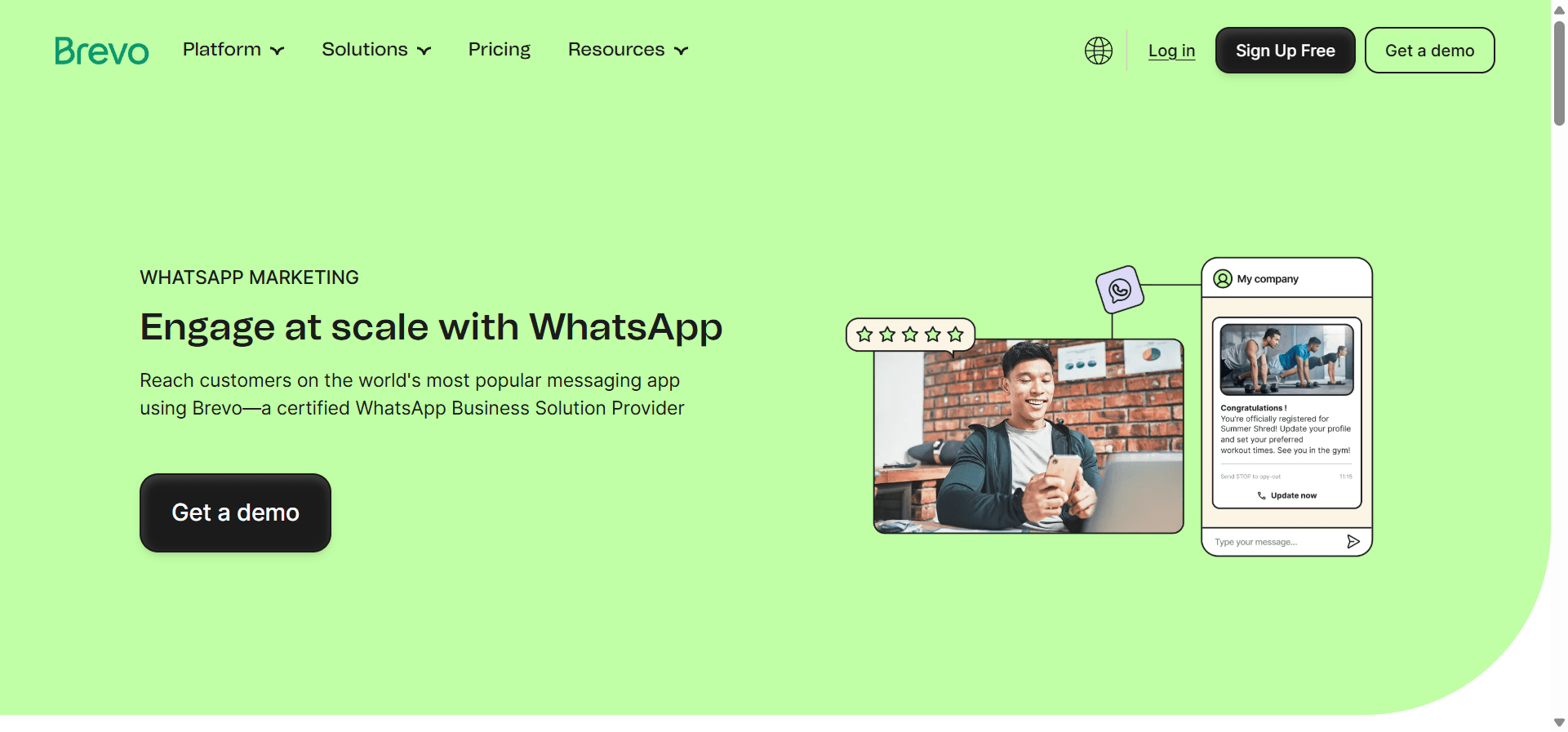
Brevo is a certified WhatsApp Business Solution Provider, though WhatsApp is only one channel in its platform. Setup starts with a WhatsApp business profile and a dedicated phone number. First time WhatsApp customers need to book a sales demo rather than a self-serve signup.
Campaign messages can include buttons and video, which helps when promoting a sale or product launch. Replies are handled in Brevo’s chat tool where you can see a contact’s full history.
The Professional plan includes 10 users, which suits a small marketing team. Brevo also connects to tools like Shopify and Zapier, so contacts from your store can be used in WhatsApp campaigns.
Best for: Marketing teams already using Brevo for email that want WhatsApp campaigns using the same contact list and workflows.
What sets it apart: WhatsApp sits inside the same automation builder as email and SMS, so you can move a contact from email to WhatsApp based on behavior without another tool. WhatsApp messages are paid with prepaid credits that don’t expire.
Pros
- One platform for email, SMS, and WhatsApp campaigns
- Prepaid WhatsApp credits remain active indefinitely
- An established customer base for enterprise clients
Cons
- WhatsApp campaigns are only available on the higher-tier plans, Professional and Enterprise
- Campaign messages are limited to 1,024 characters
- Built for marketing campaigns rather than support teams handling many replies
Recent changes: In March 2026, Brevo released an AI chatbot that answers common questions and qualifies leads before handing them to a person. WhatsApp is one of the channels it can run on. In July 2026, Brevo added a WhatsApp button to its CRM, so sales reps can message a contact directly from a deal or contact record.
Pricing
Brevo’s current plans are Free, Starter ($9/month), Standard ($18/month), Professional ($499/month) and Enterprise, with WhatsApp available only on the last two.
Reviews
4.5 out of 5 (2,743 reviews) by G2 4.2 out of 5 (6,873 reviews) by Trustpilot 4.6 out of 5 (156 reviews) by Gartner
BotSpace
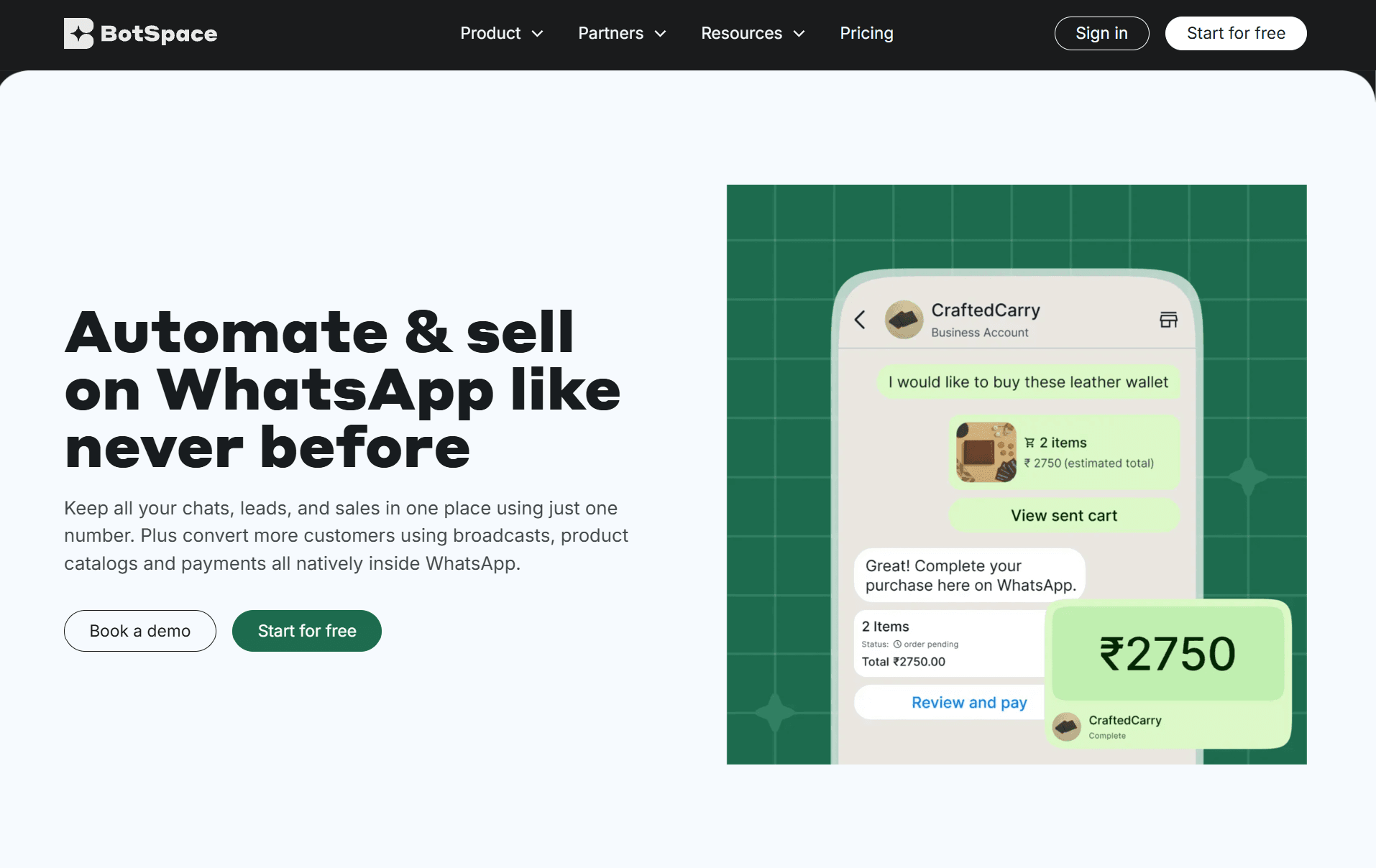
BotSpace treats a chatbot as the first step in every conversation. The bot answers routine questions and can ask sales qualifying questions before a person joins. This makes it a practical WhatsApp automation tool if you get many repeat queries.
The same tool covers Instagram, so you don’t need a separate workspace for it. On Instagram, BotSpace can reply automatically to comments and story mentions.
For WhatsApp commerce, it supports catalogs and in-chat payments. It connects with tools like Shopify and HubSpot, and has its own mobile apps for iOS and Android.
Best for: Small businesses and e-commerce brands that want to start free and pay as conversations grow.
What sets it apart: BotSpace prices by “engaged contacts,” meaning contacts who both send and receive a message in a month rather than by message or total contacts. It collects Meta’s fees through a prepaid wallet and passes on the Meta’s pricing as is.
Pros
- Free-forever plan with shared inbox, broadcasts, and integrations
- No markup on Meta’s fees
- AI agent priced per resolution instead of a fixed fee
Cons
- The Free plan includes 1 seat and up to 5 workflows
- Costs rise with engaged contacts every month, irrespective of your revenue
- AI Copilot and AI Insights are extra add-ons
Recent changes: BotSpace added the Rex AI agent and AI Copilot to build up its WhatsApp automation capabilities.
Pricing
The Free plan gives you basic WhatsApp outreach functionality. The Pro plan starts at ₹999/month for 500 engaged contacts and 5 seats and the Premium on is custom built for your requirements.
Reviews
4.8 out of 5 (37 reviews) by G2 4.8 out of 5 (24 reviews) by Shopify App Store
Boost Your Customer Engagement With WhatsApp Business API.
Get a powerful sales engagement platform, Zixflow to increase engagement and conversions.
Start Todaytyntec
tyntec is a European cloud communications company that sells to enterprises and mobile operators. Its approach is to bring WhatsApp into the software a business already uses. That way, your reps don’t have to learn a new interface.
Most of the work happens through APIs. Developers can update the business profile and receive delivery updates through webhooks. Templates can be managed by API and can include media and buttons, which helps with different types of sales.
tyntec also has ready connections to enterprise tools. These include Microsoft Dynamics 365 and Salesforce, as well as bot platforms like Cognigy.
Best for: Enterprises and software vendors in Europe that need WhatsApp inside their own systems with data hosted under GDPR.
What sets it apart: For software vendors, tyntec offers two models, pay as you go with a one-time setup charge plus per-message fees or a monthly subscription that includes unlimited session messages for each active contact.
Pros
- Data centers in Germany that operate under GDPR
- Billing models designed for software vendors
- SMS fallback for reach
Cons
- No public pricing information available
- API-based platform so it requires developers to set it up
Recent changes: I couldn’t find any major WhatsApp product or pricing updates from tyntec in 2025 or 2026. If recent improvements matter to your decision, ask tyntec about its WhatsApp roadmap before you sign.
Pricing
tyntec doesn’t publish prices. You’ll have to contact its sales team for a quote.
Reviews
3.6 out of 5 (7 reviews) by Capterra
DelightChat
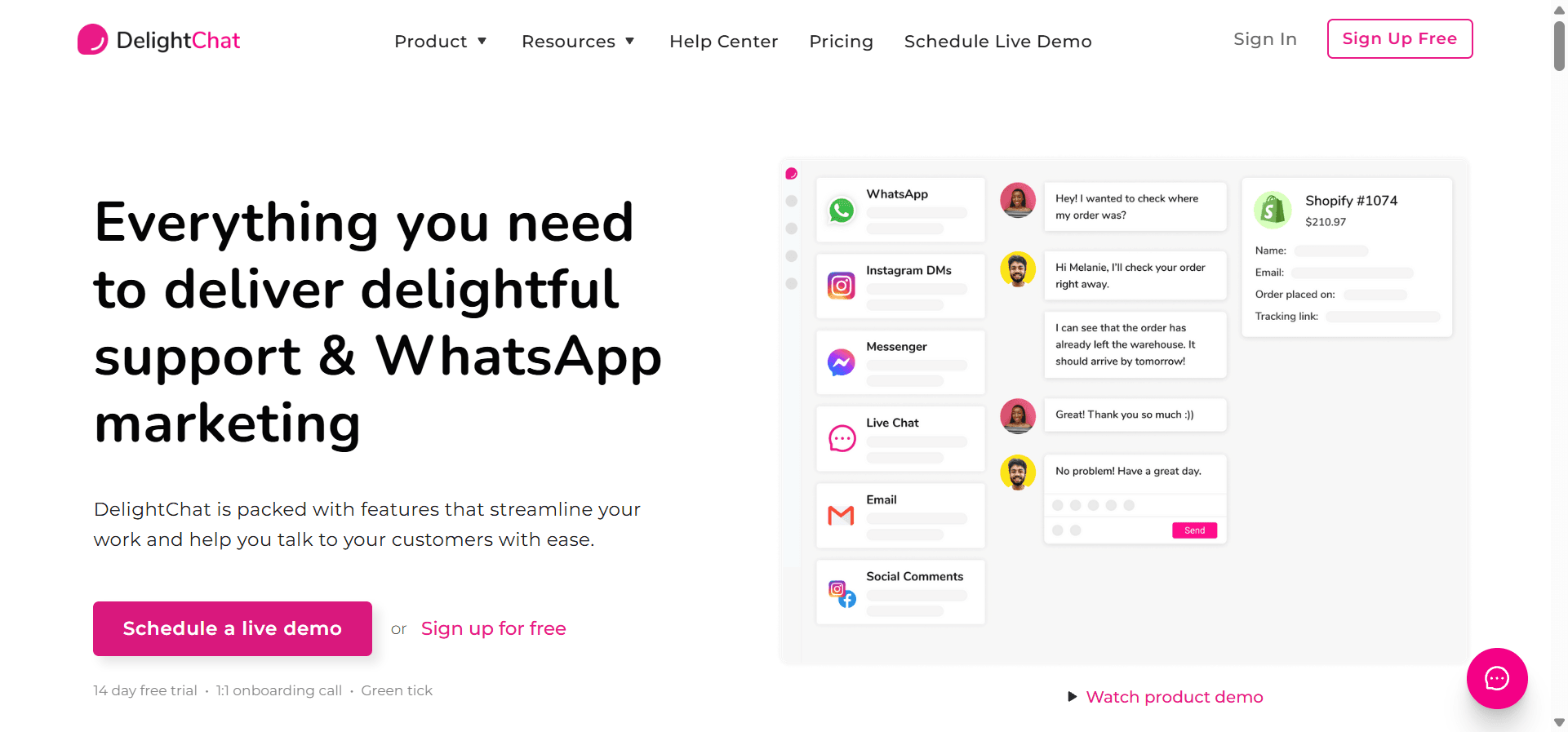
DelightChat brings support conversations from several channels into one screen. Alongside WhatsApp, you can reply to Instagram and Facebook messages there. Email and live chat tickets arrive in the same place as well.
Because it connects to Shopify, you can see a customer’s orders inside the ticket. Stores can also add a widget where shoppers check their order status without contacting support. Only tickets that a human replies to count toward your plan, so automated replies don’t use it up.
On the marketing side, it runs cash-on-delivery verification and win-back campaigns. These help stores follow a customer-centric selling approach.
Best for: Shopify stores whose WhatsApp use is mostly support tickets plus some marketing.
What sets it apart: Plans are priced by support tickets and marketing contacts rather than by messages, and WhatsApp rates are passed through with no markup. The first WhatsApp number is included on every plan.
Pros
- No setup fee for getting WhatsApp API access
- iOS and Android apps available for agents to answer tickets away from their desks
- Shopify Flow can trigger WhatsApp messages from store events
- One account can run several Shopify stores
Cons
- Ticket and contact caps with overage charges
- Extra WhatsApp numbers cost $25/month each
Recent changes: DelightChat has updated its product often in 2026. In August, it added a self-serve wizard for connecting a WhatsApp Business number, so stores no longer need help from its team to get started. The same month, it gave its AI chatbot custom rules that always pass certain types of chats to a human agent.
Pricing
Startup costs $29/month, Scale $99/month and Growth $299/month, plus WhatsApp charges. Annual plans get 30% off through sales.
Reviews
4.8 out of 5 (2 reviews) by G2 4.8 out of 5 (206 reviews) by Shopify App Store
360Dialog
360Dialog’s core product is direct API access and its requests follow Meta’s own Cloud API format. Each number gets one API key, so developers familiar with Meta’s documentation have little new to learn. A sandbox lets teams test before their business is verified.
Businesses that don’t want to build their own interface can use 360dialog’s marketplace. It matches them with vetted WhatsApp tools that run on its API. Software vendors and resellers can join its partner platform instead.
The team can also help with business verification and the steps to obtain the green tick. 360Dialog supports coexistence too so a number can stay on the WhatsApp Business app while connected to the API.
Best for: Agencies, software vendors, and in-house developers that want direct API access at Meta’s rates but need to build or connect their own interface.
What sets it apart: You pay a flat monthly fee per phone number, and message rates follow Meta’s rate card in EUR & USD. The exception is a 7% surcharge on marketing messages sent through the standard messages endpoint instead of Meta’s Marketing Messages API.
Pros
- Documentation in nine languages, making setup super easy
- Docs are available as plain markdown files, which makes them simple for AI coding assistants to read
- An optional add-on, 360Pilot, tracks revenue from WhatsApp campaigns
Cons
- No built-in team inbox or campaign tools, so non-technical teams need developers to get started
- Subscriptions are billed only in EUR or USD, so Indian businesses pay the subscription charge in foreign currency
- The per phone fee can make the costs rise quickly for businesses that run several numbers
Recent changes: In 2026, 360Dialog replaced its top tier, Advanced, with a new Scale tier that can send up to 1,000 messages per second.
Pricing
Each WhatsApp number costs €49 per month on the Regular tier, €99 on Premium, and €500 on Scale. Meta’s messaging fees are added on top.
Reviews
4.7 out of 5 (147 reviews) by G2 4.1 out of 5 (29 reviews) by Trustpilot 3.5 out of 5 (13 reviews) by Capterra
Picked a Suitable WhatsApp API Provider Yet?
Get started with Zixflow for free and pay according to the number of messages you send.
Reach Out To SalesBird
Bird splits its WhatsApp product into separate building blocks. Teams can start with the sending API and templates alone. Two-way messaging and analytics can be added later.
Every plan lets you bring your own number and includes opt-out management. Bird supports coexistence as well, so a number can keep working in the WhatsApp Business app.
Additionally, developer tooling is a focus of the platform. Bird offers a command-line tool and an MCP server to let you use coding assistants such as Claude Code and Cursor work with its APIs.
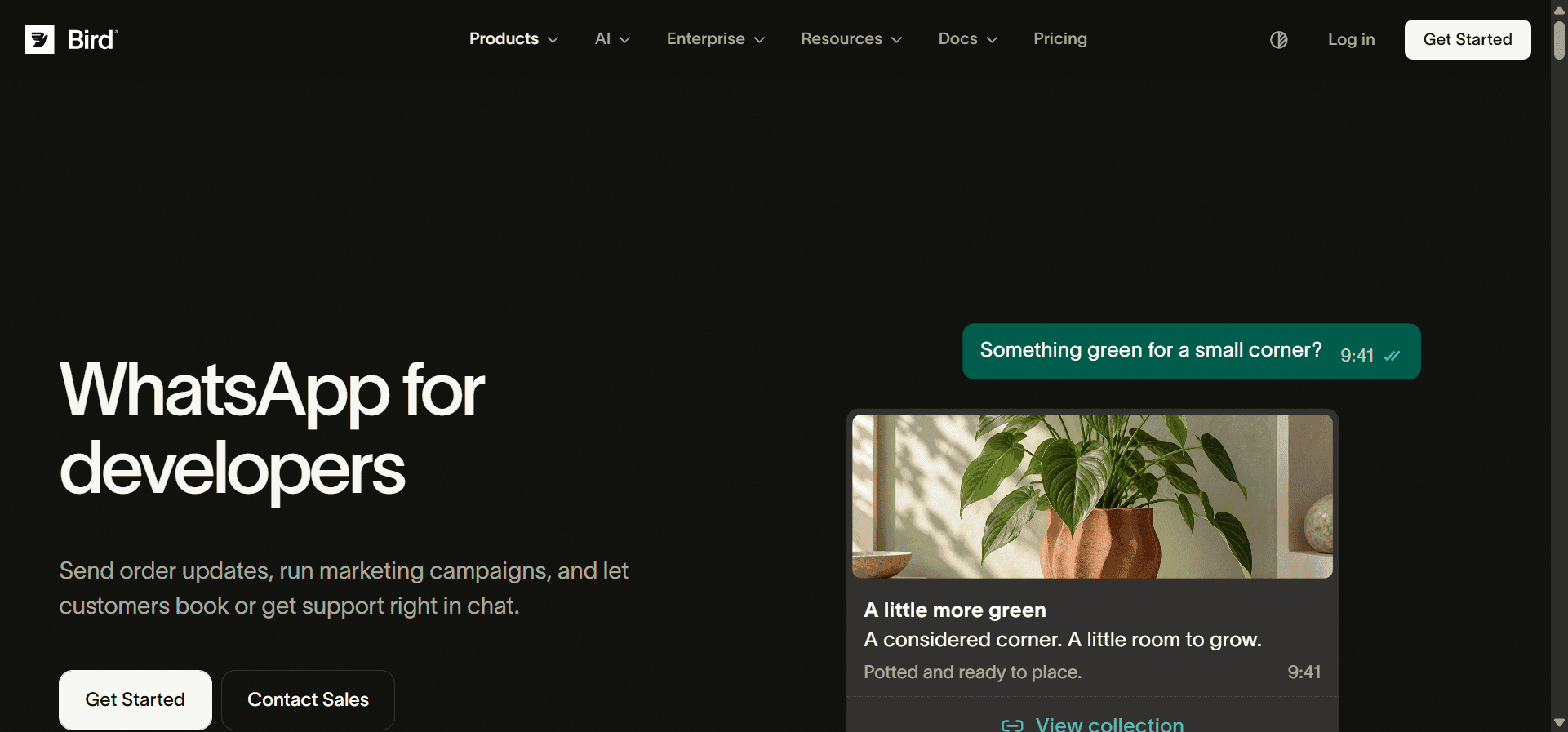
Best for: Developers and growth teams that want usage-based WhatsApp pricing where incoming messages are free.
What sets it apart: Bird charges only for outbound messages, so incoming customer messages cost nothing. Sending speed depends on your plan. For example, you get 10 sends a minute on pay as you go, 30 on Startup, 100 on Growth, and 300 on Scale.
Pros
- Deposits on paid plans become spendable balance
- Supports WhatsApp group messaging and Meta’s Business Agent
- Interface available in seven languages, including German and Spanish
Cons
- Slow sending on cheaper plans. Pay as you go allows 10 messages a minute, so a 10,000-message campaign takes about 17 hours
- Bird’s own fee still applies to messages that Meta doesn’t charge for
Recent changes: Bird replaced its earlier contact-based pricing with plans built on monthly deposits. The top Scale plan also takes 10% off Bird’s own WhatsApp fee.
Pricing
Bird charges $0.005 per outbound message plus Meta’s fee. Pay as you go has no monthly deposit and the paid plans start at a $15 monthly.
Reviews
- 3.9 out of 5 (73 reviews) by G2
- 8.4 out of 10 (12 reviews) by TrustRadius
DashCX
DashCX, a product from EdgeCX, is meant to replace the personal WhatsApp chats that sales reps often use with leads. All conversations instead run through one shared business number that reps can access from a web app or from mobile apps.
Setup works more like a managed project than a self-serve signup. DashCX says setup takes about two weeks, followed by two weeks of training. It also recommends getting a new number for the account.
Its Bot Studio is a drag-and-drop builder for qualifying leads and passing them to a live rep. DashCX connects to CRMs such as HubSpot and Zoho. The interface is only in English although messages to customers can be sent in Indian languages.
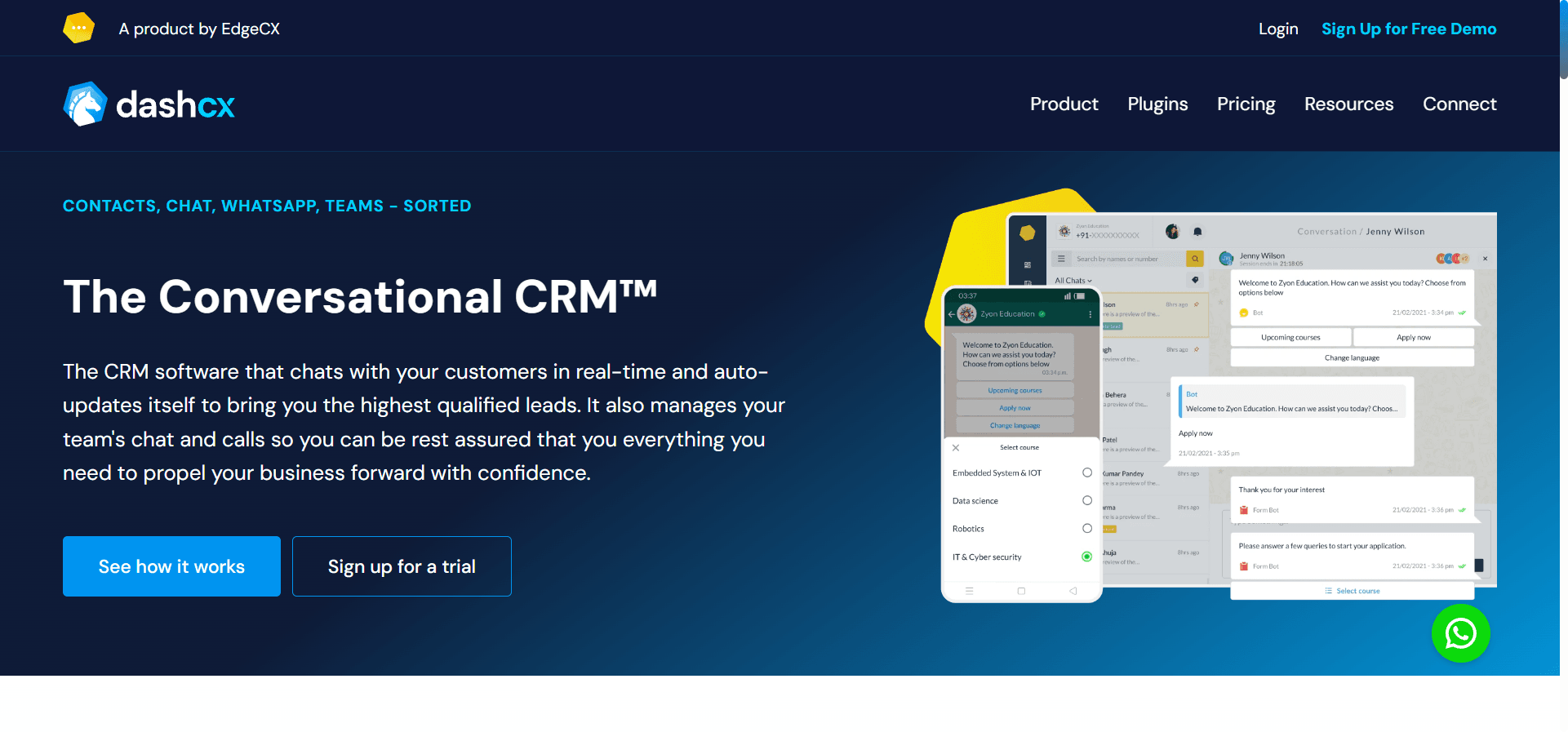
Best for: Sales teams of 3 to 20 reps that need a dedicated WhatsApp CRM rather than a general marketing tool.
What sets it apart: Pricing is per user with a minimum number of users on each plan. Advanced routing tools, such as Smart Router and webhooks, only come with the Acceleration plan.
Pros
- Form bots collect lead details inside WhatsApp broadcasts
- 1,000 free conversations a month
- $50 in free chat credits for new users
Cons
- API access starts on Velocity, which needs at least 10 users ($150/month)
- The pricing page gives two different conversation fees ($0.02 and ₹0.05), so confirm the rate before buying
- Onboarding fees vary by the underlying API provider
Recent changes: The latest dated update to the DashCX mobile app, from September 2025, refreshes conversations automatically and updates unread counts instantly. I couldn’t find any larger product or pricing announcements from DashCX in 2025 or 2026.
Pricing
Kickstart costs $10/user/month (minimum 3 users), Velocity $15/user/month (minimum 10 users), Acceleration $20/user/month (minimum 20 users), and Transformation from $649/month.
Reviews
DashCX doesn’t have many reviews on software review sites.
DoubleTick
DoubleTick lets you onboard the platform within 24 hours where you can run bulk messaging campaigns and reply from a shared WhatsApp inbox. That inbox can hold several WhatsApp numbers with access controlled by role.
Its AI copilot features help you keep up with busy chat lists. It can remind them about pending follow-ups and show which chats are still waiting for a reply. In addition to that, voice campaigns can be run from the same studio as WhatsApp broadcasts. Companies with their own CRM can embed DoubleTick through an SDK instead of switching tools.
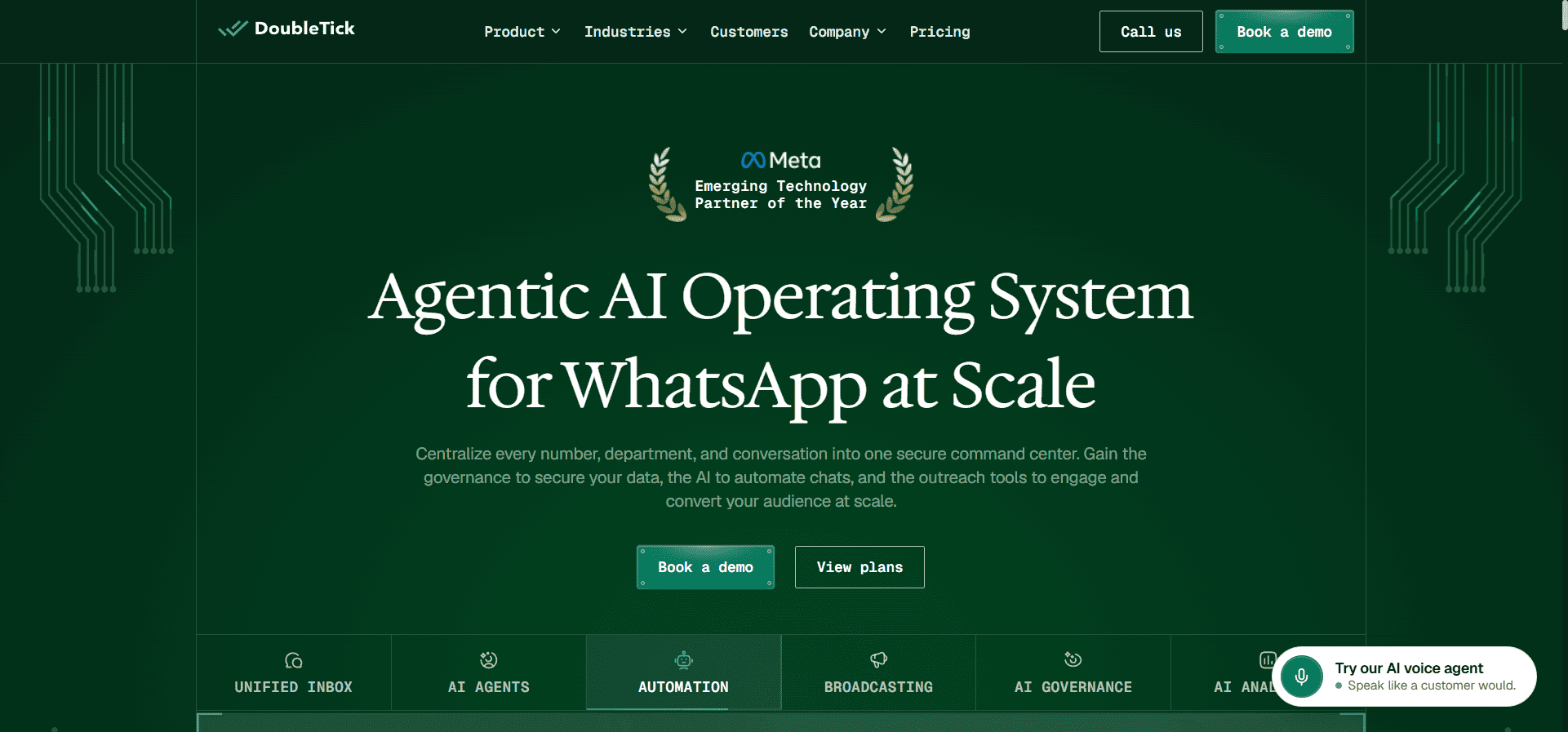
Best for: Field sales teams and small businesses whose staff work mainly from mobile phones.
What sets it apart: The product is designed around the mobile app rather than a desktop dashboard. AI agents are included on every plan and extra AI usage is drawn from a wallet that doesn’t expire.
Pros
- Catalog messages for showing products inside the chat
- 24x7 chat support on all plans
- Account manager on Pro and above plans
Cons
- The 7-day free trial is only available on the Pro plan
- Less suited to teams that need a full desktop CRM
Recent changes: I couldn’t find any dated product or pricing announcements from DoubleTick in 2025 or 2026.
Pricing
DoubleTick offers Starter at ₹3,000/month, Pro at ₹4,200/month, and Enterprise plans, with message charges by destination country. Payments can be made by card, UPI, net banking, or bank transfer.
Reviews
- 4.6 out of 5 (137 reviews) by G2
- 4.2 out of 5 (2 reviews) by Software Advice
Yellow ai
Yellow ai was founded in 2016, serving clients across 85 countries operating in sectors such as banking and healthcare. The WhatsApp bots are built in a no-code builder and run on Yellow ai’s own language models. The company claims its YellowG model keeps hallucinations below 1%, though this is a vendor figure.
WhatsApp is one of more than 35 channels the platform supports. Voice agents are also available, in over 500 languages to interact with customers in their native language.
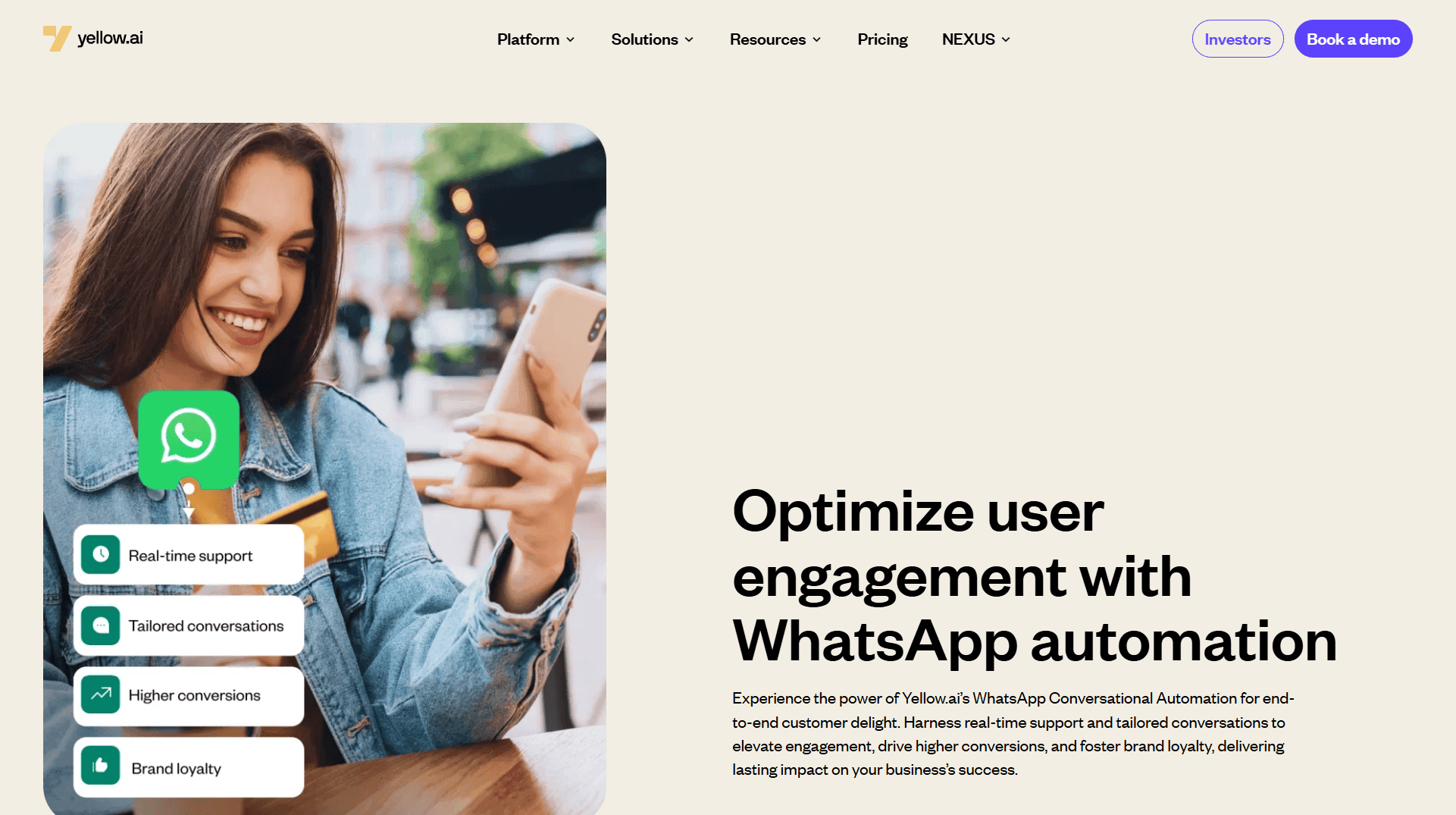
Best for: Large enterprises automating high-volume customer support with AI agents with the budget and time for a multi-month rollout.
What sets it apart: Yellow ai is built around AI agents rather than campaigns. The Enterprise plan is priced on usage and includes unlimited bots, channels, and integrations.
Pros
- More than 100 ready-made integrations
- Free plan for testing before an enterprise contract
- User360 customer profiles keep each user’s history in one place
Cons
- The Free plan is too small for live customer traffic
- Campaign tools are limited outside Enterprise and comes with one active campaign on the Free plan
Recent changes: In February 2026, Yellow ai launched Nexus, an interface that runs customer and employee automation across channels. In May 2026, it added Nexus Vox, a voice AI that can clone a brand’s voice from a short audio sample.
Pricing
The Free plan includes 1 bot, 2 channels, and 100 monthly tracked users. Enterprise is usage-based and quoted by sales based on personalized needs.
Reviews
Vonage
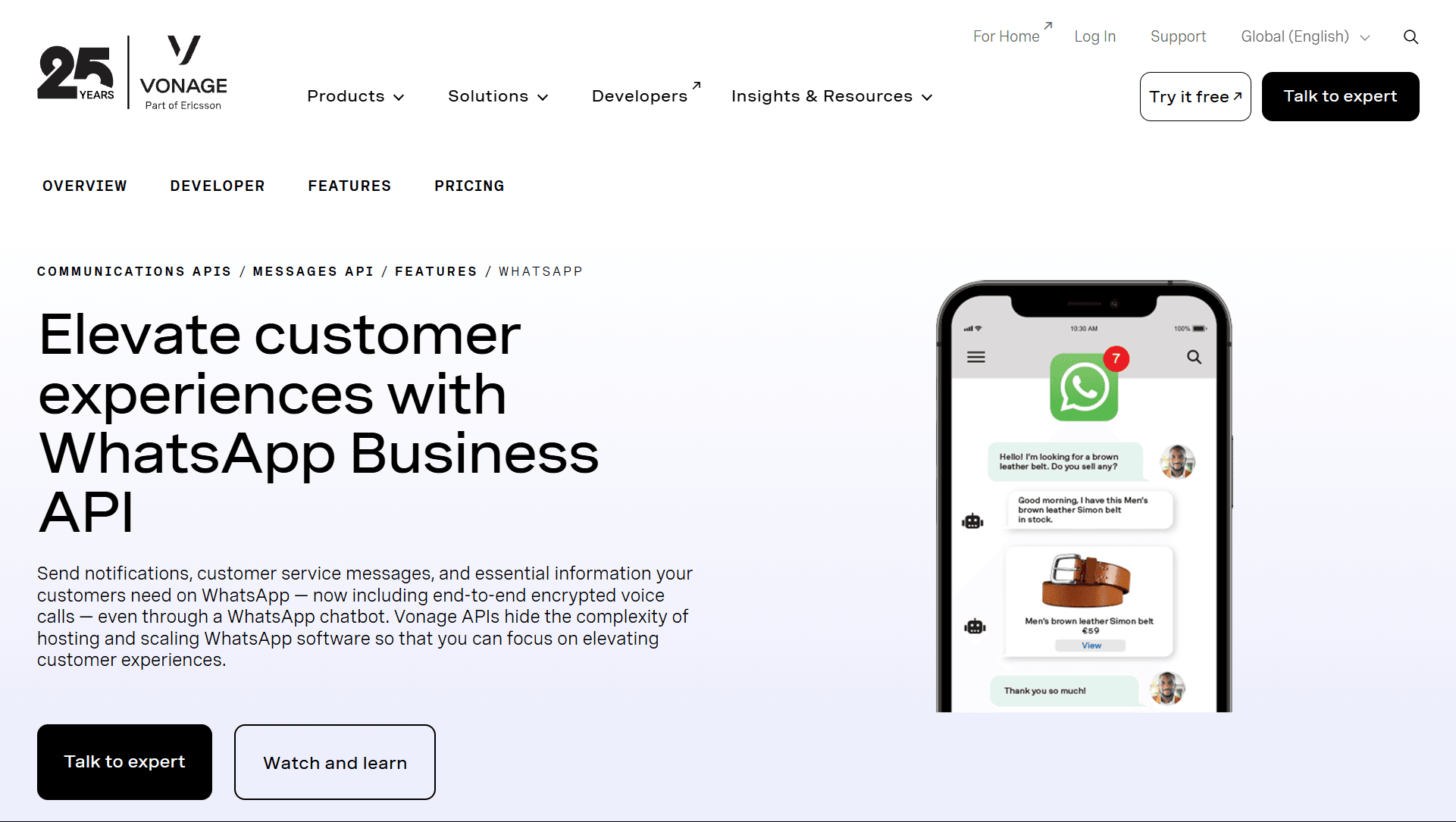
Vonage, now owned by Ericsson, offers WhatsApp through its Messages API. Developers use it to add WhatsApp notifications and conversational marketing to their own apps.
For software companies, Vonage offers a hosted signup flow. Its clients can then connect their own WhatsApp accounts without leaving the partner’s product.
Moreover, billing records are kept in the Vonage dashboard and its Reports API. Vonage warns that the price in a message’s status update may differ from the final charge. Finance teams should therefore check costs against the reports.
Best for: Developer teams already using Vonage APIs that want WhatsApp through the same integration.
What sets it apart: Vonage adds a platform fee per message that varies by country on top of Meta’s fee. Inbound messages are not charged, and volume discounts apply to Meta’s authentication and utility fees.
Pros
- One API covers WhatsApp alongside SMS and RCS
- You pay only for messages that are delivered
Cons
- Rates are in a separate pricing table so working out total cost takes effort
- Needs developers as there is no built-in team inbox
- Setup fees may apply in some countries
Recent changes: In January 2026, Vonage brought two-way WhatsApp, RCS, and SMS messaging into Salesforce’s Agentforce Marketing. Its Q3 2026 release added WhatsApp Business Calling, so customers can move from a chat to a voice call.
Pricing
Vonage charges a per-message platform fee by country and category, plus Meta’s fee. Custom pricing is available for high volumes.
Reviews
4.2 out of 5 (404 reviews) by G2
MSG91
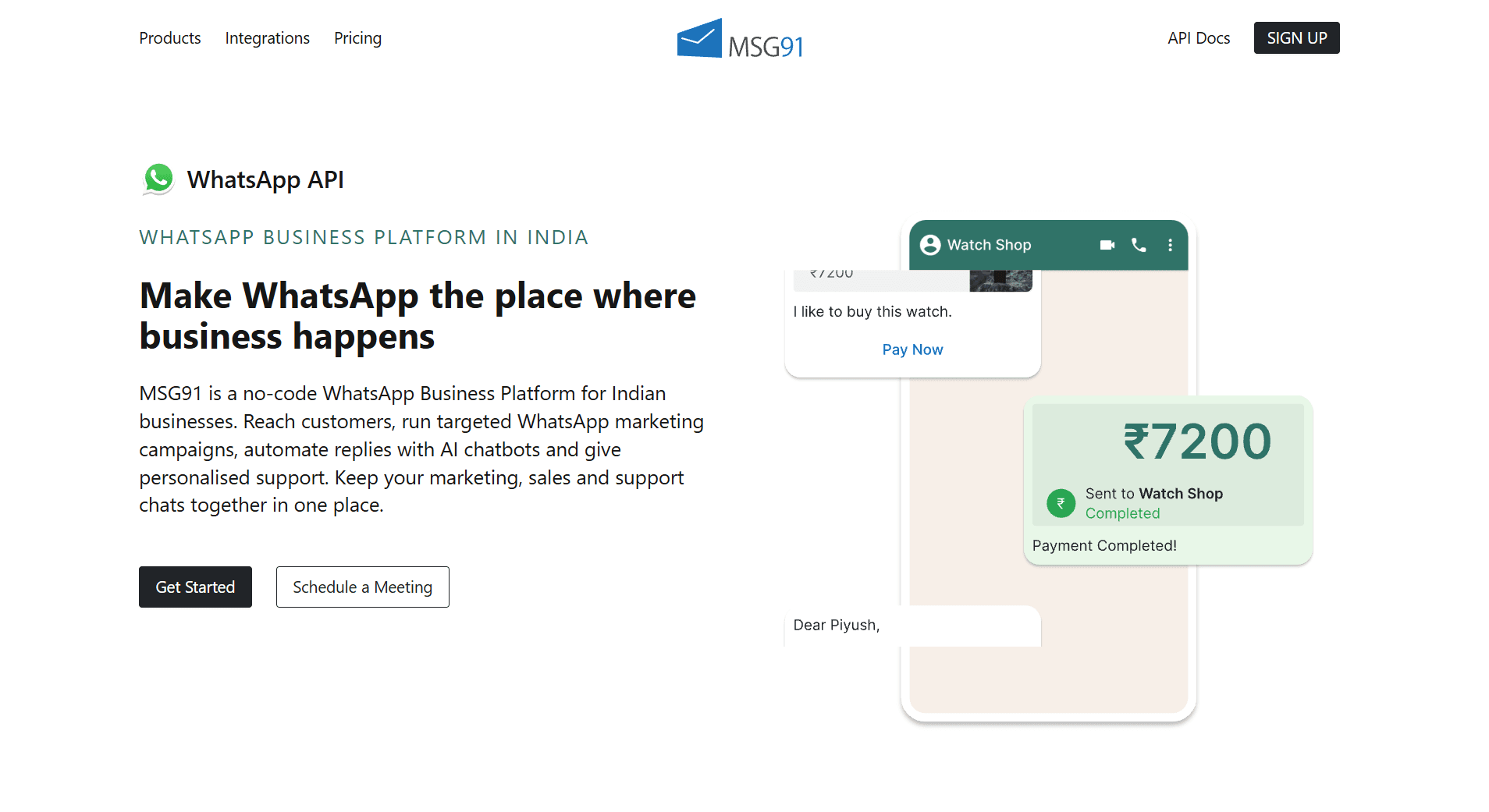
MSG91 is a no-code platform for Indian businesses. Setup takes four steps, from creating an account to verifying your number. Campaigns start with a CSV upload of contacts. You then pick an approved template, personalize it, and schedule the send.
Support chats go to Hello, MSG91’s shared inbox, which handles email and web chat too. MSG91’s WhatsApp tools also cover click-to-WhatsApp ads and in-chat payments.
Best for: Indian startups and small businesses that want to keep their WhatsApp costs low.
What sets it apart: MSG91 adds no markup to WhatsApp message rates and charges a flat ₹500 per number each month. It offers fallback to SMS, RCS, email, or voice when WhatsApp fails. It stores Indian users’ data in Indian data centers and has a SOC 2 Type 2 report.
Pros
- Integrations with Shopify and Zoho, among others
- Rule-based flows and AI can be combined in one chatbot
- Opt-out management and message log exports built in
Cons
- The support inbox, Hello, is a separate MSG91 product from the WhatsApp campaign tools
- The platform fee is charged per number, so costs grow with each extra number
Recent changes: MSG91 updated its rates for Meta’s 1 January 2026 change in India, when the marketing rate rose from ₹0.7846 to ₹0.8631.
Pricing
MSG91 charges ₹500 per WhatsApp number per month (first two months free) plus Meta’s rates with no markup. However, the GST cost is extra.
Reviews
4.5 out of 5 (199 reviews) by G2 4.7 out of 5 (42 reviews) by Capterra
No Time to Set up the WhatsApp Business API Yourself?
Sign up with Zixflow, and we will walk you through the entire process of getting your WhatsApp API up and running in no time.
Talk to Our ExpertsLimeChat
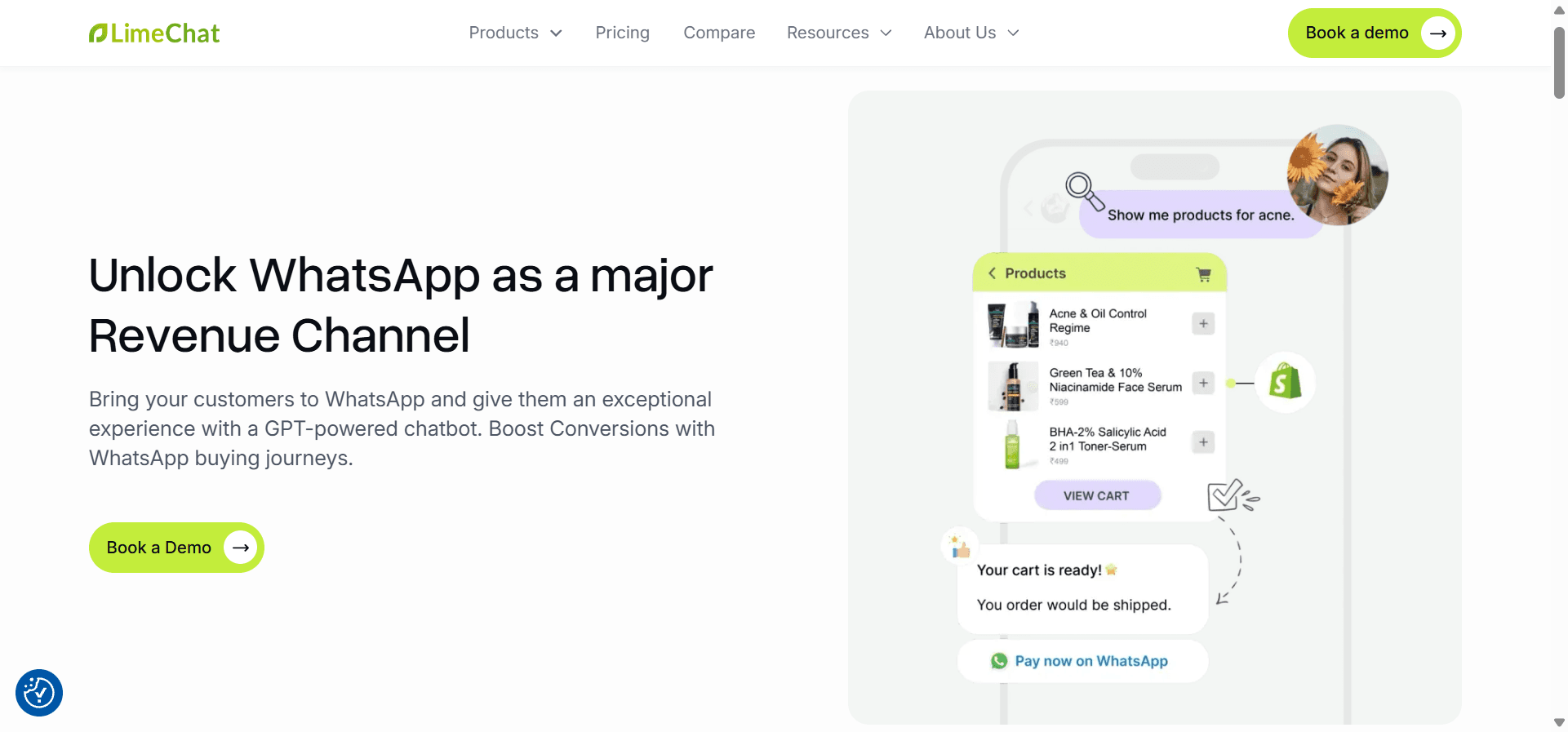
LimeChat covers e-commerce marketing for D2C brands with a focus on automotive and real estate among its target industries too. The AI agents follow your brand’s support rules and tone of voice allowing you to make the customer interactions consistent. You can also set fallback rules for when the AI isn’t sure how to answer. Plus, human agents get an AI copilot to help during live chats.
LimeChat connects with Shopify and WooCommerce out of the box. It supports more than 20 languages and is SOC 2 compliant.
Best for: Mid-size and large D2C and BFSI brands that want AI agents to handle a large share of customer chats.
What sets it apart: Its flows are built for commerce, including COD verification, COD-to-prepaid conversion, in-chat checkout, and reorder reminders. The support suite adds BFSI flows such as loan status and KYC. Every plan includes an onboarding specialist, a customer success manager, and quarterly business reviews.
Pros
- Image recognition to let AI understand photos customers send
- AI conversation audits to review chat quality
- 24/7 priority support with an SLA
Cons
- No public prices or free trial
- Marketing and support suites are priced separately, using both adds up the cost
- Meta’s message charges are billed on top
Recent changes: LimeChat has launched a voice AI agent that answers WhatsApp calls. The page also lists exclusive WhatsApp Calling access through its Meta partnership.
Pricing
LimeChat gives personalized pricing based on suite, conversation volume, and AI tier.
Reviews
4.6 out of 5 (31 reviews) by G2 4.1 out of 5 by 45 Google Reviews
Verloop
Verloop uses WhatsApp chatbots to handle routine support questions at any hour. WhatsApp is one of several channels it covers, alongside website chat and Instagram. Agents work from a live chat console, and past conversations are archived so you can review them at any later time.
Best for: Support teams in India that handle a high volume of repeat questions.
What sets it apart: Verloop’s voice feature lets customers send voice notes to its bots in 14 Indian languages, which helps businesses whose customers prefer speaking to typing.
Pros
- Lead capture tools for sales teams and not only support
- Targeted email follow-ups for captured leads
Cons
- No published plan prices
- Focused on support, so campaign and broadcast tools are less of a priority
- Its WhatsApp billing help article still describes conversation-based pricing, so confirm how it bills under Meta’s per-message model
Recent changes: I couldn’t find public product announcements from Verloop in 2025 or 2026. You can ask about its WhatsApp roadmap during a demo.
Pricing
Verloop doesn’t publish plan prices. Get in touch with its sales team for a quote.
Reviews
4.7 out of 5 (230 reviews) by G2 4.7 out of 5 (10 reviews) by Capterra
Trengo
Trengo is often compared with helpdesks such as Zendesk and Freshdesk, and it belongs to the wider group of customer engagement platforms.
Inside Trengo’s inbox, your team members can leave internal comments and mention teammates. The saved views and labels help each person focus on their own queue. And when a chat ends, it can be tagged with an outcome such as resolved or escalated.
Rules for auto-replies and routing keep response times short. Trengo also connects natively to HubSpot and Shopify, among other business tools to make the adoption easy.
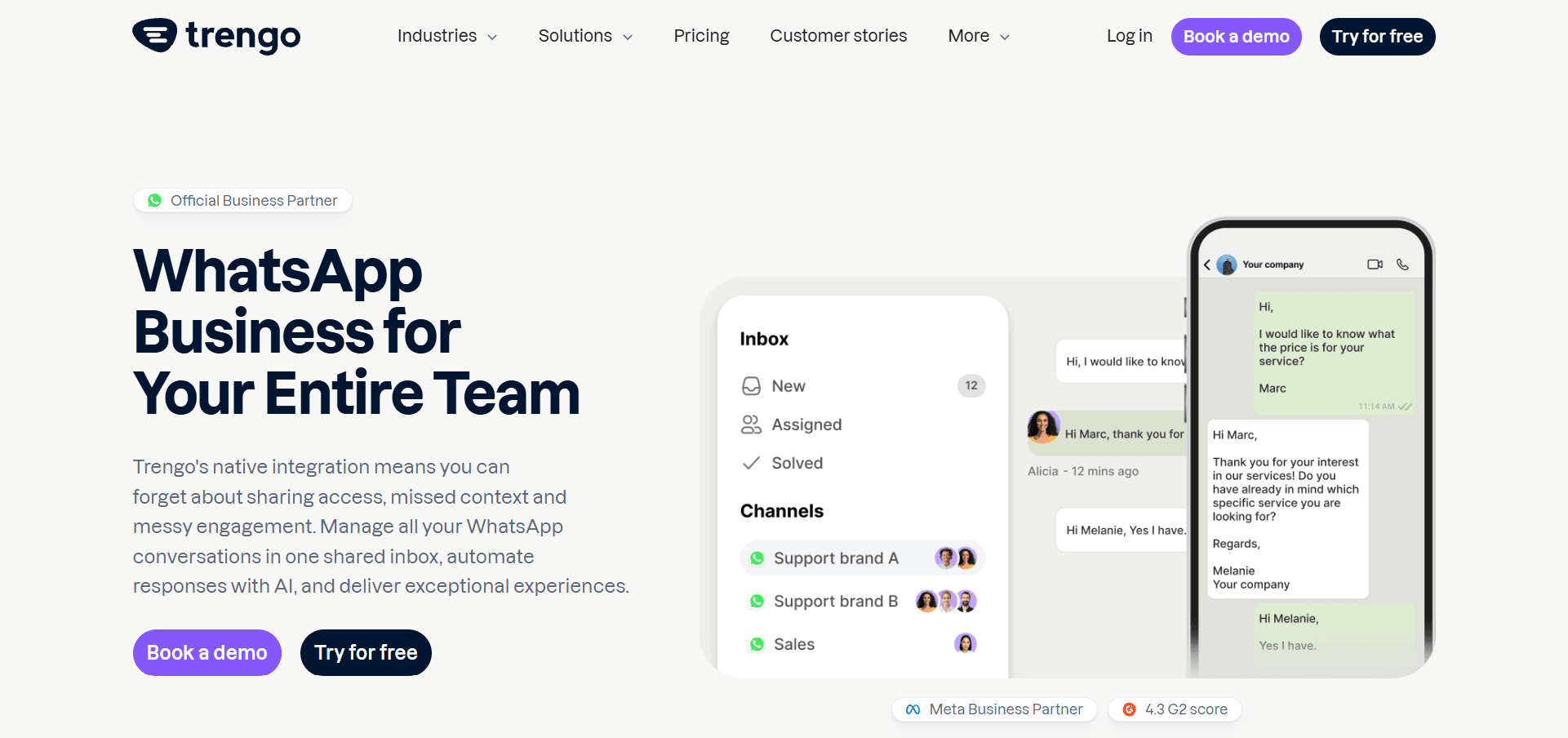
Best for: European support teams that want one inbox for every channel and are comfortable with conversation-based plans.
What sets it apart: Plans include a fixed number of users and conversations. Its AI agent (HelpMate) adds a surcharge per AI-handled conversation. This makes cost predictable for steady support volume but expensive for spikes.
Pros
- Role-based permissions control what each agent can see
- Native integrations with WooCommerce and Klaviyo
- Free trial to test out the tool
Cons
- The Base plan is capped at 5 users, so a growing support team has to move up to Boost
- Extra conversations cost €15 - €18 per 100 conversations
Recent changes: Trengo’s AI Journeys feature is in beta, and Trengo says its final pricing and packaging may change once it launches.
Pricing
The Base plan starts at €119/month (annual) or €149 (month) with 3 users. Boost costs €299/month (annual) or €349 (monthly) with 10 users. Pro costs €499/month (annual) or €599 (monthly) with 20 users. The Enterprise plan is custom.
Reviews
4.3 out of 5 (246 reviews) by G2 4.1 out of 5 (206 reviews) by Trustpilot
CM
CM is headquartered in the Netherlands and processes customer data within the EU. That matters for European companies with strict data rules.
On top of WhatsApp, it also supports lesser-used channels, such as Apple Messages for Business and LINE. If a WhatsApp message fails, it can fall back to SMS.
Developers can connect over HTTP or SMPP, and a sandbox is available for testing. Marketing and service teams can use CM’s Engage Platform instead. Linked to a contact management tool, it can work as a WhatsApp CRM.
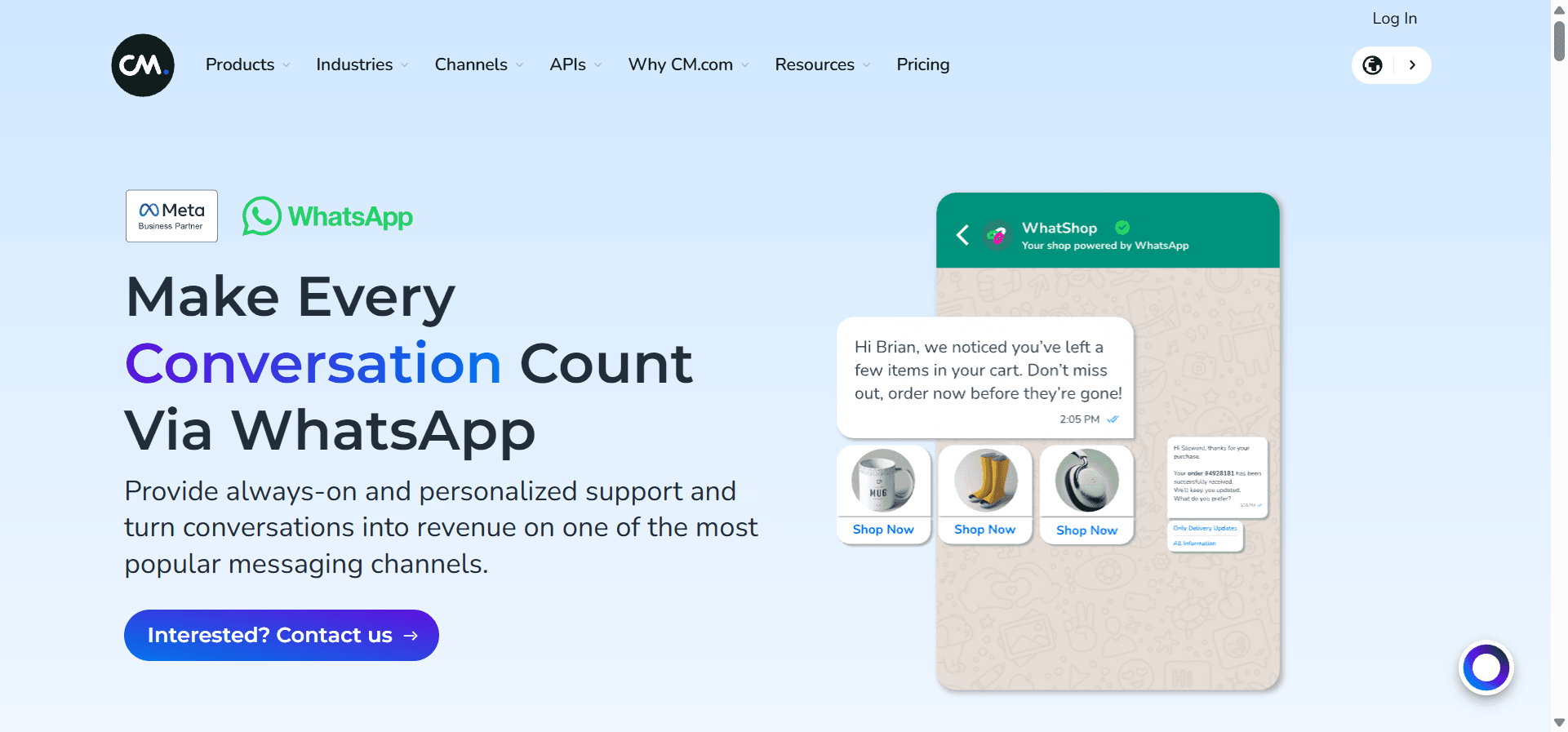
Best for: European enterprises that want messaging and voice from one vendor with throughput-based plans.
What sets it apart: Pricing has two parts:
- A platform subscription based on throughput and connections
- A message bundle priced by monthly active users, conversations, or messages
This lets you choose the billing model that matches your use case.
Pros
- High throughput on upper plans (up to 1,000 messages per second on Pro)
- Real-time delivery updates through status webhooks
- A regulation filter checks messages against local rules before sending
Cons
- Total cost combines a subscription, a bundle, and Meta’s fees, which makes comparison harder
- Only annual contracts are available for subscriptions
Recent changes: In June 2026, CM.com also launched a Customer Context Platform that gives its AI agents customer data and memory.
Pricing
Subscriptions start at €49/month (annual contract). Message bundles start at €102/month for 10,000 messages but rates vary by region, message type, and volume commitments. The pay-as-you-go at €0.009 per message with Meta’s WhatsApp fees are extra.
Reviews
4.8 out of 5 (12 reviews) by G2 1.3 out of 5 (103 reviews) by Trustpilot 4.9 out of 5 (7 reviews) by Capterra
Rasayel
Rasayel’s inbox is shaped around how sales reps work. Your reps can schedule messages and set reminders to follow up with a lead. Voice notes from customers are transcribed by AI, so they can skim them instead of listening. Each agent can keep private views alongside the team’s shared ones. The mobile apps for iOS and Android let them reply on the go.
Broadcasts are capped per day, at 250 users on Start and 5,000 on Grow. Beyond its WhatsApp integrations with CRMs, Rasayel also offers an open API and a Zapier connection.
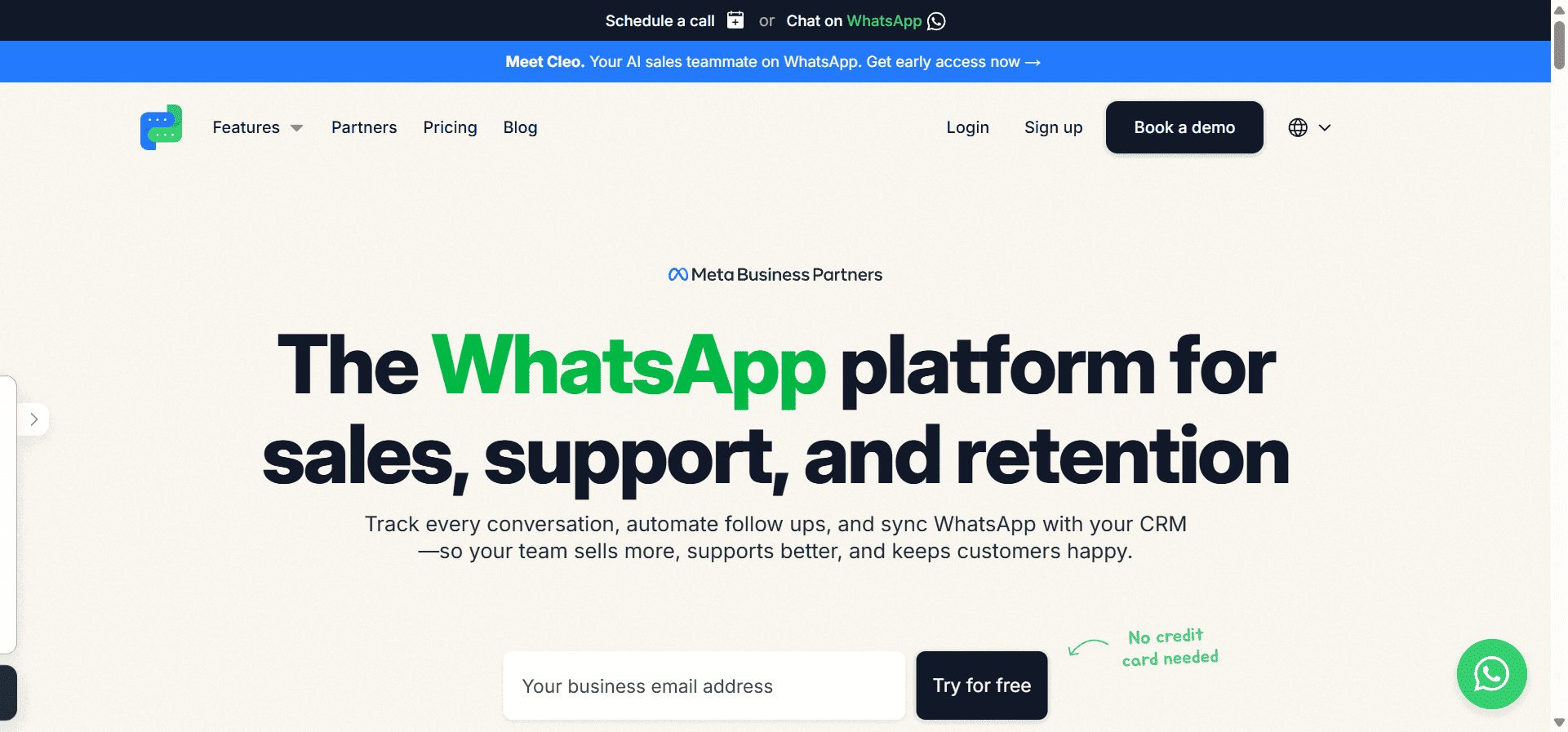
Best for: B2B sales teams of 5 or more reps that sell over WhatsApp and work in a CRM.
What sets it apart: It focuses on sales pipelines rather than marketing campaigns. Meta’s fees are paid by you directly to Meta, so Rasayel adds no message markup.
Pros
- 7-day free trial with no credit card
- An onboarding session is included on the Grow plan
- Multiple WhatsApp numbers included (3 on Start)
Cons
- Minimum 5 users on Start and 10 on Grow plan
- Salesforce integration costs an extra $300/month
- Plans cap monthly messages (10,000 on Start)
Recent changes: Rasayel raised its per-user prices from $27 and $36 to $30 and $40.
Pricing
The Start plan costs $30/user/month (minimum 5 users), the Grow is $40/user/month (minimum 10 users), and the Enterprise starts at $2,000/month on annual billing.
Reviews
4.5 out of 5 (44 reviews) by G2
Gupshup
Gupshup single API covers over 30 channels, including Truecaller and Telegram so you can manage your multichannel customer interactions from a single solution.
Additionally, you can work with Superagent over WhatsApp or by voice. It can also be used from inside AI assistants such as ChatGPT and Claude.
For companies that can’t send data to the cloud, Gupshup announced Superclaw. This self-hosted version runs on a local computer and keeps data on the device. It is aimed at small businesses and regulated enterprises that want to store their data locally instead of a cloud platform.
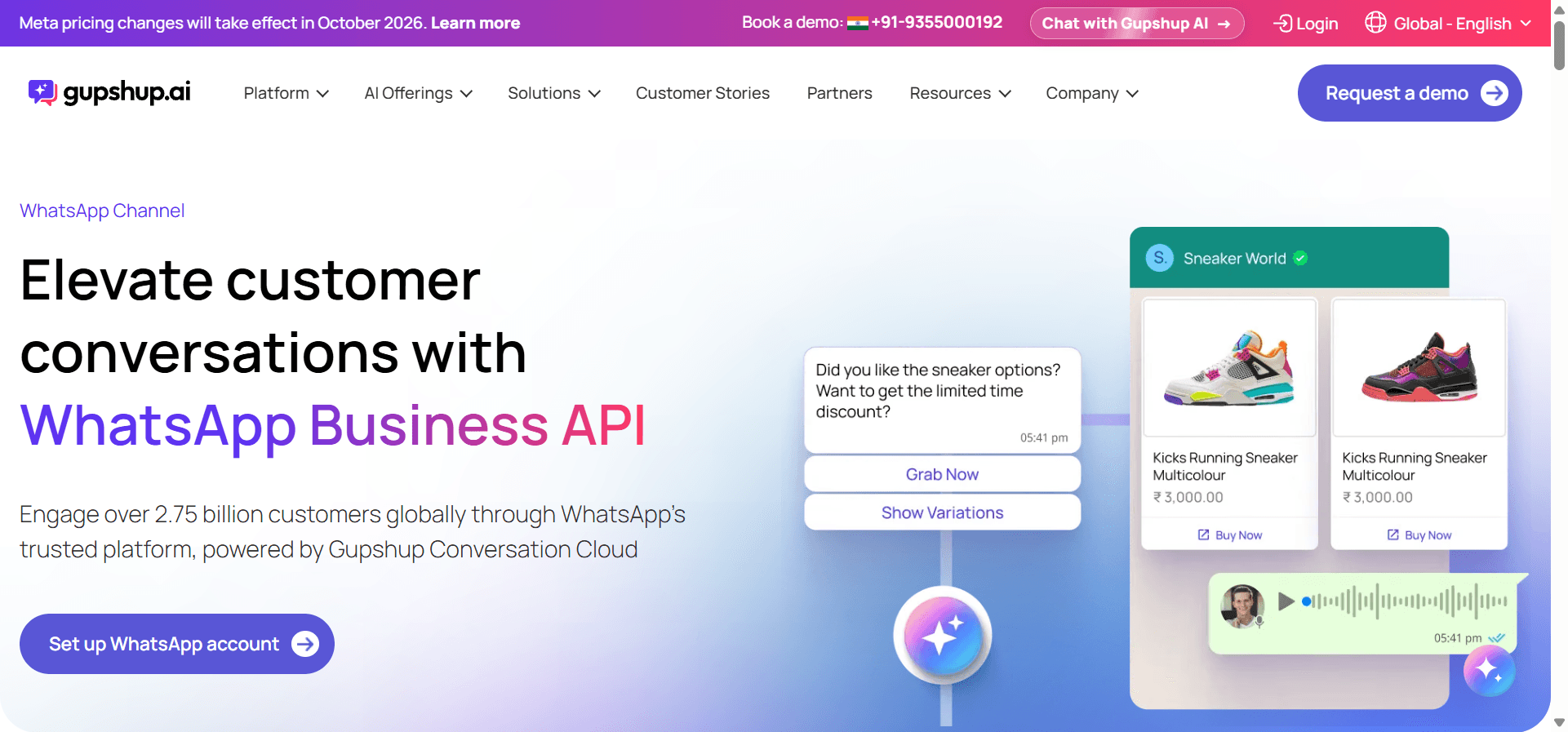
Best for: Enterprises with high message volumes that want AI agents on top of the WhatsApp Business API.
What sets it apart: Gupshup offers a library of pre-built AI agents trained for specific industries. Its billing also depends on how your messages are sent. For example, it adds a 6% markup on marketing messages sent through the standard Cloud API instead of Meta’s Marketing Messages Lite API.
Pros
- Interface available in 13 languages, including Hindi and Arabic
- Both the self-serve and enterprise options available
Cons
- Superagent is still in beta
- Costs rise with message volume and the marketing markup depending on the technical setup
Recent changes: In April 2026, Gupshup announced Superagent, an AI agent in beta that builds campaigns and customer journeys from a chat interface.
Pricing
Gupshup charges per message based on message type, country, and volume, on top of Meta’s fees. You’ll have to download the rate card from its website to get exact pricing details per country.
Reviews
Advantages of using WhatsApp API
After learning the difference between a WhatsApp BSP and the WhatsApp API, now it’s time to look at the benefits of using WhatsApp API for your business. So, let’s get started.
Communication scalability
The WhatsApp Business API is designed for medium to large businesses that need to communicate with a vast number of customers. It allows you to handle thousands of customer interactions simultaneously through automation and connect with them via central software, making it ideal for scaling up your outreach efforts.
Better customer engagement
WhatsApp is one of the most widely used messaging platforms globally, with close to 3 billion active users. So, you can use the WhatsApp API to reach customers on a platform they already use regularly, leading to higher engagement rates. The API lets you have a two-way conversation, enabling you to respond to customer queries, send updates, and offer real-time support.
Automate with chatbots
The WhatsApp API allows for the integration of chatbots, which can automate responses to common queries. Automation reduces response times and frees up your customer service agents to handle more complex issues. Chatbots can also be enhanced with artificial intelligence for more sophisticated interactions with minimal human intervention.
Personalized communication
Using the WhatsApp Business API, you can send tailored messages at scale to your customers without having to manually type in each message. These personalized messages have a higher chance of driving engagement.
With the API’s ability to dynamically insert customer-specific information into template messages using variables, you can create more meaningful and tailored communication.
Secured platform
Conversations on WhatsApp are encrypted between users. When a business uses the WhatsApp Business API, messages are processed by Meta’s Cloud API and by the provider you have chosen. So, the provider becomes part of how customer data is handled.
For example, if you work in finance, healthcare or another regulated industry, ask each provider where message data is stored and how long it is retained? Also inquire about which compliance reports, such as SOC 2 or ISO 27001 the provider can share, if needed.
How is WhatsApp pricing calculated?
Meta charges businesses per delivered message not per conversation. It moved to this model on 1 July 2025. Messages your customers send to you are free.
Template messages fall into three categories:
- Marketing - messages for promotional objectives
- Utility - messages for transactional or informational objectives
- Authentication - messages for identity verification objectives
Each is priced by category and the recipient’s country. In India, the rates effective 1 October 2026 are ₹0.8631 per marketing message and ₹0.115 per utility or authentication message.
From 1 October 2026, two things changed:
- Service messages, which are free-form replies inside the 24-hour customer service window, are charged at the utility rate after the first 1,000 per phone number each month.
- Utility templates sent inside an open customer service window are no longer free.
Messages sent after a customer clicks a Click-to-WhatsApp-ad are still free during the free 7-day entry point window. Utility and authentication messages get volume discounts as you send more each month. On top of Meta’s fee, your provider may add a subscription, a per-message fee or a markup.
See Meta’s WhatsApp pricing documentation and our guide to WhatsApp marketing costs for details.
How to choose the right WhatsApp API provider?
When choosing a WhatsApp API Provider, there are several important factors to consider to ensure you get a reliable solution for your company. Below are some of the key aspects to look out for:
Official WhatsApp partner
Ensure that whichever provider you pick is an official WhatsApp Business API provider. Using an unofficial or unauthorized provider may result in unreliable service and a potential violation of WhatsApp’s terms of service, resulting in your account getting banned.
Pricing considerations
Your WhatsApp bill has two parts:
- Meta’s per-message fee
- The provider’s own charges
Providers charge in very different ways. Some add a markup to every message while some add a flat fee per message. Plus, a few providers charge a fixed monthly fee per phone number, and some pass Meta’s rates through with no markup.
Ask for the provider’s per-message rate card before you decide to commit to compare total cost at your expected volume rather than the subscription price alone.
Quick integration
Check the documentation and resources provided by the provider to make sure the integration process is smooth. It shouldn’t be a complex process to integrate the WhatsApp API with your CRM system.
Compliance and security
Make sure the provider adheres to WhatsApp’s policies and guidelines, as non-compliance can lead to restrictions or loss of service. Also, verify that the provider has strict data protection regulations and follows industry security standards. Since you deal with sensitive data on WhatsApp, security, and compliance is crucial to safeguard your customers’ information.
Scalability
Whether you are a startup or a large enterprise, your API provider should be able to handle your messaging volume without having any performance issues. As your business expands, so will your need to send more messages. That’s why your API provider needs to have a reliable infrastructure to keep up with the growing demands of your business.
Multi-agent inbox
If more than one person replies to customers, you need a shared inbox with chat assignment. Check how many users each plan includes, since this is where costs often jump.
Wati’s Growth plan includes 3 users and no extra seats, Rasayel requires a minimum of 5 paid users, and DashCX charges per user with a minimum of 3. API-first providers such as Twilio, Vonage and 360Dialog do not include a full team inbox, so you would build one or connect a separate tool.
No-code automation builder
For non-technical teams, a drag-and-drop automation editor is required. Additionally, some providers limit how fast you can send on lower plans.
For instance, Bird’s pay-as-you-go plan sends 10 messages per minute, so a 10,000-message campaign would take about 17 hours. Wati’s Growth plan caps broadcasts at 15,000 a month and automation triggers at 1,000 a month.
If you run large WhatsApp campaigns or time-sensitive alerts like OTPs, check throughput and monthly caps before choosing a plan.
How to get started with the WhatsApp Business API?
Usually, companies use a WhatsApp API provider to get started with the setup. Here are the steps:
- Setting up a WhatsApp Business account with company details and phone number
- Linking it to the WhatsApp Business Platform
- Designing and verifying WhatsApp messaging templates
- Building automation workflows with relevant triggers and logic
Choosing the right WhatsApp API provider enables you to breeze through these onboarding steps and get up and running effortlessly.
Check out our in-depth guide on how to set up the WhatsApp Business API.
Knock your communication worries out of the park by choosing the right WhatsApp API provider
These are some of the best WhatsApp Business API providers that will assist you in setting up your WhatsApp Business account and executing your WhatsApp marketing initiatives.
However, I would also like to mention one more marketing software that you can integrate with WhatsApp API to run outreach campaigns.
Zixflow is a top-class marketing platform that lets you make the most of WhatsApp API while also providing the functionality to simplify your sales process. It is a straightforward marketing software that allows you to reach out to your audience in a simple yet effective manner.
It lets you try out the platform for free and check out its marketing capabilities with a 7-day trial. Plus, with its pay-as-you-go wallet, your account will only be deducted based on the number of messages you send.
Frequently asked questions about WhatsApp Business API providers
Given below are some of the common questions regarding WhatsApp Business API. These questions will enhance your understanding of the WhatsApp API and how you use it for effective business communication.
What is WhatsApp Business API?
The WhatsApp Business API is a platform designed for medium to large businesses that want to engage with customers at scale. Unlike the WhatsApp Business App, which is intended for small businesses, the API allows you to integrate WhatsApp messaging into your customer service, sales, and marketing systems.
It enables you to send automated notifications, customer support messages, and two-way communication on a platform that customers are already comfortable using. By using advanced features like chatbot integration, automated workflows, and CRM integration, you can build a robust engagement framework for managing all of your external interactions.
Can I use the WhatsApp Business API for free?
Signing up for the WhatsApp Business API is free but sending messages is not. Meta charges per delivered template message, and from 1 October 2026 it also charges for service replies after the first 1,000 per phone number each month.
Your provider may add a subscription or per-message fee. Messages sent within the free entry point window after a customer clicks a Click to WhatsApp ad remain free.
How quickly can you start using the WhatsApp Business API?
The time required to set up the WhatsApp Business API can vary depending on factors such as the complexity of your existing systems, your choice of BSP, and the approval process. In general, it can take somewhere from a couple of days to up to a week to get your account approved and start running WhatsApp campaigns. A BSP can expedite the process by providing you with pre-built solutions and technical support.
Does WhatsApp API allow you to send bulk messages?
Yes, you can send WhatsApp messages at scale using the WhatsApp Business API. However, bulk messaging requires using pre-built and pre-approved templates. This ensures that you adhere to WhatsApp’s anti-spam policies.
Templates are useful for sending messages for different use cases, such as shipping updates, appointment reminders, or promotions, but you must follow strict content guidelines. Also, you cannot send unsolicited marketing messages through WhatsApp, and customers must opt-in to receive these communications.
Can I automate responses with WhatsApp Business API?
Yes, automation is one of the key features of the WhatsApp Business API. You can set up automated responses using chatbots, which can handle common queries like FAQs, booking confirmations, or order status updates.
Automation can also be configured to send template messages based on the actions performed by your users. For instance, you can send welcome messages after a user signs up or post-purchase confirmations once an order is placed.
Can the same phone number be used for WhatsApp Business API and WhatsApp Business app?
Yes, through Meta’s coexistence feature if your provider supports it. Coexistence lets you keep using the WhatsApp Business app on your number while also connecting it to the WhatsApp Business API, with message history synced between them.
Some app features stop working, such as broadcast lists, group chats. and disappearing messages but the throughput is fixed at 20 messages per second. Without coexistence, a number registered on the API can’t be used in the app at the same time.
Can the WhatsApp Business API be accessed from multiple devices?
Yes. Because the API works through a provider’s web dashboard, your team can log in from multiple devices. With Zixflow, you can use the same account on a PC, laptop or mobile phone.
Can I add my sales or support teams to my Zixflow account?
Yes, you can add unlimited users to your Zixflow account based on the plan you have chosen.
Can I use the WhatsApp API with my current business infrastructure?
Yes, you can connect the WhatsApp Business API with your existing tech stack. Zixflow lets you integrate it with numerous external apps like Zapier, Pabbly, Make, Gmail, Poper AI, and much more.
Which WhatsApp Business API provider is best for small businesses?
For small businesses, the best fit depends on team size and budget.
BotSpace has a free plan with a shared inbox, Wati and Interakt offer polished no-code inboxes with paid plans from $55 to $59 a month, and MSG91 charges only ₹500 a month per number plus Meta’s rates.
Zixflow starts at $49 a month and suits small businesses that also need SMS, RCS or email. Compare user limits and message markups, as these change the total cost more than the subscription price.
What's the difference between an official Meta partner and an unofficial WhatsApp API provider?
The official Meta Business Partners are registered in Meta’s Partner Directory and have direct access to the WhatsApp Business API with appropriate authorization.
Unauthorized gateways are used by unofficial providers to send messages, which is against WhatsApp’s terms of service and may lead to account deactivation or delayed message delivery. It is important to ensure that a provider is a Meta Partner before committing.
Can I switch WhatsApp API providers later?
Yes. Meta supports moving a phone number from one provider to another, and approved templates can be recreated in a new WhatsApp Business account owned by the same business through Meta’s template migration.
Plan the switch carefully though. You may need to rebuild automations, reconnect integrations, and some messaging may pause during the move. Ask your new provider to handle the migration.