The Complete D2C Customer Engagement Playbook
Build a D2C customer engagement strategy around the interactions that keep customers connected with your brand after they make a purchase.
 by Sahil Tyagi
A D2C customer engagement playbook is a structured framework covering every stage of the direct-to-consumer customer lifecycle with defined messaging tactics, channel selection, and automation flows for each stage.
The playbook approach works because D2C brands own the customer relationship directly, meaning every engagement touchpoint is a first-party data asset that compounds in value over time.
The D2C market is now a $213 billion industry globally, and every brand in it is sitting on the same structural advantage, i.e., direct access to the customer. But that advantage only compounds if you actually use it.
Most D2C brands don't use this advantage completely. They invest heavily in acquisition and treat the customer relationship as something that will maintain itself. According to Bain & Company, Indian e-commerce brands have an average repeat purchase rate of just 23% within 12 months of the first order, which means 77% of first-time buyers never make a second purchase. That's a customer acquisition budget that disappears into a one-purchase transaction.
What separates D2C brands with strong LTV from those struggling to make their unit economics work isn't product or price, it's customer engagement. Brands with structured engagement programs recover more of their CAC and build the kind of loyalty that doesn't collapse when a competitor runs a sale.
That's why, below, I'll walk you through everything you need to build a D2C customer engagement strategy that works across the full customer lifecycle. What it is, why it works differently for D2C than for traditional retail, the core benefits, and specific playbook strategies you can start implementing immediately.
What is D2C customer engagement?
D2C customer engagement is the set of strategies a direct-to-consumer brand uses to build meaningful relationships with its customers across the full lifecycle. It encompasses every stage of the sales pipeline where the brand communicates with the customer.
The D2C model gives you something traditional retail channels never could, complete visibility into every customer's purchase history, communication behavior, and engagement signals. As a D2C brand, you need to know which customers haven't bought in a while or which customers always buy the same product variant.
D2C customer engagement is the practice of turning that data visibility into personalized interactions that keep customers active and spending.
What makes D2C engagement distinct from a generic marketing program is that it's built around the full customer journey, not individual campaign moments. D2C engagement initiatives trigger actions based on what each customer does, along with the behavior signals about where they are in their relationship with your brand.
Why does D2C customer engagement matter for sustainable business growth?
When it comes to the business case for customer engagement, the numbers are unambiguous. Loyal customers convert at 60 to 70% compared to 5 to 20% for new prospects. But the impact shows up across multiple dimensions of business performance. Here are a few of the most important reasons every D2C brand should be building a structured engagement program:
Higher CLV without more spend
The most direct financial outcome of strong D2C customer engagement is a higher LTV from your existing customer base. When a customer buys twice instead of once, their contribution to your business doubles, and when they buy multiple times, they often cover their original acquisition cost several times over.
This is especially important in an environment where paid social CAC has risen. With acquisition becoming more expensive, the brands that scale profitably are those that extract more revenue per acquired customer.
First-party data that gets more valuable over time
D2C brands accumulate a behavioral data asset with every customer interaction. Each email open, WhatsApp reply, product view, purchase, and support conversation adds a data point that makes the next interaction more relevant and more likely to convert.
92% of D2C marketers say first-party data is now essential to their growth strategy. The brands that build deliberate engagement programs are the ones enriching that data continuously.
In addition to that, the business implications go beyond better personalization. Strong first-party data also improves paid acquisition performance because you can use your highest-value customer segments as seed audiences for lookalike modeling. Engagement that feels customer-centric in the short term becomes a data asset that pays dividends for every future campaign.
Advocacy that reduces acquisition costs
D2C customers who are genuinely engaged with a brand don't just buy again, they defend the brand in public forums. This organic advocacy produces acquisition at near-zero marginal cost.
User-generated content created by engaged customers also outperforms paid creative. UGC in ads delivers 20 to 40% higher CTR than polished brand creative. Every engaged customer who posts about your product is producing marketing content that converts better than most of what's coming out of the production budget.
Your customer engagement strategy is what creates the conditions for this advocacy. Customers who feel seen by a brand are far more likely to become public advocates than customers who were acquired by an ad.
Better campaign performance across every channel
When your customer base is actively engaged, every campaign you run performs better. Engaged customers have higher performance metrics and an unengaged list drags down average campaign metrics even when the message is well-crafted.
D2C brands with rich engagement history and behavioral data can segment and personalize to the point where campaigns feel tailored rather than broadcast. And the channel that benefits most from this engagement foundation is WhatsApp.
WhatsApp averages 98% open rates and over 50% click-through rates, compared to 25% for SMS and 1 to 4% for email. But those numbers are only achievable if the messages being sent are relevant and timely. Engaged audiences are what make those open rates translate into actual revenue.
Engage with Customers at the Right Moment.
Broadcast schedules your outreach campaigns around each customers’ actions so you can connect with them effectively.
Schedule CampaignsHow to build a robust D2C customer engagement playbook?
Now that you have a solid understanding of what D2C customer engagement is and why it drives measurable business outcomes, let's look at ways to craft a customer engagement playbook for your business:
Build a post-purchase sequence to retain first-time buyers
The post-purchase window is the highest-leverage period in a D2C customer relationship. A customer who just bought from you is more engaged with your brand at that moment than they will be at any point in the future. Many D2C brands waste this window with a generic shipping confirmation and then silence.
A structured post-purchase onboarding sequence works because it meets the customer at the moment of highest engagement and uses that attention to deepen the relationship rather than simply confirming a transaction. The sequence should do three things:
- Reinforce the purchase decision
- Educate the customer on how to get maximum value from the product
- Create a natural pathway to the second purchase
Each of those objectives requires a different message at a different moment, which is why a single follow-up email won't accomplish what a properly timed sequence can.
To build this sequence, start by mapping the product usage timeline. When does the customer first use the product? When would they realistically run out of a consumable, or form a habit around a wellness supplement?
Those timing anchors determine when each message in the sequence should fire. The first message, sent immediately after delivery, is about reinforcing the purchase decision and setting expectations. The second message, sent around the expected first-use moment, is educational.
The third, typically at the natural replenishment point, is the conversion moment. This step could include a personalized reorder prompt with a first-repeat-purchase incentive, sent at the exact moment the product is likely running low.
D2C brands that implement this kind of behaviorally anchored post-purchase sequence see meaningfully higher 90-day repeat rates than those sending typical promotional messages. The key is personalizing the timing and content to the specific product the customer bought.
Use behavioral segmentation to make messages personal
Behavioral segmentation is the practice of grouping customers based on what they actually do, rather than who they are demographically. In a D2C context, that means utilizing RFM segmentation to divide your customers to tailor your communication to each behavioral pattern.
This strategy works because behavioral data is the most reliable predictor of future behavior. For instance, a customer who has bought three times in six months is giving you a very clear signal about their relationship with your brand. So is a customer who bought once in eight months. Treating those two customers the same actively damages both relationships.
The practical way to implement behavioral segmentation is to start with four core behavioral buckets:
- Active customers - purchased within your typical repurchase window
- Engaged but inactive - opened messages recently but haven't purchased
- At-risk - declining engagement and longer-than-normal purchase gap
- Lapsed - no engagement or purchase in an extended period
Each bucket gets a different communication strategy. Active customers should receive loyalty rewards based on their category preferences and referral invitations. Engaged-but-inactive customers need a compelling reason to return. At-risk customers need a win-back sequence with escalating urgency. Lapsed customers need a reactivation campaign.
Create a WhatsApp-first engagement layer for real-time conversations
For D2C brands serving customers in markets where WhatsApp is the primary communication channel, WhatsApp is the most commercially important engagement layer available. It's not a secondary channel to email, for many D2C brands in India and other WhatsApp-dominant markets, it's the primary one.
The reason WhatsApp works so effectively for D2C engagement is that it operates in a communication context customers reserve for people and brands they actually want to hear from. When D2C brands use WhatsApp marketing automation correctly, they are building a real-time engagement channel that feels like a conversation.
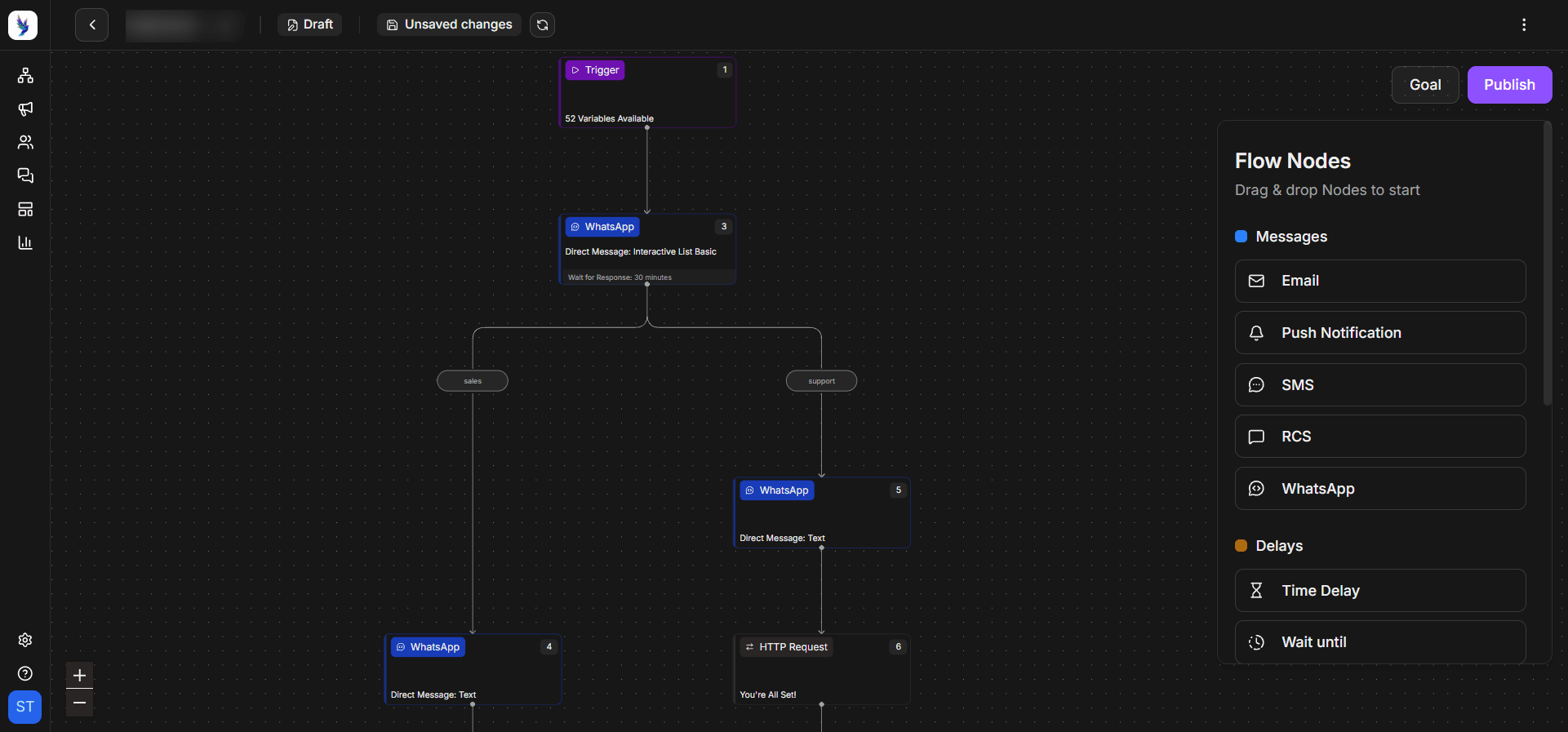
Building a WhatsApp engagement layer starts with three foundational flows:
- An order update flow that keeps customers informed from purchase through delivery in real time
- A post-purchase support flow that makes it easy for customers to ask questions or report issues without friction
- A reorder and win-back flow triggered by behavioral signals
Together, these three flows cover the most critical customer moments and build a communication habit of reaching out when they think of your brand, they know WhatsApp is where to go.
Build a loyalty program that deepens customer relationships
A loyalty program is not a discount program. The distinction matters enormously for how you design it and what it produces commercially. A discount program trains customers to wait for the next promotion before buying. A loyalty program creates value that the customer earns through engagement and spending, which builds habitual purchasing behavior independent of promotional activity.
Loyalty programs work for D2C brands because they give you a structured reason to communicate with customers between purchases that isn't a sales pitch. Each touchpoint is an opportunity to keep the brand present in the customer's life without requiring a discount to justify the message.
The most effective D2C loyalty programs are tiered, and these tier thresholds should be calibrated to your purchase frequency distribution. Look at your customer data and find the natural clusters: the 20% who buy most frequently, the 60% who buy at a moderate cadence, and the 20% who buy rarely.
Design tiers around those natural behaviors so that the middle tier is achievable for the majority of your engaged customers and the top tier is aspirational but realistic. Within each tier, the rewards should be things that reinforce purchasing behavior.
See Your Segments Take Shape.
Zixflow tells you the live count for each segment so you group your audience with matching characteristics.
Book a DemoUse customer feedback loops for continuous improvement
Engaged customers tell you what they need, but many D2C brands aren't systematically listening. Customer feedback loops are the mechanisms for collecting that signal and acting on it. They are not a customer satisfaction exercise but a retention tool.
The reason feedback loops improve engagement is that they make customers feel heard. When a customer flags an issue with your product and you follow up to say you have addressed it, you have converted a complaint into a loyalty event. That customer now knows their feedback has an impact, which makes them more likely to share future feedback rather than quietly churning.
To implement an effective feedback loop, build three collection points into your customer journey. The first is a post-delivery survey. It ideally involves two to four questions delivered via WhatsApp within 48 hours of confirmed delivery. Keep it short, such as one question about the product experience, one about the delivery experience, and an open-ended field for anything else.
The second collection point is an exit survey triggered when a customer who was previously active stops engaging. This survey should consist of what changed, what was missing, and what would bring them back. Each of these surveys generates actionable data that makes the next version of your customer journey more effective.
Measure engagement metrics that predict revenue
Measuring engagement is not the same as measuring reach. The engagement metrics that predict D2C revenue are behavioral and longitudinal. These include repeat purchase rate, purchase interval, channel-specific conversion rate, reactivation rate, and NPS over time.
The reason measurement matters as a distinct engagement strategy is that you can only optimize what you can see clearly. D2C brands that track the right e-commerce metrics and KPIs can identify which engagement programs are actually moving retention numbers and which are producing opens without revenue impact. That distinction determines where your automation budget should be concentrated.
Build a measurement framework around three time horizons. At 30 days post-acquisition, track the first-engagement rate. At 90 days, track the repeat purchase rate by acquisition channel and by engagement level. At 180 days, track the active customer rate.
A strong 90-day repeat rate means your post-purchase sequence is working. A weak one means there's a gap in the lifecycle. Each of those is a solvable problem, but only if you're measuring with enough precision to see where the gap actually is.
Building your D2C customer engagement one step at a time
D2C customer engagement is ultimately about making the most of the structural advantage the D2C model gives you. Every brand that sells direct to consumers has access to something traditional retail never had.
The brands that build structured customer engagement models around that access with post-purchase sequences and behavioral segmentation are the ones that turn a first purchase into a long-term customer relationship.
The single most important insight from this playbook is that engagement is not marketing. Marketing brings customers in; engagement keeps them. So, begin by deciding on two things, a post-purchase sequence and a behavioral segmentation model with four clean buckets.
Those two elements alone will produce a measurable improvement in repeat purchase rate within 90 days. Then layer in the WhatsApp engagement flows, the loyalty mechanics, and the feedback collection as your program matures. Not every strategy needs to go live at once.
With that said, if you are looking for a platform to run your D2C customer engagement program across numerous channels built around behavioral triggers and a unified customer data layer, Zixflow is built for that use case. Start a free trial and connect your customer data to see how your engagement metrics look across the full lifecycle.
Frequently asked questions about D2C customer engagement
What is D2C customer engagement?
D2C customer engagement is the set of strategies and communications a direct-to-consumer brand uses to build ongoing relationships with customers across the full lifecycle, from first purchase through repeat buying and advocacy.
Why is customer engagement important for D2C brands?
Customer engagement is important for D2C brands because the economics of the D2C model depend on repeat purchasing. Structured engagement programs improve repeat purchase rates, increase LTV, reduce churn, and build the customer relationships that generate organic referrals.
How do I measure D2C customer engagement?
Measure D2C customer engagement using behavioral and revenue metrics rather than activity metrics. The most important are: 90-day repeat purchase rate, active customer rate at 180 days, channel-specific conversion rate per segment, reactivation rate on win-back campaigns, and NPS trend over time. These metrics tell you whether your engagement program is moving commercial outcomes.
How does WhatsApp improve D2C customer engagement?
WhatsApp improves D2C customer engagement by providing a real-time, high-attention communication channel that operates in the personal messaging context customers reserve for important conversations. WhatsApp averages high engagement rates compared to other outreach channels.
For D2C brands in markets where WhatsApp is the primary messaging channel, it enables order updates, personalized reorder prompts, win-back sequences, and two-way customer conversations that build a genuine relationship.
What D2C customer engagement metrics should I track weekly?
On a weekly basis, track:
- Email and WhatsApp campaign conversion rate by segment
- New repeat purchasers generated that week as a count
- Win-back campaign response rate
- Support resolution time
Monthly, review the 30-day and 90-day repeat purchase rate by acquisition cohort, active customer rate, LTV by segment, and churn rate. Those metrics together give you a complete picture of engagement health across the short and long term.