Customer Feedback Loops: How to Collect and Act on Customer Input?
Build a customer feedback loop by collecting customer input and using it to make meaningful changes to the customer experience.
 by Sahil Tyagi
A customer feedback loop is a systematic process of collecting customer input and acting on it to produce a real outcome. The key distinction between these feedback loops is whether they are circular or linear. A linear process collects and stops, while a circular process collects, analyzes, acts, and notifies the customer.
Building a feedback loop has the following steps:
- Map every touchpoint where feedback naturally occurs
- Choose the right collection method for each stage
- Centralize all feedback into a single tagged record
- Close the loop by responding directly to customers who gave feedback
- Connect feedback patterns to your product roadmap
Collecting customer feedback and acting on it are very different things. Businesses spend a lot of resources on gathering this information but don’t do much with these insights as they sit in a spreadsheet, while the same problems that prompted the feedback quietly drive customers to churn.
This is more than just a customer feedback collection problem. In fact, for every complaint a company receives, there are approximately 26 other customers who are equally unhappy but chose to say nothing. A customer feedback loop solves this by making collection and action a continuous system instead of a periodic exercise.
If you treat customer feedback as an operational practice rather than a reporting process, then you are among the few who see those numbers improve your bottom line.
That's why in this guide, I'll walk you through what customer feedback loops actually are, why they matter at each stage of your business, and how to build one that connects input to action in a way your team can sustain.
Let's get into it.
What is a customer feedback loop?
A customer feedback loop is a systematic process in which you collect input from your customers to implement processes that address issues customers had with your business. The loop closes when customers can see that their feedback produced a real outcome, thereby further reinforcing the relationship and making future feedback more likely.
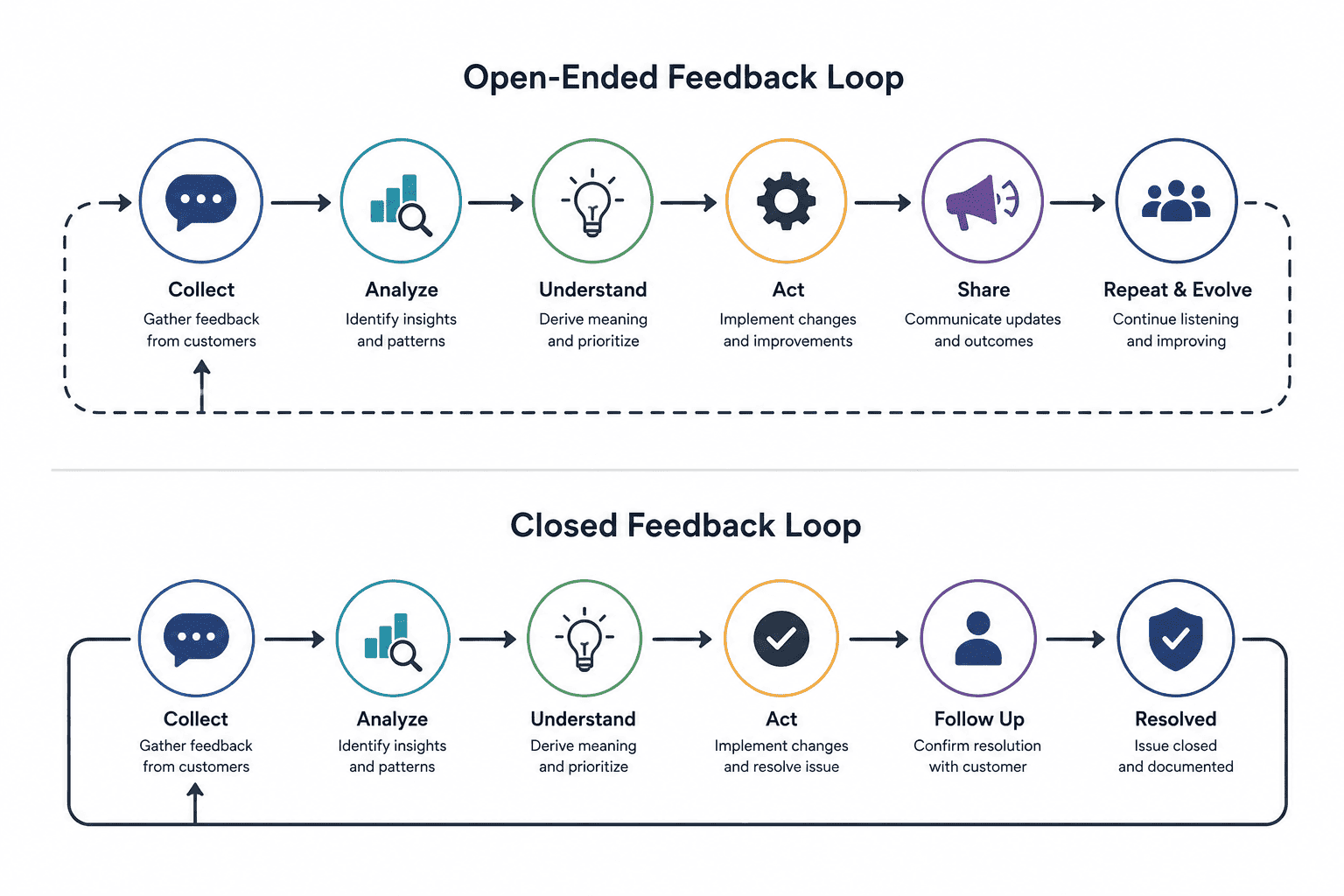
The difference between businesses that benefit from customer feedback and those that don't usually comes down to whether the process is circular or linear.
- A linear process collects, reports, and stops
- A circular process collects, analyzes, acts, and notifies, then starts again
The circular version compounds results with each cycle of feedback to make your offerings more aligned with what customers actually need.
Customer feedback loops operate at multiple levels of your business simultaneously.
- At the product level, they inform feature prioritization and design decisions.
- At the service level, they surface recurring issues that need process changes.
- At the relationship level, they create touchpoints that make individual customers feel heard.
Managing all these effectively is what separates a feedback program that drives measurable outcomes from one that generates dashboards no one acts on.
Open vs. closed customer feedback loops
An open feedback loop is one where the process ends at analysis. You collect the feedback, review it internally, and may or may not act on it. The role of the customer stops after submitting the feedback but they are not informed about whether their input was used or not.
A closed feedback loop completes the cycle by following up with the customer who gave the feedback. If a detractor rated your product a 6 out of 10, your team reaches out to understand why, resolves the issue if possible, and confirms with the customer that it was addressed.
66% of consumers say they feel more valued when their feedback is acknowledged. Meanwhile, 89% are open to share a positive review after a company acts on their feedback. Closing the loop turns a feedback program into an advocacy driver.
| Aspect | Open Customer Feedback Loop | Closed Customer Feedback Loop |
|---|---|---|
| Definition | Feedback is collected, but there is no consistent process to act on it or communicate the outcome. | Feedback is collected, acted upon, and the outcome is communicated back to the customer. |
| Primary focus | Gathering customer opinions and insights | Turning feedback into action and measurable improvements |
| What happens to feedback? | It may be stored, reviewed occasionally, or passed between teams without follow-through. | It is assigned, prioritized, acted upon, and tracked to completion. |
| Customer involvement | Usually ends after the customer submits feedback. | Continues after submission through updates. |
| Measurement | Often measured by feedback volume, response rates, or sentiment. | Measures both feedback and outcomes, such as resolution rate, retention, satisfaction, or product improvements. |
| Customer experience | Customers can feel that their opinions are being ignored | Customers feel heard and see that their input has an impact |
| Result | Generates customer insights | Creates a continuous improvement cycle |
Why do customer feedback loops matter for business growth?
After learning about what customer feedback loops are and how they work, let's take a look at why investing in one is worth your team's time and resources:
Reduced churn through early problem detection
Customer feedback loops surface problems before they become churn. When a customer hits a friction point and your system catches that signal, you can intervene while the relationship is still recoverable.
The churn impact of structured feedback programs is well documented. In fact, brands that close the loop on customer feedback reduce churn by 10% compared to others that only collect without acting. That reduction compounds over time because every customer retained is also a customer who continues generating revenue.
Better products built around customer needs
Without a structured feedback loop, product decisions default to internal assumptions about what customers want. With a structured customer feedback loop, they're grounded in patterns drawn from real usage and real frustrations.
The competitive advantage here is significant. 80% of companies that regularly use customer insights are more likely to release successful products compared to those that don't. This success rate comes from the feedback loop's ability to distinguish between features customers request and problems customers actually need solved.
A well-designed feedback loop captures both the surface request and the underlying friction it represents.
Higher revenue through improved customer satisfaction
The link between customer feedback loops and revenue is direct. A satisfied customer spends more with your business, stays longer, and refers others. 84% of businesses that prioritize customer feedback see a measurable increase in revenue.
A feedback loop continuously identifies where customers are dissatisfied and routes that information to the internal members responsible for fixing it. This generates a cascading effect where the cumulative effect on revenue is larger than most organizations estimate before they implement a structured feedback process.
An early warning sign for systemic issues
Individual feedback gives you signals. However, aggregated feedback from a structured loop gives you patterns. Those patterns are the most valuable output of a well-run feedback system, as they reveal systemic issues that no single customer complaint would surface on its own.
For example, when thirty customers in the same pricing tier all report the same onboarding friction, it's a process failure with a predictable retention impact.
A feedback loop that surfaces this pattern in real time lets you address it before it affects the next cohort of customers. This early warning function is particularly valuable for B2B customer engagement teams managing complex accounts where the stakes of a single churn event are high.
How to build a customer feedback loop?
With that foundation in place, let's look at how to build a feedback loop that functions as a real operational system rather than a quarterly survey exercise. These steps cover the full cycle from designing your collection strategy to making sure feedback drives changes your customers can see in real time:
Map every touchpoint where feedback naturally occurs
Before you decide how to collect feedback, you need a clear picture of where in the customer experience feedback is most likely to surface, along with the points where it's most consequential. Mapping your feedback touchpoints is the foundation everything else is built on.
A complete customer journey map will reveal the moments where customers form their strongest opinions. These could be:
- The onboarding experience
- The first interaction with your product's core feature
- The first time they need support
- A renewal decision
These are the touchpoints where feedback is both most informative and most actionable. Many businesses focus their feedback collection on post-purchase surveys and annual NPS campaigns that capture opinions from a narrow window of the customer journey.
The customers most at risk of churning are often the ones who went quiet after onboarding, not the ones who filled out your quarterly survey. When you map the full journey, you find the gaps in whether the customer's experience is working.
The mapping process should be honest about where your current feedback collection is underweighted. The goal of this step isn't to add more surveys but to make sure you're listening at the moments that actually determine whether a customer stays.
One thing to acknowledge here, not every business needs to map dozens of touchpoints on day one. If you're a small team with 50 customers, starting with three key moments, such as post-onboarding, post-first-support interaction, and quarterly check-in, is more than sufficient.
Complexity in your feedback architecture should grow with your customer base, not before it.
Choose the right feedback collection method for each stage
Different moments in the customer journey call for different types of feedback. Matching the collection method to the moment is what determines whether you get responses that are actually useful.
For instance, NPS surveys work well for relationship-level feedback at low frequency, meaning once a quarter or after a significant milestone. They give you a directional signal about overall customer sentiment.
On the other hand, CSAT surveys are better suited for transactional moments immediately after a support interaction or after a product update. They measure how a specific experience landed and not the overall relationship.
To gather this kind of real-time feedback at scale, you need to use the correct channel that makes it easy for customers to send in their feedback without going through extensive survey forms.
In-app prompts, triggered email surveys, and conversational channels like WhatsApp marketing automation are significantly more effective than standalone survey emails. A micro-survey sent via WhatsApp within five minutes of a customer completing an action will get a dramatically higher response rate than a survey email sent the following morning.
When writing questions for your feedback survey, closed-format surveys are faster to respond to and easier to analyze at scale, but they only capture reactions to options you include.
A single open-ended question at the end of each survey, such as "Is there anything about your experience that we haven't asked about?" consistently surfaces the feedback categories you didn't think to measure. Building this into every collection mechanism ensures you don't have systematic blind spots.
That being said, open-ended responses are only useful if you have a process for analyzing them. If you don’t have the capacity to review and tag hundreds of free-text responses, a structured survey with well-chosen options will produce more actionable output than an open-ended one that never gets read.
Centralize all feedback into a single record
Feedback collected across multiple channels, including surveys, support tickets, chat conversations, social mentions, and sales calls, produces value only when it can be analyzed together. You get siloed signals rather than a coherent picture when all this lives in separate systems.
The solution is a single system of record where every feedback signal lands. For most businesses, this means routing feedback from all channels into a CRM or a dedicated feedback management tool that is labelled correctly.
The tagging structure matters because feedback that isn't categorized consistently can't be aggregated, which, in turn, can't surface patterns. Decide on your taxonomy before you start collecting at scale.
Some of the common categories you can use include product (broken down by feature), onboarding, support, pricing, and competitive positioning.
Additionally, one of the most underestimated sources of feedback for many businesses is the customer engagement data that doesn't come with an explicit label.
A customer who never activates a key feature isn't leaving feedback saying the onboarding failed. But their behavior is feedback. Integrating behavioral signals alongside explicit survey data gives you a richer view of where customers are struggling. The combination of what customers say and what they actually do is more predictive than either source alone.
Centralization also prevents the common failure mode where one department is aware of a customer problem but another has already made a decision that will make it worse. A shared system of record makes the customer's voice visible across all the departments simultaneously.
Close the loop by responding to customers who gave feedback
Closing the loop is the step most businesses skip. It's the step that determines whether your feedback program builds customer loyalty or just generates data. Closing the loop means reaching back out to the customer and communicating what happened as a result.
For detractors, this means a personal outreach like a call or message that acknowledges their specific complaint and explains what you are doing about it. For high-volume feedback that can't all receive individual responses, a broadcast communication explaining that you heard a specific type of feedback and are acting on it.
The most effective channel for individual loop-closing is a direct message, not an email. A WhatsApp message sent by a named team member to a customer who gave a low NPS score lands entirely differently than a generic follow-up email from a no-reply address.

The personal nature of the outreach signals that someone actually read their feedback, which will make you stand apart from brands that treat survey responses as data points rather than customer communications.
Implement customer feedback into your future roadmap
The final and most impactful step is institutionalizing the connection between feedback and decision-making. A customer feedback loop that shapes your product roadmap and business strategy is transformational.
Building feedback into your roadmap requires a few structural commitments.
First, feedback needs to be represented in the room where prioritization decisions are made. This means having an understanding of customer patterns from your feedback system and incorporating them in product discussions with relevant data to back it up.
Second, the roadmap itself needs a mechanism for tracking which features were prompted by customer feedback, so the team can close the loop with customers when those improvements ship.
The feedback-to-roadmap connection also needs to be honest about capacity. You can only meaningfully act on three to five pieces of structural feedback per quarter. Trying to respond to everything produces shallow fixes that don't resolve the underlying issues.
Selecting fewer priorities and executing them well produces a better business outcome than a long list of incremental changes that no one notices.
One practical starting point for this step could be scheduling a monthly 30-minute cross-team review where the top five feedback themes from the previous month are shared. This single meeting creates more accountability for acting on feedback than most elaborate feedback management systems do.
Turning customer feedback loops into a system that actually sticks
I’ve walked you through the full architecture of a customer feedback loop, starting from what makes it circular rather than linear to operational steps that turn feedback collection into a system that compounds your business growth over time.
The most important thing to carry forward is that the collection step is the least important part. If you’re just gathering data and not acting upon it, you’re missing out on a huge growth opportunity.
If you're starting from scratch, don't try to build the complete system at once. Pick two feedback touchpoints and schedule one cross-team review meeting per month. Run that structure for 90 days before adding complexity. Most of the value in a customer feedback loop comes from consistency and response quality.
With that said, if you want to close your customer engagement loops faster and at scale, Zixflow's engagement capabilities let you run triggered messages across WhatsApp, RCS, email, and SMS with automatic fallback if a message fails to get delivered.
Schedule a personalized demo with our team to see how we make it easy to stay connected with your customers.
Frequently asked questions about customer feedback loops
What is a customer feedback loop?
A customer feedback loop is a process in which a business collects and analyzes customer inputs to improve its product or service. The loop is considered closed when the customer is notified that their feedback produced a real outcome.
What is the difference between an open and closed feedback loop?
An open feedback loop ends at data collection or internal analysis and never communicates back to the customer. A closed feedback loop completes the cycle by following up with the customer who gave feedback to acknowledge it and confirm the outcome.
How do you collect customer feedback effectively?
Effective feedback collection matches the type of data you want to collect. You can trigger micro-surveys via in-app prompts or WhatsApp to grab customer attention and prompt them to provide their feedback quickly.
How do customer feedback loops reduce churn?
Customer feedback loops reduce churn by detecting dissatisfaction before it becomes a cancellation. When a customer gives a low satisfaction score or mentions a recurring problem, a closed-loop system triggers an outreach from you while the relationship is still salvageable.
How do you build a customer feedback loop for a small team?
For small teams, start with two or three feedback touchpoints that cover the most crucial stages of their sales pipeline. Then, use a shared spreadsheet or a simple CRM to tag and track customer responses across these touchpoints. After that, make it a habit of having a 30-minute monthly/weekly review to identify the top three recurring themes. This way, you can bring consistency to your process without relying on sophisticated tools with no response protocol attached to them.