How to Choose a Customer Engagement Platform?
The right customer engagement platform should fit your existing workflows and make it easier to manage customer interactions.
 by Sahil Tyagi
A customer engagement platform is software that orchestrates personalized communication with customers based on real-time behavior and past interactions. It differs from a CRM because a CRM is a system of record that stores customer data, while an engagement platform is an action-driven tool that uses that data to send timely messages at scale.
The features that separate customer engagement platforms that perform in production from ones that only impress in a demo are:
- Omnichannel messaging with genuine channel depth
- Real-time event-driven journey automation
- A unified first-party customer data layer
- AI-powered personalization with machine-learning layer so it keeps on improving
- Dynamic real-time segmentation
- A deep integration stack across data ingestion/triggers/export
- Compliance certifications supporting industry standards and data handling laws
The customer engagement tools market is projected to reach $75.35 billion by 2035, up from $25.5 billion in 2025, according to Research Nester. The growth reflects a straightforward business reality that brands that communicate well with their customers retain them for longer.
Platforms that make communication systematic, personalized, and scalable have become one of the most commercially justified software investments in the market. But the category is also one of the most crowded and noisiest.
Every solution promises advanced capabilities to streamline customer engagement operations. However, the gap between what's on a feature list and what actually works for your business can be enormous.
Choosing the wrong customer engagement platform means re-platforming again, which costs more in engineering time, lost campaign momentum, and organizational disruption. To avoid these kinds of interruptions, a thorough platform assessment before you decide is crucial.
That's why in this guide, I'll walk you through what you need to evaluate when comparing customer engagement platforms for your business. I'll also cover the questions that separate good vendor conversations from great ones along with the common mistakes teams make when selecting a platform.
What is a customer engagement platform?
As suggested by the name, a customer engagement platform is software that enables you to orchestrate personalized communication with your customers based on real-time behavior, purchase history, and lifecycle stage.
It coordinates messages across various channels from a single system, using customer data to let you determine the correct course of action that will produce the best outcome. The goal is to replace generic, scheduled mass messages with timely, relevant communication that feels tailored to each individual customer.
At the core of any engagement platform is a customer data layer. A unified profile for each contact that aggregates purchase history, behavioral events, communication preferences, and lifecycle stage. Every message sent by the platform is shaped by that profile. The richer and more current the data, the more relevant the communication can be.
Customer engagement platform vs. a CRM
Now you might ask, “if customer data is the core of an engagement platform, how is it any different than a CRM?”
Well, a CRM is primarily a system of record. It stores customer information and tracks interactions.
A customer engagement platform is a system of action. It uses that customer information to allow you to send timely messages at scale.
The distinction matters practically because many businesses start with a CRM and assume it handles engagement. Some do but many don’t. A CRM without an engagement layer means your customer data lives in a system that tracks it but doesn't activate it. A customer engagement platform is what turns that CRM data into campaigns, journeys, and conversations.
Some engagement platforms include a built-in CRM. Others integrate with your existing CRM via API. The question isn't whether to use one or the other, it's whether the platform you choose can cleanly consume your CRM data and act on it in real time.
If there's a delay between when a customer's status changes in your CRM and when the engagement platform reflects that change, your triggered messages will be late, and late messages underperform by a large margin.
| Feature | CRM | Customer Engagement Platform |
|---|---|---|
| Main purpose | Manage customer relationships | Engage customers across their journey |
| Primary focus | Customer and sales data | Customer interactions |
| Customer data | Stores customer information | Uses customer data for engagement |
| Communication | Manages sales and customer conversations | Sends personalized messages at scale |
| Channels | Mainly email and sales communication | WhatsApp, SMS, email, push, chat, and more |
| Automation | Automates sales tasks | Automates customer interactions |
| Segmentation | Groups customers for sales | Groups customers based on behavior or custom filters |
| Customer journeys | Tracks the sales journey | Automates the customer journey |
| Personalization | Uses customer details | Uses real-time customer behavior |
How did we settle on these features for a customer engagement platform?
The features mentioned in this list didn't come from a single source. It came from our direct experience building a customer engagement platform. Conversations we had with our clients and seeing how the industry works inside-out.
We started with failure patterns, not feature lists. When we looked at businesses that invested in engagement platforms and weren't seeing the results they expected, the problems clustered predictably:
- Their platform processed events in batches and missed the behavioral window that makes triggered messages effective
- Segmentation was static and went stale between campaigns
- Channels ran in parallel without knowing what the other was doing
- Total cost of ownership ballooned because the pricing model didn't reflect how the bill would grow as message volume scaled
Each feature on this list maps to one of those failure modes.
Finally, we weighted the list toward features that are easy to overstate in a pitch and difficult to verify in a demo. For example, real-time message latency, significance of A/B testing, multi-touch attribution, and data residency options. The questions throughout this guide are designed to pressure-test those claims before you commit.
Test Before You Commit.
Try Zixflow hands-on and pressure-test the claims yourself before you decide.
Check out nowWhat you should look for in a customer engagement platform?
Now that you understand what the platform should do, here's how to evaluate what's in the market. These aspects separate platforms that sound impressive in a demo from ones that actually perform in production.
Omnichannel messaging with channel depth
The first feature to evaluate isn't whether the platform supports multiple channels. Almost every platform claims omnichannel coverage. The question is how deep the support actually goes for the channels your customers use.
A customer engagement tool that technically supports WhatsApp but doesn't have complementing capabilities like two-way conversation flows, template management, and WhatsApp automation built for scale isn't meaningfully omnichannel for you who depend on WhatsApp as a primary engagement channel.
Channel depth means the platform was built for the channel, not bolted onto it. In that sense:
- Email depth means deliverability tools, IP reputation management, and dynamic content blocks.
- WhatsApp depth means interactive message templates, multi-step flows, and a shared inbox for managing replies.
- SMS depth means shortcode support, compliance tools, and two-way messaging.
When evaluating a platform, ask to see the specific workflow for your most important channel. How the platform handles your highest-volume channel is what determines the ROI of the investment.
The other critical omnichannel requirement is channel coordination, not just parallel coverage. A platform that runs WhatsApp, email, SMS, and RCS as separate systems without knowing what happened in each channel for each customer doesn't produce a coherent customer experience. That coordination is what cross-channel customer engagement actually means in practice.
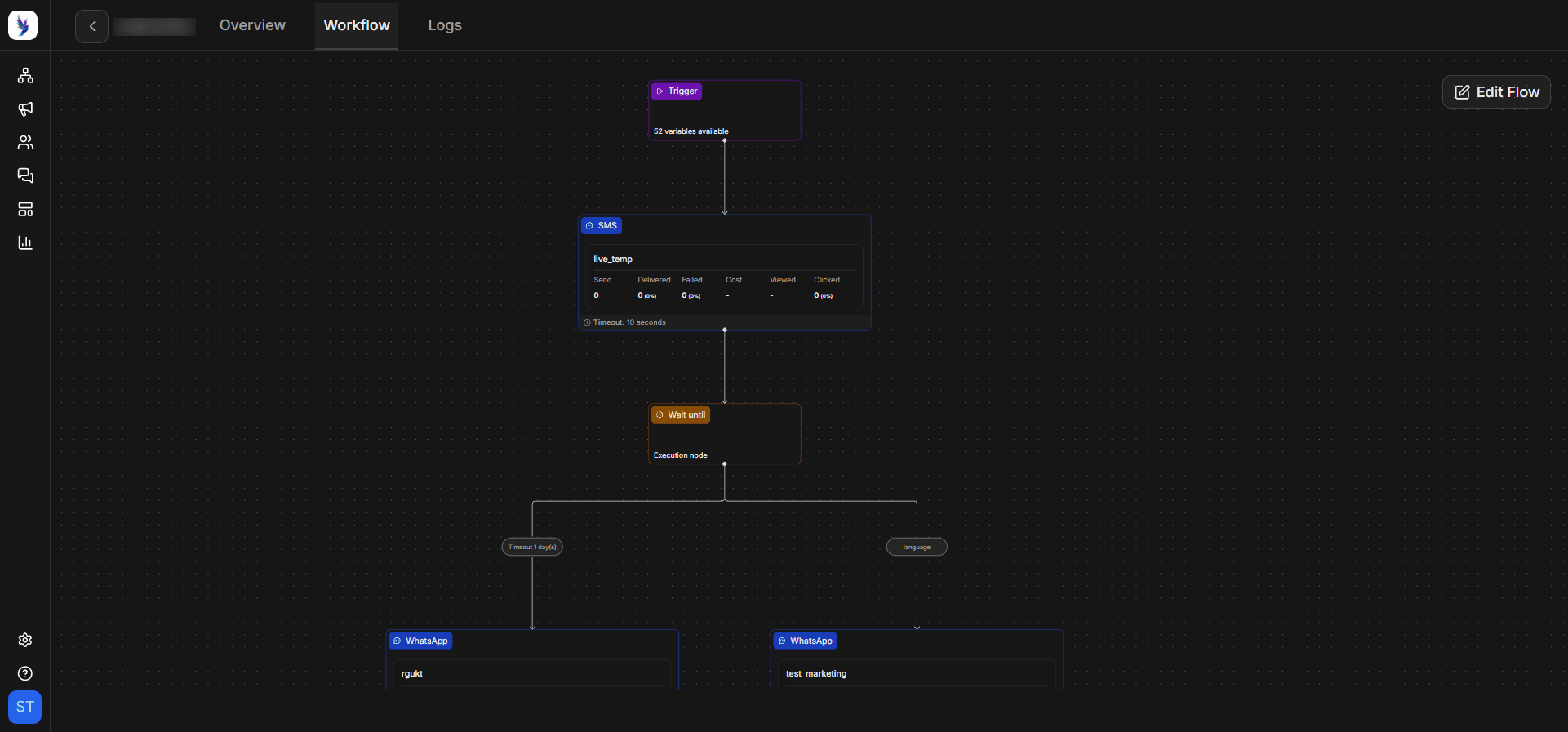
Real-time journey automation
The difference between a basic marketing automation tool and a customer engagement platform often comes down to one technical capability, how quickly the platform can react to a customer event.
A platform that processes events in batches cannot trigger a cart abandonment message 15 minutes after the customer leaves the checkout page. Platforms that process events in batches are fundamentally limited to calendar-driven communication.
True event-driven automation means that when a customer event fires, the platform responds at the right moment. That responsiveness is what makes behavioral triggers commercially effective.
This is particularly important for e-commerce as the 15 to 30-minute window after cart abandonment is when recovery messages work. A right WhatsApp cart recovery message with the full list of items and tailored offer can quickly convert an abandonment into a customer.
Evaluate this feature by asking vendors to demonstrate live triggers in their platform. Ask what the latency is between an event being sent and a message being triggered.
Also ask how the platform handles event ordering, when multiple events fire simultaneously. Does the platform suppress redundant messages or send them all? The answer to these questions reveal how sophisticated the automation actually is under the hood.
Unified customer data layer
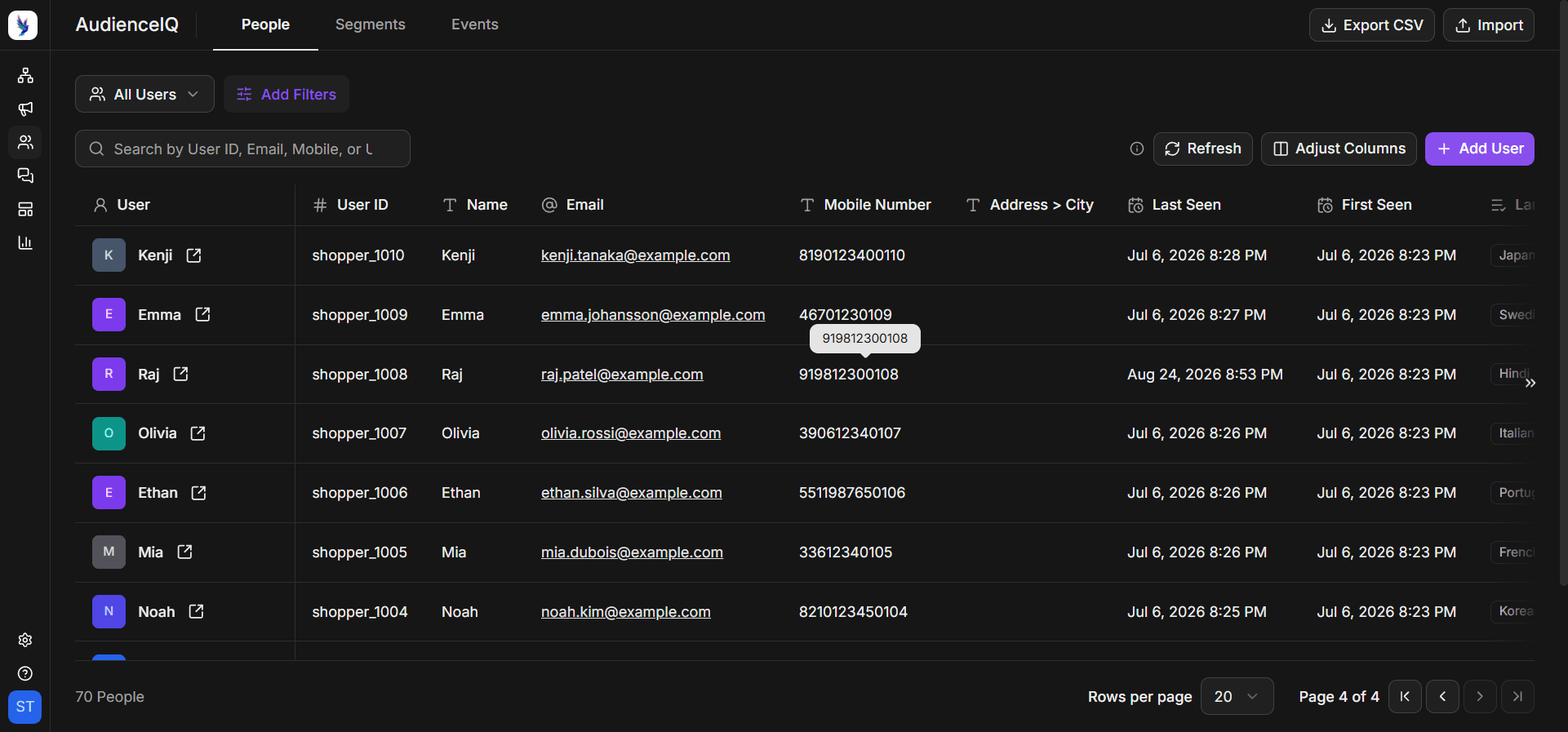
The quality of personalization a platform can produce is directly limited by the richness of the customer data it can access. A platform that can only see the stored data, without syncing to your e-commerce platform or CRM, will personalize messages based on an incomplete picture of each customer.
What you need to look for is a platform with flexible data ingestion across multiple sources to receive customer events and profile updates. It can be done via API, webhook, SDK, or native integration and reflect those updates in customer profiles in real time.
Additionally, first-party data management is also increasingly important as third-party tracking becomes more restricted. An engagement solution that relies heavily on tracking pixels and third-party cookies for behavioral data will see its personalization capability degrade over time as browser privacy policies tighten.
Platforms built around server-side event tracking and first-party identifiers (customer IDs, email addresses, phone numbers) are more durable as the privacy landscape evolves. This is one of the less visible but commercially important architectural differences between platforms in the market today.
AI-powered campaign personalization
AI in customer engagement platforms ranges from useful to largely cosmetic. The genuinely useful applications are:
- Send-time optimization - determining the best moment to send a message to each individual based on their historical engagement patterns
- Channel selection - choosing which channel is most likely to produce a response for each customer based on their behavior or availability
- Content personalization - dynamically selecting which product recommendations, subject line variant, or message content to show each recipient
- Predictive segmentation - identifying customers likely to churn, convert, or respond before the behavior happens
The cosmetic applications are features that market as AI but are actually rule-based. For example, AI subject line tools that just A/B test variations or AI segmentation that applies fixed behavioral rules.
Understanding the difference here matters because cosmetic AI doesn't improve performance meaningfully over a well-designed manual approach, while real machine learning-based optimization compounds over time as the model learns from more data.
When evaluating AI personalization features in a platform, ask the vendor to explain the model behind their AI recommendations. Asking questions like:
- What data does it train on?
- How frequently does it update?
- How does it handle cold-start scenarios for new customers with no history?
- Can you see and understand what the AI is doing or is it a black box?
Transparency in AI recommendations are critical for marketing campaigns as you need to trust what the platform is doing on your behalf when you are not looking.
Ask Us How the AI Works.
Bring your toughest AI questions to a personalized Zixflow walkthrough.
Book a DemoSegmentation & and audience management
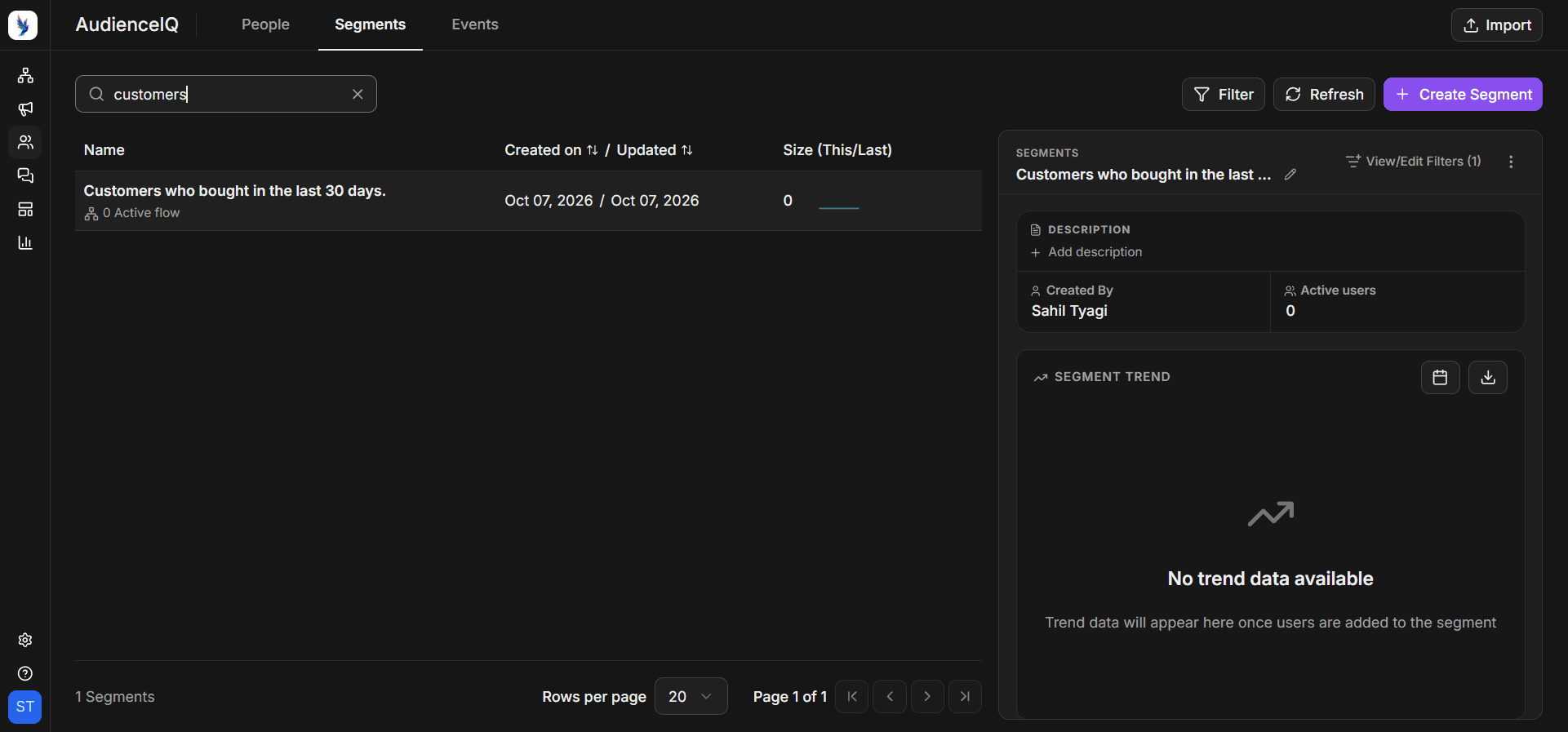
Segmentation is where the logic of your engagement program lives. The platform you choose has to give you the ability to create audiences based on any combination of customer attributes or custom filters that you consider important for your effective engagement.
Dynamic, real-time segmentation is the feature that enables lifecycle marketing at scale. When your segments update continuously, your campaigns always go to the right people.
The difference between a dynamic segment and a static one is the difference between a program that runs itself and one that requires constant manual upkeep to stay accurate.
Moreover, evaluate the granularity of segmentation available. Behavioral segmentation like "customers who clicked a specific product category link" requires the platform to track and store event-level behavioral data. The more granular the segmentation capability, the more precisely you can match a message to a behavioral moment.
Effective integration stack
A customer engagement platform is only as powerful as the data it can access. A platform with sophisticated automation that can only see the data stored within it will produce campaigns that miss context visible in external tools.
Integration depth is the feature that determines whether the platform will actually behave intelligently based on your full customer picture.
Evaluate integrations across three categories.
- Data ingestion - can the platform receive customer data from your CRM, e-commerce platform, data warehouse, and any other systems where customer information lives?
- Conditional triggers - can events from external systems trigger automated messages in the platform without requiring manual exports?
- Data export - can the platform push engagement data back to your CRM and analytics tools so that those systems also have a complete picture of each customer's communication history?
The quality of native integrations varies significantly across platforms. Some have deep, maintained integrations with common e-commerce platforms that require minimal setup and work reliably at scale. Others have integrations that technically work but require significant custom development to handle edge cases or real-time sync requirements.
Before making a platform decision, test the specific integrations you need in a sandbox environment rather than deciding first and then checking whether the platform is compatible with your existing tech stack.
Compliance and security
Data privacy is no longer a legal afterthought for customer engagement programs. Regulations including GDPR, India's DPDP, and regional data protection laws impose specific requirements on how customer data is collected, stored, processed, and used for marketing communications.
A platform that doesn't support this kind of in-depth consent management and data deletion requests creates compliance risk that grows with every customer added to the system.
Some of the the certifications that you should verify are:
- SOC 2 Type II (covers data security controls)
- ISO 27001 (information security management)
- GDPR compliance documentation (including data processing agreements and data residency options)
Ask specifically about where customer data is stored and whether the platform supports data residency requirements for your markets. For businesses operating across multiple countries, the ability to store data in specific geographic regions is often a legal requirement.
Consent management is the compliance feature most frequently overlooked in platform evaluations. A platform needs to be able to track which channels each customer has consented to receive communications on to honor opt-out requests across all channels simultaneously.
Analytics capabilities
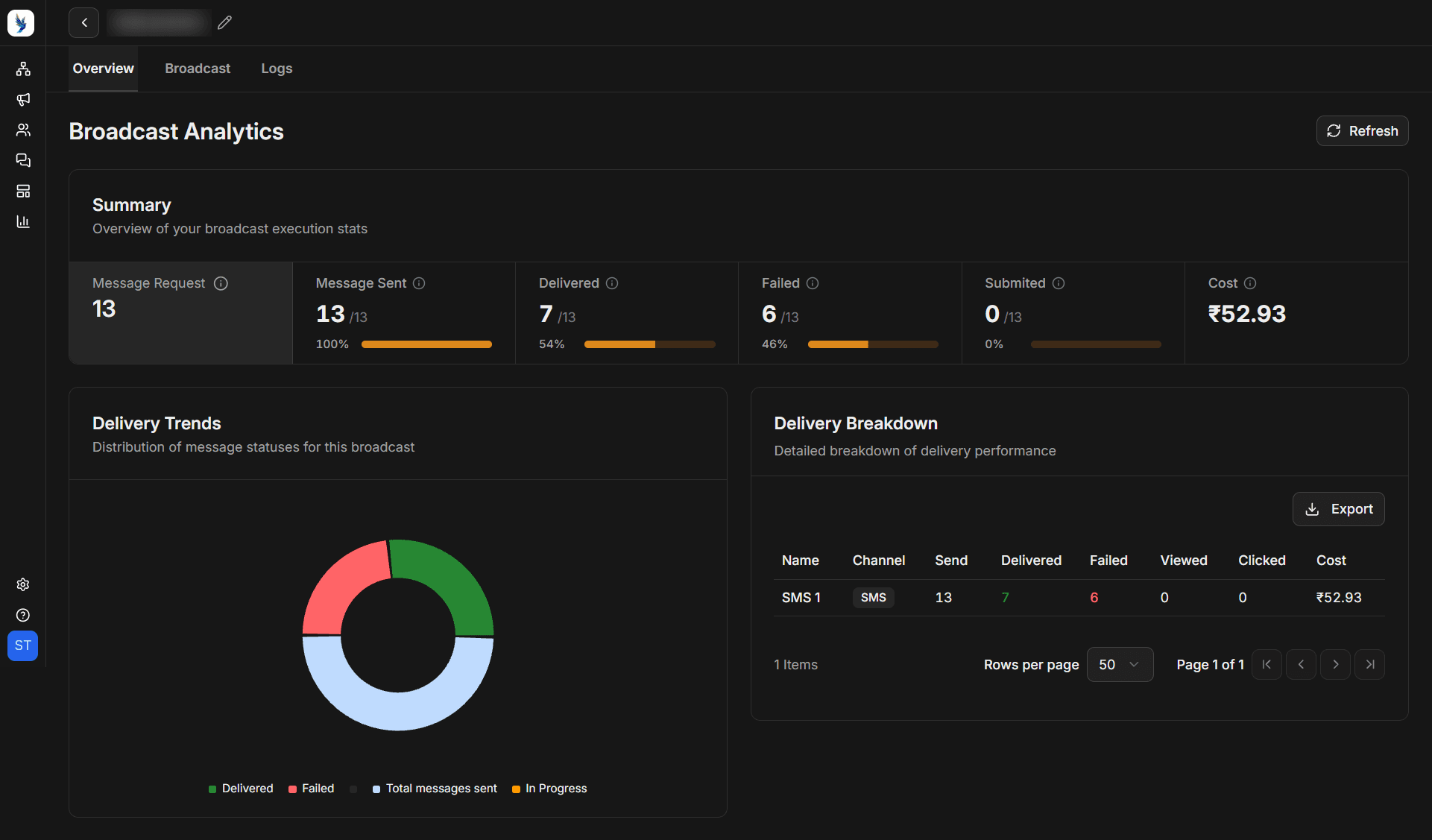
The reporting capability of an engagement solution determines how well you can understand and improve your engagement program over time. There are two levels of analytics to evaluate.
The first is campaign-level reporting, including open rates, click rates, conversion rates, and revenue attribution for individual campaigns and flows. This tells you what each specific message is producing commercially.
The second level is program-level reporting, consisting of cohort analysis that tracks how groups of customers acquired in different periods behave over time, lifecycle stage movement that shows how customers flow between segments, and engagement health metrics that indicate whether your overall customer base is becoming more or less engaged quarter over quarter.
This level of reporting is what connects your engagement program to the business metrics that matter. Connecting your engagement program to your e-commerce metrics and KPIs framework requires attribution that accurately reflects the full journey from first touch to purchase.
Total cost of ownership
Platform subscription cost is often the smallest component of the total cost of owning a customer engagement platform. Implementation, data migration, technical integration, team training, and ongoing administration can collectively exceed the first year of platform fees for complex deployments. Evaluating platforms on subscription cost alone is one of the most common mistakes you can make in the buying process.
Total cost of ownership usually has following components:
- The platform fee itself
- Implementation cost
- Training
- Ongoing administration
- Partner or agency support if required
A platform that takes six months to implement and another three to get the team proficient has nine months of zero ROI before the investment starts paying back.
Lastly, when comparing pricing models, look for pricing structures that scale predictably as your business grows. Some platforms charge per active contact, while others charge per message sent.
A good way to understand the cost is to ask the vendors for a 12-month cost model based on your current contact volume and expected growth rate. Ask explicitly what happens to the cost when you add a new channel or double your message volume. That conversation usually reveals the true cost structure more clearly than the pricing page does.
Know the Real Engagement Cost.
Talk to our sales experts to determine how your costs would scale as your volume grows.
Get in TouchQuestions to ask before you sign for a customer engagement platform
With that said, here are the questions that separate good vendor conversations from great ones. These are the questions that go beyond the demo and reveal how the platform actually performs in production:
Can you show me a customer with needs like mine?
Every vendor has a marquee customer list. What's more useful is asking to speak about a reference customer who is a similar size, in a similar vertical, using the platform for similar use cases.
Ask the vendor about similar customers who use their platform for matching requirements. If the vendor struggles to produce them, that's a signal that their most relevant customers are few. A vendor with genuinely successful customers in your segment will be on the ready to tell you about the core problems that they solve.
What does implementation look like for a business like mine?
Ask the vendor to walk you through a realistic implementation timeline for your specific setup, listing all your current data sources, your existing integrations, and your team's technical capacity. Ask how many hours of engineering time will be required and whether there's a dedicated implementation team or a self-serve setup process.
The honest answer to this question should include caveats about data quality. The most common reason implementations take longer than projected is not the platform's complexity, it's the customer's data.
Inconsistent identifiers across systems, missing behavioral event tracking, consent records that don't cover the channels the business wants to use, and CRM data that needs cleaning before it can be imported. A vendor who doesn't ask about your data readiness before quoting an implementation timeline is probably quoting the best-case scenario.
How does your roadmap address the direction our engagement program is moving?
A customer engagement platform is a multi-year investment. The features you need today may not be the features that matter most in 18 months. Asking about the vendor's roadmap isn't about predicting the future, it's about understanding whether the platform's direction aligns with yours.
If you know your engagement program will expand to include WhatsApp commerce, ask whether the platform is investing in WhatsApp capabilities. If compliance requirements in your markets are likely to get stricter, ask how the vendor approaches regulatory changes in their product development.
A vendor with a transparent roadmap and a history of shipping features on time is a better long-term partner. A platform that's technically good today but whose development velocity is slowing will fall behind competitors whose teams are shipping faster.
Choosing the right customer engagement platform for your business
Selecting a customer engagement platform is one of the higher-stakes software decisions you can make for your business, because the platform shapes how you communicate with customers across the full lifecycle.
This guide has covered what the category actually means along with the questions to ask vendors before signing turn a good evaluation into a great one. Time spent in due diligence before deciding saves a disproportionate amount of time and cost after.
Start your evaluation with the features most critical to your highest-priority use cases. Focus the evaluation on what matters most to your specific business rather than trying to score every platform on every possible feature.
That said, if you're looking for a customer engagement platform built for businesses that want to leverage AI functionalities across multiple channels, Zixflow is the solution designed to provide next-level engagement capabilities.
You can talk to our experts to see how Zixflow can elevate your customer engagement efforts.
Frequently asked questions about choosing a customer engagement platform
What is a customer engagement platform?
A customer engagement platform is software that enables businesses to orchestrate personalized, cross-channel communication with customers based on customer actions and past interactions. It coordinates messages across email, SMS, WhatsApp, push notifications, and other channels from a single system, using customer data to determine the best messages that match their interests.
What is the typical cost of a customer engagement platform?
Platform subscription costs vary widely based on contact volume, message volume, and feature set. It ranges from a few hundred dollars per month for small businesses on entry-level plans to tens of thousands per month for enterprise deployments.
More important than the subscription cost is total cost of ownership, which includes implementation, integration work, training, ongoing administration, and any partner or agency support required.
How long does it take to implement a customer engagement platform?
Implementation timelines range from a few weeks for simple setups with clean data and standard integrations to several months for complex deployments.
The most common cause of implementation delays are inconsistent customer identifiers, missing event tracking, and CRM data that needs cleaning before import. Always ask vendors for an implementation estimate based on your specific data setup and integration requirements.
What is the difference between omnichannel and multi-channel engagement platforms?
A multi-channel platform sends messages on multiple channels separately, without coordinating what happens across those channels. An omnichannel platform coordinates communication across channels from a single customer profile. True omnichannel requires a shared customer data layer and real-time coordination between channels.
Do I need a customer engagement platform if I already have a CRM?
Possibly yes. A CRM without an engagement layer gives you customer data but no automated way to act on it. If you are manually importing contacts into campaign tools, sending the same broadcast messages, or unable to trigger behavioral messages based on real-time customer events, you likely need a customer engagement platform in addition to your CRM.
What questions should I ask when evaluating customer engagement platforms?
The three most important questions to ask vendors are:
- Can you describe a client with similar engagement needs with the same in size, vertical, and use case to our business?
- What does implementation actually look like for our specific data setup and integrations, including realistic timelines and engineering hours required?
- How does your product roadmap address where our engagement program is heading over the next 18 to 24 months?
These questions go beyond the demo and reveal how the platform actually performs in production and whether the vendor is a reliable long-term partner.