How AI Personalization Actually Works?
AI personalization uses customer data and behavior to tailor content and experiences to each person based on their interests and actions.
 by Sahil Tyagi
AI personalization uses machine learning models and behavioral data to make a distinct decision for every individual customer to determine what to send, on which channel, and when, based on each person's specific context and history.
Building an AI personalization system has multiple layers:
- Data collection (behavioral, transactional, contextual, and engagement data unified into a first-party dataset)
- Identity resolution across touchpoints using a CDP to connect fragmented signals into one profile
- Predictive modeling to anticipate purchase likelihood
- Churn probability and optimal channel
- Real-time decision-making triggered by customer events rather than scheduled sends
- Content optimization where the AI simultaneously selects the channel, subject line, and product recommendation
Many marketers know that personalization works but not the underlying concept behind it. You're sending product recommendations based on the last thing someone bought, or first-name subject lines on batch campaigns, and calling it personalized.
That's not personalization. That's segmentation with extra steps.
Personalization has been a marketing priority for years, but the AI layer is what makes it viable at scale. 56% of brands now use AI to tailor customer experiences, and 75% of those brands report increased customer spending as a direct result. Plus, the customers who receive personalized experiences now actively notice when they don't.
With that said, in this blog, I’ll break down how AI personalization works under the hood, including the data it uses, the models that drive decisions, the channels it operates across, and how you can put it to work.
What is AI personalization?
AI personalization is the use of machine learning models along with behavioral data to deliver experiences that are uniquely relevant to each individual customer. Unlike manual segmentation, which assigns customers to predefined groups and sends the same message to everyone in that group, AI personalization makes a distinct decision for every customer based on their specific context.
The key distinction is scale and specificity. An AI model can maintain millions of individual profiles, each updated continuously as new behavior comes in. An AI system weighs hundreds of signals simultaneously and decides what to send and on which channel.
AI personalization sits at the intersection of customer engagement and behavioral science. It's the mechanism by which platforms like Netflix serve 76,897 distinct micro-genre categories rather than a single recommendation list.
Why does AI personalization drive real results?
The performance change between personalized and non-personalized campaigns is measurable and large enough to affect your bottom line. That said, here are the outcomes that matter most:
Significant revenue lift
Personalization directly lifts top-line revenue by getting the right offer in front of the right customer at the right moment. When customers see products or content that actually match their preferences, they buy more often and spend more per transaction.
The McKinsey data on this is consistent across industries, companies that get personalization right generate 40% more revenue from those efforts than companies still running batch campaigns. At scale, that's not a marginal gain. It compounds across every campaign and every customer segment.
Higher conversion rates
AI-triggered behavioral messages consistently outperform static campaigns because they arrive when a customer's intent is highest. For example, triggered behavioral emails sent within 60 minutes of a customer action achieve 11.4x higher transaction rates than standard promotional emails.
On channels like WhatsApp, the same principle holds because customers who receive a personalized follow-up within five minutes of showing interest convert at dramatically higher rates than those who receive a message hours later.
Better customer retention
It’s not a mystery that customers who feel understood stay longer. Customers who receive generic outreach, especially at the wrong frequency or on the wrong channel, churn. AI personalization addresses both sides of this by increasing the relevance of communications and reducing the noise that drives customers to disengage.
Effective customer engagement models show that customers who receive personalized lifecycle communications have materially lower churn rates than those on standard batch campaigns.
The AI's ability to detect early churn signals and respond with a relevant intervention before a customer leaves is one of its most underestimated aspects.
Improved engagement across channels
Personalization doesn't just change what you say but also where and when you say it. An AI model knows a customer consistently opens WhatsApp messages on weekdays and rarely engages with email.
These details are measurable through customer engagement metrics like click-through rate, response rate, and time-to-conversion, all of which improve when a message arrives on the channel a customer actually uses.
How can you implement an AI personalization layer for your business?
Understanding the business case is one thing, but knowing the mechanics is what lets you build a system that actually works. AI personalization is a stack of interconnected layers, each dependent on the one below it. Here are the steps for building your AI personalization infrastructure:
Data collection for personalization decisions
Every AI personalization system runs on data, and the quality of that data determines the ceiling for everything that follows. The more signals the model has access to, the more granular its decisions will be.
The data AI personalization models typically use falls into four categories:
- Behavioral data: What a customer clicks, browses, searches, views, and ignores. This is the richest signal and updates in real time.
- Transactional data: Purchase history, order frequency, average order value, return rates, and subscription events. This tells the model what a customer has committed to.
- Contextual data: Device type, location, time of day, browser, referral source, and session context. These signals determine what type of message will land in that moment.
- Engagement data: Channel opens, reply rates, unsubscribes, WhatsApp message reads, and response latency. This is how the model learns which channels each customer actually uses.
The shift away from third-party cookies has made first-party data collection a core strategic priority. If you have already built a clean first-party data set from your channels, you are better positioned to run significantly better AI personalization initiatives than those still relying on borrowed data signals. This is worth prioritizing now, before you build the model layer on top of it.
Identity resolution across touchpoints
A customer might visit your website using any kind of device. Without identity resolution, these devices or channels are recorded as separate interactions.
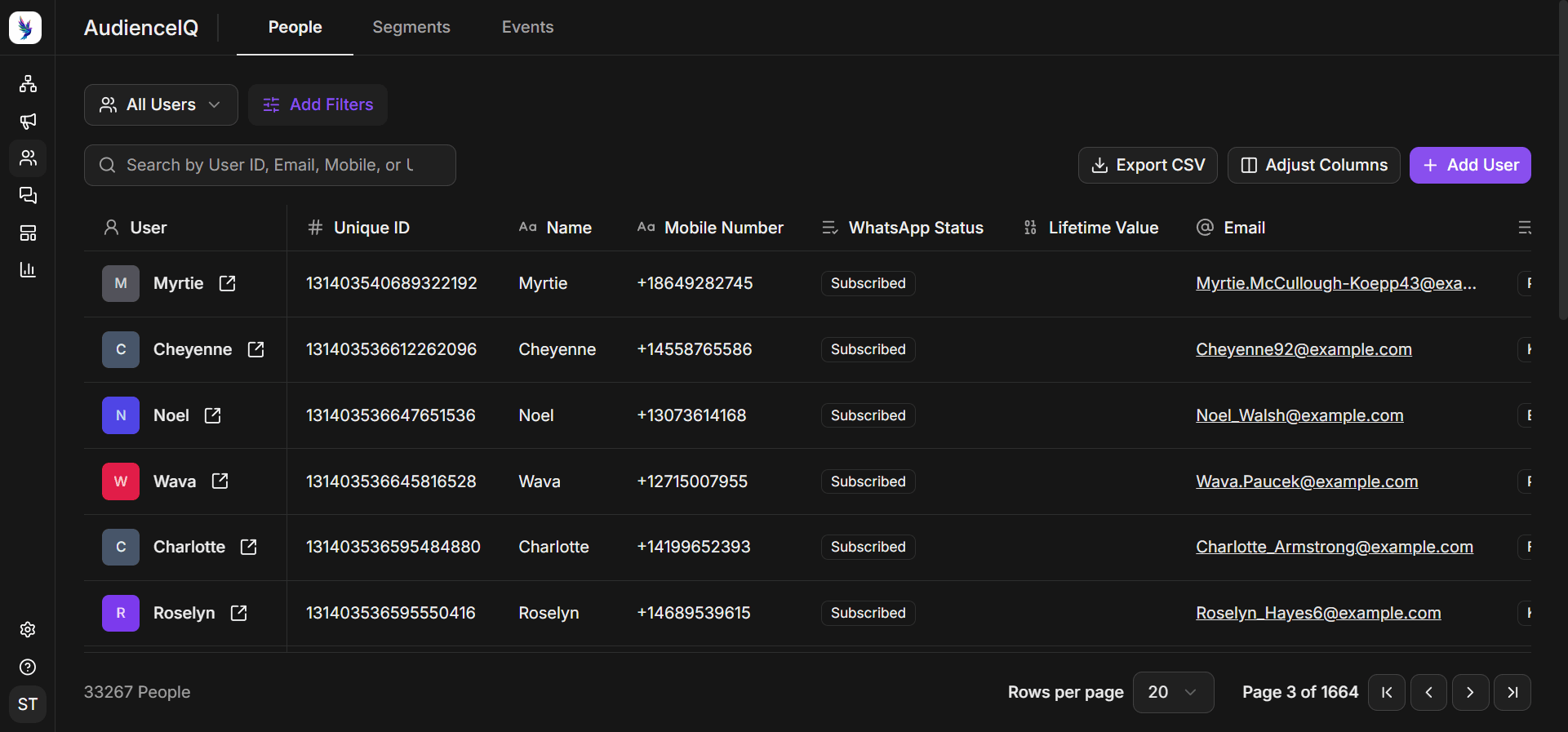
Identity resolution is the process of connecting all the signals from one real person into a single persistent profile. It includes all of their details, like email address, ph one number, or device ID. It's what allows a model to know that the person who browsed your pricing page three times is the same person who opened your WhatsApp message last Tuesday and hasn't yet converted.
A Customer Data Platform (CDP) is the most common tool for this. It ingests data from all your channels, resolves identities across touchpoints, and creates a unified customer record that the AI model can reason over.
If your data is siloed across multiple tools that you use, then this is the layer to invest in first. No model can personalize accurately from fragmented data.
Predictive modeling to anticipate next actions
Once you have unified customer data, the next layer is prediction. Rather than reacting to what a customer just did, AI personalization models are designed to anticipate what they're likely to do next and get ahead of it. Additionally, effective personalization systems requires reps who understand AI, making recruiting AI talent an important consideration for maintaining predictive models.
Predictive models in personalization typically work through two methods.
- Collaborative filtering asks: What did customers who behave similarly to this person end up doing?
- Content-based filtering asks: Based on what this specific customer has engaged with, what would they logically be interested in next?
Production systems typically combine both, with the outputs weighted by confidence and recency. In practice, these models are predicting a range of outcomes simultaneously:
- Purchase likelihood in the next 7 or 30 days
- Churn probability based on engagement trajectory
- Best channel for the next outreach
- Optimal send time based on historical response patterns
- Highest-value product or offer to surface next
This is also where the customer journey map becomes an AI input rather than just a strategy document. The model learns which journeys lead to conversion and which ones lead to churn. This allows it to adjust individual paths accordingly.
Real-time decision making
Batch personalization runs on a schedule. You update your segments, run your models, generate a list, and send on time. Real-time AI personalization runs at the moment of a trigger event and decides in milliseconds. These are fundamentally different systems that generate different results.
Real-time decision-making means that when a customer abandons their cart, the system doesn't wait for the next scheduled campaign. It fires the recovery message immediately.
The infrastructure for this is event-driven, based on the actions of your customers. For example, WhatsApp marketing automation is one of the most effective channels for real-time personalization because WhatsApp has near 100% open rates, and customers expect a response within minutes.
Channel selection and optimization
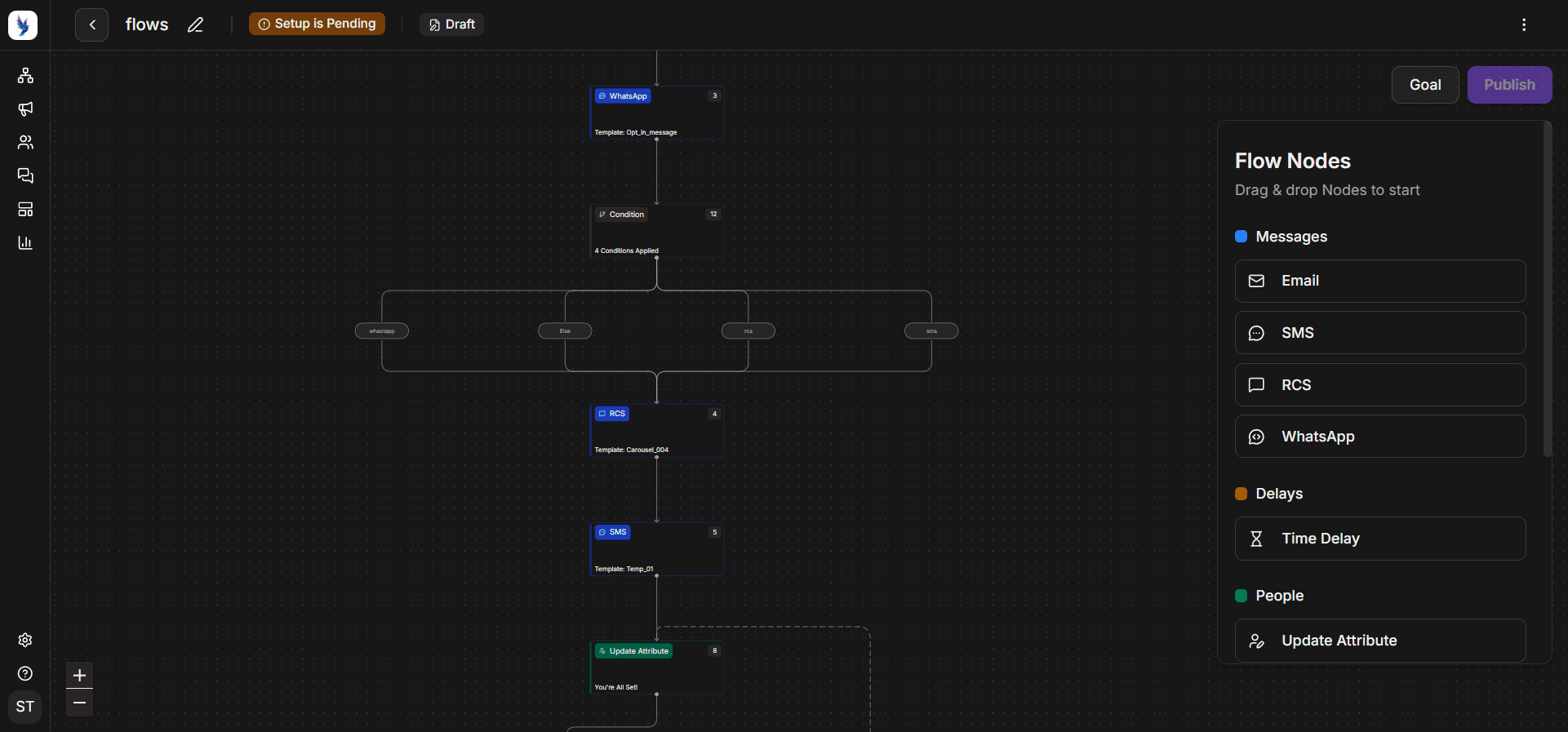
The channel a message is sent on is itself a personalization decision. A customer who hasn't opened an email in 90 days but reads every WhatsApp message within five minutes should not receive your next campaign by email. The AI model knows this because it's tracking channel-level engagement for every individual.
In addition to that, message content optimization runs in parallel. The model isn't just deciding the channel. It's also selecting which subject line, which CTA, which product visual, which offer tier, and what sequence of messages is most likely to result in conversion for this specific customer at this specific moment. In practice, this means:
- Subject lines are chosen from a set of tested variants based on individual open history
- Product recommendations are ranked by individual purchase probability, not category popularity
- Offer amounts are calibrated to what this customer has historically responded to
- Send time is predicted from the customer's own engagement time distribution, not a global best-send-time average
For teams tracking e-commerce metrics and KPIs, this layer is where the most measurable conversion gains show up. Revenue per recipient, click-through rate, and average order value all improve when message content and channel are optimized per individual rather than per segment.
Getting smarter with each interaction
Static personalization requires someone to update the rules when customer behavior changes. An AI personalization model updates itself.
This is the compounding property that makes AI personalization significantly more valuable over time. In the first month, the model is working from limited signals and making rougher decisions. After six months of live data, it has a much cleaner picture of each customer's preferences.
The practical implication is that AI personalization systems reward consistency. Teams that run their models continuously on live customer data outperform teams that run models sporadically or only before major campaigns.
The more interaction data flows through the system, the more accurate its decisions become. The faster it learns to detect changes in customer behavior before those shifts show up in your aggregate metrics.
Personalize your messaging with AI effectively
This article broke down how AI personalization actually functions. AI models use the data they run on and stitch fragmented touchpoints into unified profiles.
The most important thing to take away is the distinction between segmentation and AI personalization. AI personalization makes an individual decision for every customer. That difference doesn't just improve campaign metrics. It raises the ceiling for what your customer engagement strategy can produce.
For teams that want to move from segmentation to real AI personalization without building custom infrastructure, it's worth seeing what Zixflow can do out of the box. From behavioral triggers to channel routing to individualized journeys, Zixflow lets you manage it all from a single location. Start your free trial and see the difference in your first campaign.
Frequently asked questions about AI personalization
What is AI personalization in marketing?
AI personalization in marketing is the use of machine learning models and real-time behavioral data to deliver individualized messages and experiences to each customer. AI personalization makes a distinct decision for every customer based on their unique history and preferences.
How is AI personalization different from traditional segmentation?
Traditional segmentation puts customers into groups and sends the same message to all of them. AI personalization evaluates each customer individually. Segmentation scales to dozens of groups. AI personalization scales to millions of individual decisions.
What data does AI personalization use?
AI personalization typically draws on four types of data:
- Behavioral
- Transactional
- Contextual
- Engagement
The richest personalization systems unify all four into a single customer profile.
What is an AI personalization engine?
An AI personalization engine is the software layer that combines customer data, predictive models, and delivery logic to generate individualized decisions in real time. Zixflow's AudienceIQ and Journeys together function as a personalization engine for messaging channels.
Can small businesses use AI personalization?
Yes. Modern customer engagement platforms make AI personalization accessible without building custom ML infrastructure. Zixflow provides behavioral triggers and AI-powered channel routing to ensure messages are delivered 99% of the time.
A business with as few as 5,000 active customers can generate meaningful personalization lift from behavioral triggers and dynamic message content, all without a data science team.
What is the biggest risk of AI personalization?
The primary risk is using AI personalization in a way that feels invasive to customers. To handle this issue, you can use first-party data collected with consent, give customers control over their preferences, and make it easy to opt out of specific types of personalization.