What is a Customer Data Platform (CDP)?
A Customer Data Platform (CDP) unifies customer data from multiple sources to create unified profiles, improve personalization, and drive engagement.
 by Sahil Tyagi
A Customer Data Platform (CDP) is a single platform that gathers first-party customer data from various sources to create persistent customer profiles that can be accessed by marketing, analytics, and personalization tools in near real time.
CDPs are not like CRMs, which manage customer relationships. CDPs are designed to provide a single, authoritative view of every customer based on their real-time interactions and transactions.
Since third-party cookies are losing their influence, it is more crucial than ever to have a robust first-party data strategy and to understand if it's suitable for a CDP or not, for long-term customer engagement and growth.
Most CDP projects don't fail because the technology doesn't work. They fail because the business that bought the platform wasn't ready for it. The data was messier than expected, the team didn't have bandwidth to act on segments, or no one had defined a clear use case before signing the contract.
The technology is genuinely capable. The gap is almost always between execution and realistic expectations. The global CDP market was valued at $3.5 billion in 2023 and is projected to grow at a CAGR of 27.8% to 2033, according to Grand View Research.
That growth reflects real demand from businesses that have hit the ceiling of what disconnected data tools can do. But adoption numbers don't capture how many of those implementations actually deliver on their promise.
This is exactly why this guide covers not just what a customer data platform is, but whether your business is ready for one. Here, we'll break down how a CDP works, the real benefits it delivers when deployed correctly, practical strategies for getting value from one, and the specific signs that tell you whether you need a CDP right now or whether a simpler solution will serve you better.
What is a Customer Data Platform (CDP)?
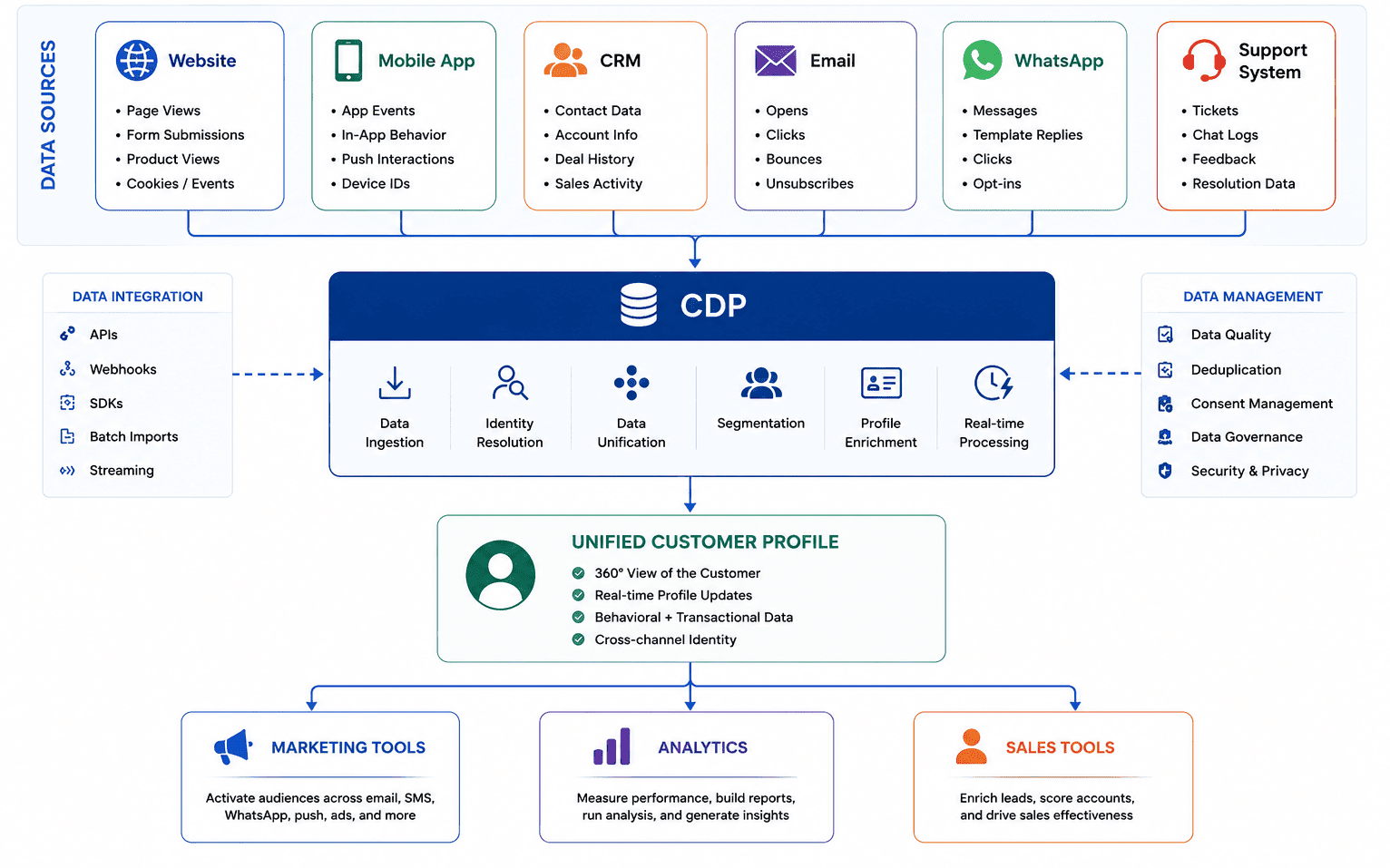
A customer data platform (CDP) is a software system that collects first-party customer data from multiple sources, resolves individual customer identities across channels, builds persistent unified customer profiles, and makes those profiles accessible to other marketing and analytics tools in real-time.
It is designed to be operated directly by marketing teams, without requiring ongoing support from data engineers.
The core capability that defines a CDP is identity resolution at scale. Your customers interact with your brand across various sources, including your website, mobile app, WhatsApp campaigns, email broadcasts, offline transactions, and support channels. Each of these interactions generates data, and without a CDP, this information lives in separate systems.
A CDP links every touchpoint to a single persistent profile per individual, updating continuously as new behavioral, transactional, and engagement data arrives.
What separates a CDP from a data warehouse is who it's built for.
A data warehouse holds the same information, but accessing it requires SQL and a data team. A CDP surfaces that same data through a marketer-accessible interface with built-in audience segmentation and native connectors. It pushes prospects directly to relevant outreach channels without a data request and a two-day wait.
CDP vs. CRM: What's the difference?
A CDP collects first-party behavioral and transactional data across every touchpoint, links it to known individual identities, and builds accurate profiles that persist over the customer's entire lifecycle.
It is built for activation, taking unified customer data and routing it to the right execution tool at the right moment. A CDP doesn't replace your CRM; it feeds it with richer behavioral context so your entire stack performs better.
A CRM (Customer Relationship Management system) manages known customer relationships and sales pipeline data. It is primarily updated manually by teams and records what your team did with a customer, not what the customer did independently. It won't capture:
- How did a prospect behave on your pricing page?
- How did they respond to a WhatsApp campaign?
- Whether their product usage has dropped over the past two weeks
CRMs are built around your team's actions, while CDPs are built around the customers’.
| Aspect | Customer Data Platform (CDP) | Customer Relationship Management (CRM) |
|---|---|---|
| Primary Purpose | Unifies customer data from multiple sources and activates it for personalized outreach | Manages customer relationships, sales activities, and account interactions. |
| Focus | Customer behavior and engagement across all channels | Sales pipeline, customer communications, and relationship management |
| Data Type | First-party behavioral, transactional, and engagement data | Contact information, sales records, notes, tasks, and deal history |
| Data Collection | Automatically collects data from websites, apps, email, WhatsApp, support systems, and more | Mostly relies on manual updates from sales and support teams, though some automation exists |
| Customer Profiles | Creates unified, persistent customer profiles by combining data from multiple touchpoints | Stores customer and account records based on known contacts |
| Identity Resolution | Matches interactions across devices and channels to a single customer profile | Limited identity resolution capabilities |
| Real-Time Updates | Continuously updates profiles as customer actions occur | Updates primarily when team members or integrated systems add information |
| Marketing Activation | Sends customer segments to email, SMS, WhatsApp, advertising, and personalization platforms | Supports customer communication but is not designed as a central activation layer |
| Typical Users | Marketing, growth, customer success, and analytics teams | Sales, account management, and customer support teams |
| Best For | Personalization, omnichannel marketing, lifecycle campaigns, and customer intelligence. | Managing leads, opportunities, customer accounts, and sales processes. |
| Relationship | Often feeds enriched customer insights into the CRM. | Often consumes customer insights generated by the CDP. |
Why does a CDP matter for your business?
A unified view of every customer
Data fragmentation is the root cause of most personalization failures in growing businesses. When customer data is spread across 5 to 15 disconnected tools, every team works with an incomplete picture, and no one has the full story.
Your email platform sees campaigns open. Your website analytics sees page views. Your CRM holds support tickets. None of those systems knows what the others captured, so your marketing decisions are based on whichever fragment of the customer's journey your current tool can see.
A CDP resolves those identities into one persistent profile per customer, giving every team access to the same accurate, complete view. According to McKinsey, companies that personalize effectively using unified customer data generate 40% more revenue than competitors who don't. That personalization starts with a complete view, which is exactly what a CDP creates.
One thing to keep in mind is that the personalization depends entirely on the quality of data going into the CDP. If your current systems have duplicate records, inconsistent email formats, or poorly instrumented event tracking, the CDP won't create a unified view.
It will instead unify the mess.
Auditing upstream data sources is not an optional pre-step. It's what determines whether the platform delivers on its promise or not.
Better audience segmentation
Unified profiles transform what's possible with audience segmentation. Instead of grouping customers based on what one platform can see, you can build segments that combine behavioral signals and engagement patterns across every channel simultaneously.
For example, you can create a segment of customers who visited the pricing page three or more times in the past 14 days, have not started a trial, and whose last WhatsApp message went unread.
According to Deloitte, 80% of participating consumers prefer companies that offer personalized experiences and are willing to spend 50% extra with these brands. Behavioral segmentation built on unified CDP data is the operational infrastructure that makes that relevance achievable at scale.
Real-time personalization across every channel
Personalization only converts when it's timely. A re-engagement message sent within 10 minutes of a cart abandonment consistently outperforms one sent 24 hours later.
Without a CDP feeding real-time signals to your execution layer, you're personalizing based on yesterday's data at best, and your messages arrive out of sync with where the customer actually is in their journey.
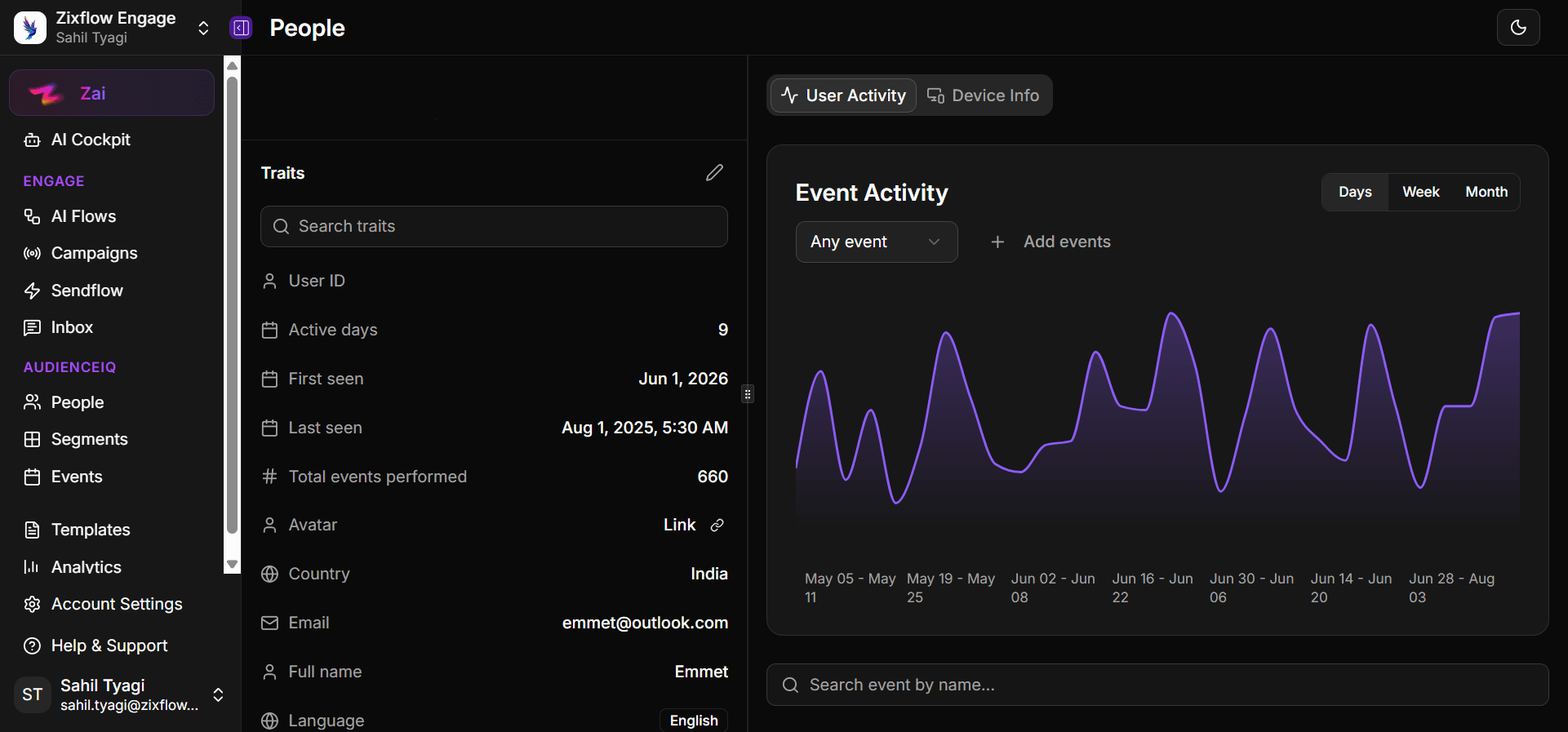
A CDP enables event-driven triggers that fire across channels simultaneously. The moment a defined customer action occurs, the platform updates the profile, understands the current stage, and pushes the update to trigger a coordinated response across the preferred channel.
Note - Real-time triggers only work if your CDP comes with messaging capability or your downstream messaging tools are connected to it. If your execution platform receives a segment update but has no active flow ready to fire, it fires into nothing. Zixflow provides omnichannel messaging workflow design to ensure that prospects receive the most relevant message at the right time so they can act on it effectively.
Reduced workloads on your teams
Without a CDP, your data engineering team spends a disproportionate share of their time writing one-off integrations, maintaining pipelines, and fielding segmentation requests from marketing.
A CDP moves data access to marketing through a no-code or low-code interface with pre-built connectors to the tools your team already runs, freeing engineering bandwidth for higher-value work.
The nuance most brands don't emphasize is that a CDP increases your data operations burden significantly during implementation only. The lowered workload comes after that initial investment, typically 3 to 6 months in, once the platform is stable. Plan for this, and don't treat implementation as a project your marketing team can own alone.
How to use a CDP to drive business growth?
Unify customer identities across all the touchpoints
Identity resolution is the foundational use case of any CDP. It is the process of connecting anonymous web sessions to known users, linking mobile app activity to email addresses, and tying offline transactions to online profiles so that every channel's data describes the same individual.
Most customer journeys today span multiple devices, multiple sessions, and multiple channels. A user might first encounter your brand through a paid ad on mobile, research the product on desktop, receive a WhatsApp follow-up, and convert three days later through a direct visit. Without identity resolution, those four interactions appear to belong to four different reps.
The most effective starting approach is instrumenting your website and mobile app with the CDP's tracking to capture behavioral events in real-time. To do that, you can connect server-side API calls for transactional events like purchases and subscription activations.
You can also configure identity resolution rules that match anonymous events to known users through email addresses, phone numbers, or logged-in user IDs, then verify the output by looking up known customers in the CDP. This way, you can confirm that all expected data sources appear in their unified profiles before building any campaigns on top of them.
Businesses with significant offline activity typically discover their largest customer understanding gaps here, because their digital teams have never had visibility into purchase behavior that happened off a screen.
Build high-precision behavioral segments
Behavioral segmentation uses the customer profiles in your CDP to group them based on combinations of actions, engagement patterns, and transactional signals rather than static demographic attributes. The result is audiences that reflect actual intent rather than assumed characteristics.
A behavioral segment describes intent. For example, a user who has visited your website four times in the past 21 days, completed an onboarding flow, but hasn't activated a paid plan, is clearly in active consideration mode. No demographic filter produces that signal with comparable precision.
The higher your segment accuracy, the more closely your messages match what a customer actually needs at that moment.
The best way to take advantage of a CDP for this is to analyze your highest-converting customers backward to identify which behavioral patterns consistently preceded their conversion. Common signals include:
- Repeat visits to pricing or comparison pages
- Completion of product tours
- High open rates on specific email content types
- Click-through patterns on marketing efforts like customer engagement campaigns are tied to specific product categories
Use those patterns to define your highest-intent segment. You also need a corresponding suppression segment for customers who have already converted, so acquisition messaging never reaches active subscribers.
A thing to take into account that many brands miss is building too many segments before validating any of them. Start with three to five customer segments tied to clearly defined campaigns. Have visible proof that those segments drive measurable results before expanding.
Orchestrate real-time omnichannel customer journeys
A customer's decision-making process doesn't follow a single channel, and it doesn't respect your campaign calendar.
Without a shared real-time data source feeding all of your channels, each platform sends messages based on an incomplete picture of the customer. The result is fragmented, sometimes contradictory messaging.
A CDP fixes this by orchestrating an omnichannel customer engagement journey, where the platform acts as an intelligence layer that determines when a customer should receive a message, on which channel, and with what content.
The best way to go about this is to begin by mapping your single highest-value customer journey, typically the path from free trial to paid conversion, and defining the triggers at each decision point that should initiate a message.
Using these triggers, set up an omnichannel outreach workflow that triggers the right message that reaches customers within minutes on the appropriate channel.
Predict and prevent customer churn
Churn rarely happens suddenly. In most subscription and retention-dependent businesses, customers who are about to leave show measurable warning signals for 2 to 4 weeks before they cancel. Without a CDP monitoring those signals in real-time, you won't know a customer is at risk until they've already left.
So, start by evaluating the behavioral history of customers who churned in the previous 12 months to identify which combinations of signals most reliably preceded their departure. Common leading indicators could include factors like:
- A 50% or greater drop in login frequency over a rolling 14-day window
- Two or more consecutive unread messages across any channel
- Zero usage of core features for 7 or more consecutive days
Utilize these indicators to build a dynamic "churn risk" segment that populates automatically as customers cross the threshold, then connect that segment to a dedicated re-engagement sequence that triggers personalized outreach within minutes of a customer entering that risk state.
The signals that predict churn vary by business type, price point, and customer segment. Your first evaluation will generate some false positives and miss some genuine churners.
Plan for two to three iterations over the first six months and add new indicators as you gather data. A churn model is not a one-time configuration; it is a living model that improves with each update.
Enable lifecycle marketing at scale
Lifecycle marketing uses your CDP to automatically identify where every customer is in their journey with your brand without requiring your team to manually maintain separate audience lists for each stage of the sales pipeline.
Effective lifecycle marketing requires knowing where each customer is at any given moment. For example, a customer who purchased 6 months ago and went silent looks identical to a new prospect in a single-channel view.
But your CDP contains the complete history of that customer, including what they bought, when they last engaged, which messages they responded to, and whether their engagement is trending up or down. That history enables genuinely relevant messaging rather than a one-size campaign sent to your entire list.
To implement a lifecycle marketing strategy, start by defining the lifecycle stages specific to your business model and events that trigger messaging to nudge prospects forward. For a SaaS business, that typically means:
Prospect → Free Trial User → Newly Activated Paid Customer → Power User → At-Risk Subscriber → Lapsed Customer → Reactivated Customer.
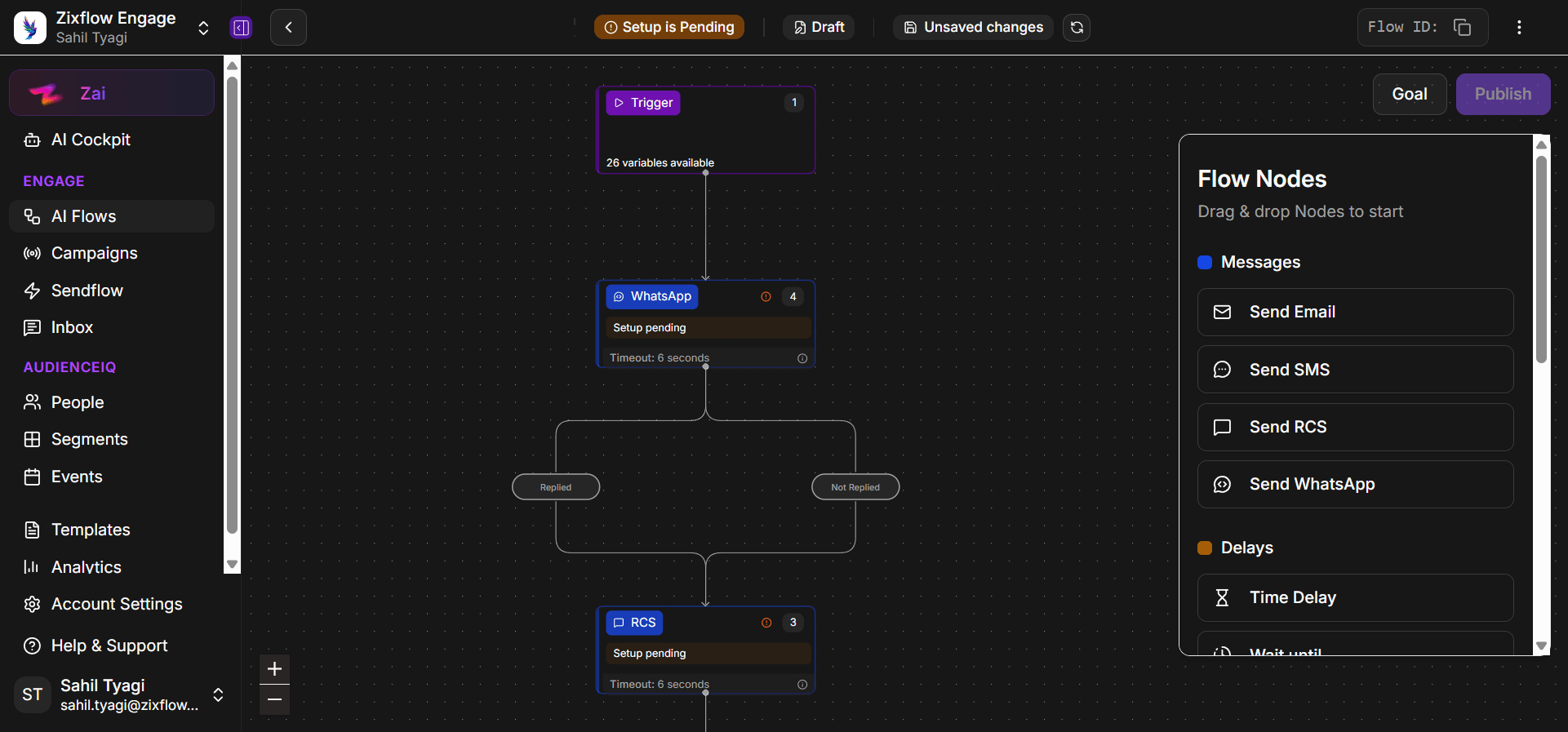
Map specific events to each transition, then design suitable messaging workflows using a customer engagement platforms like Zixflow to send marketing messages automatically.
Ready to act on your customer data?
A CDP gives you the unified data foundation. Pair that with an execution layer, and you can act on it across every channel that your customers prefer.
Most CDPs nowadays come with marketing capabilities to let you streamline your customer engagement. Zixflow, for example, allows you to trigger personalized WhatsApp, SMS, email, and RCS campaigns based on real-time actions, all from a single platform.
Book a demo to see how Zixflow works to help you convert unified customer data into measurable revenue. Or explore our guide on customer engagement automation to see how you can set up automated sequences to put your data to work.
Frequently asked questions about the customer data platform
What is a customer data platform (CDP)?
A customer data platform is a software system that collects customer data from multiple sources, including websites, mobile apps, email, CRM systems, and offline transactions, to build unified profiles that update in real-time. CDPs are designed to be operated by marketing teams without ongoing data engineering support, distinguishing them from traditional data warehouses.
What is the difference between a CDP and a CRM?
A CRM manages known customer relationships and sales pipeline data, typically updated manually by sales and support teams. It tells you what your team did with a customer.
A CDP automatically collects that data from every touchpoint and builds a continuously updated individual profile without manual input.
A CRM captures your team's actions; a CDP captures the customer's actions across your entire product and marketing ecosystem.
Do small businesses need a customer data platform?
Most businesses with fewer than 3,000 customers and engagement limited to one or two channels don't need a CDP yet. A well-configured CRM combined with an omnichannel marketing platform is typically sufficient at that scale.
A CDP becomes necessary when you're managing customers across three or more channels, data is spread across five or more disconnected tools, and your team is visibly limited by incomplete audience information or slow data access. At that point, fragmented data is actively limiting your results.
What are the most common reasons CDP implementations fail?
The most common failure modes are poor upstream data quality, along with a lack of defined use cases before purchase. A CDP is a tool, not a solution. The strategy, data governance, and operational discipline around it determine whether it delivers ROI.
How long does it take to implement a customer data platform?
Implementation timelines range from 4 to 6 weeks for simple configurations connecting a small number of data sources, to 4 to 6 months for enterprise deployments with complex identity resolution requirements.
For a mid-market business connecting 5 to 10 data sources, a realistic timeline is 8 to 12 weeks from vendor selection to first segment activation. We at Zixflow present a shorter timeline to ensure you get up and running as soon as possible.
What data does a customer data platform collect?
A CDP can collect the following kinds of data:
- Page views
- Clicks
- Feature usage
It can also collect transactional data like:
- Purchases
- Subscriptions
- Cancellations
All data must be first-party and consent-based, collected in compliance with applicable privacy regulations. such as India's DPDP Act, GDPR, or other jurisdiction-specific frameworks.
How much does a customer data platform cost?
CDP pricing varies substantially by vendor and data volume.
Entry-level configurations start around $120 to $500 per month. Mid-market platforms with full segmentation and real-time activation typically range from $1,000 to $10,000 per month, depending on monthly active users and integrations. Enterprise platforms start from $100,000 per year on custom contracts.
Always calculate the total cost of ownership rather than licensing fees alone. Include implementation costs before making a vendor decision.