Cross-Channel Customer Engagement: How to Go Beyond Single Channel?
Cross-channel customer engagement connects customer interactions across different channels while keeping the conversation consistent.
 by Sahil Tyagi
I have noticed that engagement teams measure performance by individual channels. Email open rate here and WhatsApp CTR there. The problem with this approach is not the metrics. It's the assumption underneath them, that your customer experiences your channels the same way you organize them internally.
They don't.
They move through a single experience that ignores your cross-channel lines entirely. Every time this happens, the engagement experience breaks, a customer leaves.
In fact, 67.3% of consumers say they will switch to a competitor after just two instances of receiving disconnected or contradictory messaging across channels. Yet most brands are still running channels as parallel programs rather than connected experiences.
The gap between what customers expect and what brands actually deliver has never been more expensive to maintain.
So, in this blog post, I'll break down what cross-channel customer engagement actually means, why it performs so differently from single-channel approaches, and the specific strategies that connect your channels into a cohesive growth engine.
What is cross-channel customer engagement?
As the name suggests, cross-channel customer engagement is a strategy in which you coordinate messaging and interactions across multiple communication channels so that each channel is aware of what happened on the others.
Unlike single-channel engagement, where every channel operates in its own silo, cross-channel engagement uses a unified customer profile to carry context from one touchpoint to the next in a continuous manner.
What makes cross-channel engagement unique from simply being present on multiple platforms is the connective layer. Shared data, consistent messaging, and coordinated timing between channels ensures customers experience a flow-like interaction even when they switch channels mid-engagement.
Cross-channel vs. multi-channel vs. single-channel: What’s the difference?
These three terms are often used interchangeably, but they describe meaningfully different operating models.
Single-channel engagement uses one platform to reach customers. It is simple to manage but severely limits your reach to only customers who are active on that one channel. Plus, it provides no visibility into what those customers are doing anywhere else.
Multi-channel engagement means being present on several platforms, but each channel runs independently with its own messaging strategy and no shared understanding of what the customer did elsewhere.
A customer might receive a personalized ad the day after making their first purchase, because the ad platform doesn't know the purchase happened. Similarly, a customer who clicked unsubscribe from email might still receive a promotional SMS two hours later. The channels are parallel but not connected.
Cross-channel engagement adds this connective layer. When a customer acts on one channel, that action updates the unified profile and changes what they receive next on every other channel.
In this model, the customer is the defining principle, not the channel. This shift, from channel-centric to customer-centric selling architecture, is what drives the measurable performance difference between multi-channel and cross-channel strategies.
Why cross-channel customer engagement produces better results?
Cross-channel engagement consistently outperforms single-channel and multi-channel approaches on most of the metrics for business growth. Understanding why helps you prioritize where to start and which gaps to close first.
Customers who experience connected journeys spend more
There is a direct, measurable link between the number of coordinated channels a customer engages with and the amount they spend per transaction.
When a brand's messaging is consistent and connected across channels, customers build a confident picture of the product or service they are considering. There is less friction and less need to second-guess whether the offer they saw via email is the same as what they received via WhatsApp. This confidence shortens the purchase cycle and raises average order value.
Customers engaging with brands across five or more channels spend 38.4% more per transaction than single-channel customers. The uplift is highest in luxury goods at +52.1%, consumer electronics at +44.7%, and health and wellness at +41.3%.
For businesses with a high-consideration purchase cycle, a coordinated cross-channel strategy is a direct revenue driver.
Retention improves when channels share context
Retention is a function of consistent value delivery over time, and channels are how you deliver that value between purchases.
When those channels are siloed, a customer who stops engaging with email appears to disengage from the brand entirely, even if they are highly active on WhatsApp.
A cross-channel view prevents false disengagement signals and keeps customers inside the relationship rather than incorrectly triggering win-back sequences for people who are still engaged.
Brands with robust cross-channel engagement retain 89% of customers, compared to 33% for brands with weak cross-channel strategies. It is the difference between a business that compounds its customer relationships and one that continuously replaces its own customers at full acquisition cost.
Coordinated channels enable enhanced personalization
Personalization at scale requires cross-channel data because no single channel captures the full picture of a customer's behavior.
For example, a customer who opened three emails about a specific product without clicking is telling you something different from one who clicked once and then searched your website for reviews. Neither signal is complete on its own but cross-channel engagement combines them into a behavioral profile that allows you to send a message that matches where the customer actually is in their journey.
Campaigns using three or more coordinated channels see 250% higher purchase rates compared to single-channel campaigns. This is why brands with robust customer data platforms consistently outperform the ones who personalize within a single channel and treat that as a complete strategy.
Channel coordination reduces message fatigue
One of the most common drivers of subscriber churn is receiving too many messages on a channel because the brand doesn't know the customer is already engaged elsewhere. From the customer's perspective, they're being bombarded with messages from your end, and from your perspective, no single channel overstepped, but the combined effect has.
Cross-channel coordination introduces suppression logic in your customer engagement strategy. Once a customer engages on one channel, the others back off. Frequency management across channels is not a hygiene concern but a retention strategy. And it requires channels that communicate with each other.
Real-time responses capture intent quickly
Customer intent decays within minutes, and a cross-channel strategy is the only reliable way to capture it before it expires.
A single-channel approach captures that signal on one platform and misses it entirely if the customer is more reachable via a different one. A cross-channel system evaluates which channel is most likely to reach that customer in real time and fires the response there.
Customers who receive a reply within five minutes of sending a message convert at 21 times the rate of those who wait longer. Speed of response is a competitive advantage, but only if you can reach the customer where they actually are.
How to build a cross-channel customer engagement strategy for your business?
Knowing why cross-channel engagement outperforms isn't enough. The harder question is how to build a system where channels share context and every response arrives on the right platform. That said, below are the steps that can help you design your cross-channel engagement strategy:
Unify customer data before reaching out
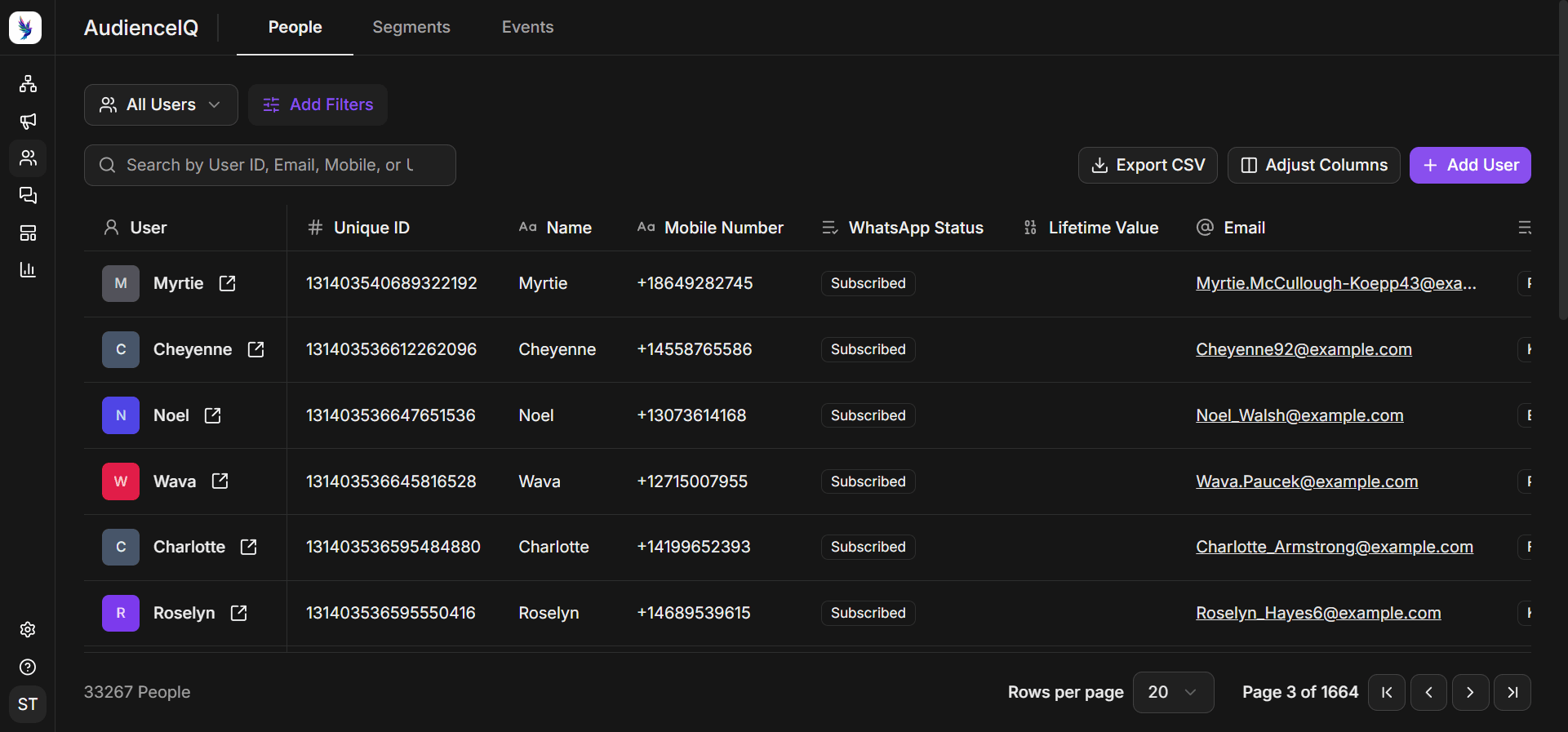
Cross-channel engagement starts not with messaging but with data. Before you can coordinate channels, you need a single, deduplicated customer profile that aggregates behavior and identity information from every source your brand uses.
Most brands have customer data scattered across different platforms with numerous identifiers marketing the same customer but across different channels. If those identifiers are never resolved to the same person, your channels will continue to treat them as different contacts.
So, how can you go about this?
Here is how to build the data foundation correctly:
- Audit every data source: Map where customer identifiers are stored across tools, including your marketing platforms, CRM, app events, and support platforms. Include offline data sources if they exist for your brand.
- Implement identity resolution: Build or connect a layer that matches identifiers across platforms using a common attribute such as phone number, email address, or device ID.
- Connect a CDP: Maintain one unified profile per contact that updates in real time as new events arrive across any channel.
- Store consent at the profile level: Opt-in and opt-out status should live on the customer profile, not per-channel. This way, suppression logic applies globally the moment a customer unsubscribes from any touchpoint.
Map channels preferences correctly
Not every customer prefers the same channel. A cross-channel strategy that assumes preference is no better than using a single channel for engagement. Channel preference is observable from customer behavior, and your engagement model should read those signals.
For example, if a customer consistently opens and clicks email but never responds to SMS, that's insight for your future campaigns. On the other hand, if a customer interacts via WhatsApp but their email open rate has been zero, that tells you WhatsApp is a much better engagement channel for that customer.
Forcing every customer through the same channel sequence because it's what your workflow supports is a supply-side approach to an inherently demand-side problem.
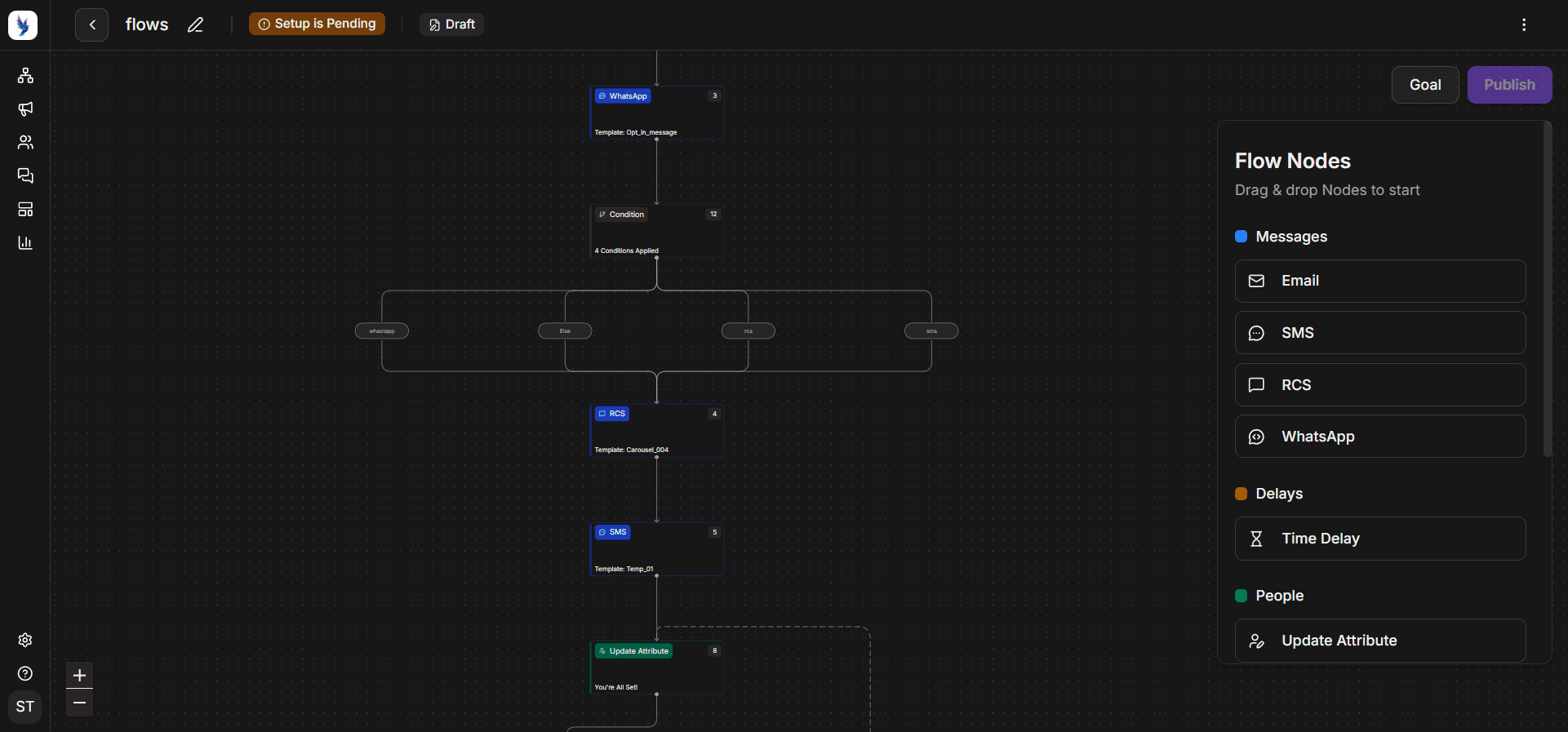
To build a preference-aware cross-channel system, begin by tracking engagement events by channel. Monitor opens, clicks, responses, and conversion events against the customer profile for every channel, not just the one that produced the conversion.
After that, set preference signals from this data. Decide that a channel with fewer than 10% engagement events over 60 days is a low-preference signal for that contact. Using that said, build a framework to determine which channel to try first in any given flow with secondary channels queued based on historical engagement rate.
Since you switched from a specific channel-first sequence to a preference-based cascade, you should see improvement in first-touch engagement rates because the message arrives where the customer is actually paying attention.
Use behavioral triggers to drive engagement
Behavioral triggers are events in your outreach framework that automatically initiate a cross-channel response without requiring manual intervention. They are the mechanism that makes a cross-channel system feel immediate rather than scheduled.
In case of customer engagement, the most valuable moments are the ones the customer signals themselves, like a product page visit, an add-to-cart action, or a support ticket opened. These events carry explicit intent and they expire quickly.
A trigger-based system catches them and responds in seconds. A campaign-based system misses most of them because they don't fall on the next scheduled send date. This principle applies to B2B customer engagement just as it does to consumer marketing.
However, before you jump into building these trigger-based journeys, define that you consider as high-intent events. These could include:
- Browse activity
- Cart additions
- App sessions
- Message replies
- Support interactions
- Payment events
Once you have figured them out, assign the action the system should take for the corresponding trigger. In this step, you determine, message, channel, timing, and fallback aspects. Having clarity on the type of action ensures there are no issues when it’s time to send the message. Also, these actions should be codified in your flow builder and not left to ad-hoc judgment.
Make every channel two-way
Cross-channel engagement fails when channels are configured only to send. The most valuable signals in a customer relationship are the replies. A channel that can't hear its audience is not an engagement channel, it's just a broadcast system.
A reply is the highest-intent signal a customer can send. Customers who are willing to respond to your messages are demonstrating active engagement that passive opens and clicks don't capture.
You can hear those replies, route them to the right response, and resolve the conversation within minutes to build a fundamentally different kind of customer relationship than a broadcast-only campaign.
To make sure you get responses to your outgoing messages, set up an inbox with a routing rule for each channel based on the message type you are likely to receive.
For example, if you are using WhatsApp and RCS, you can structure your response options to dramatically increase reply rates compared to open-ended prompts, because they reduce the friction of responding.
In addition to that, for common reply types such as order status, availability questions, and discount requests, configure an automated agent that can respond immediately without requiring a human to review each message.
Measure your customer journey
The most critical step of cross-channel customer engagement is the measurement framework. Most teams measure channel performance in isolation because that's what their individual tools make easy.
Cross-channel engagement requires measuring the journey as a whole, and the gap between those two approaches produces systematically wrong decisions.
To track your cross-channel customer engagement, you need to first assign a unified customer identifier across channels. This should not be a session ID but a persistent contact identifier that connects every touchpoint to the same person across multiple channels you operate.
After that, measure time-to-conversion from the first touchpoint. Understand how long coordinated journeys take to convert because a contact who needs three touchpoints across five days tells you something different from one who converts on the first touch.
Lastly, test the incremental value of adding a second or third channel to a journey against a control group that receives only the primary channel. This produces credible data on which combinations drive genuine lift.
Ready to connect your cross-channel customer engagement into a growth engine?
Every channel you run today is either compounding your customer relationships or fragmenting them. When running a cross-channel customer engagement, the most important thing is to make sure that the channels are connected to each other.
Siloed channels not only make it difficult for your customer-facing teams to interact with customers, but also frustrate customers due to them having to repeat the same information over and over across different channels.
To help you manage your cross-channel engagement over both modern and traditional channels, Zixflow provides you with capabilities in a single unified platform.
Check out the platform by starting a 7-day free trial for Zixflow and see what your engagement metrics look like when your channels finally talk to each other. Or you can book a demo if you want a walkthrough of how brands like Purvankara and IndoSpace built their cross-channel journey architecture.
Frequently asked questions about cross-channel customer engagement
What is cross-channel customer engagement?
Cross-channel customer engagement is a strategy in which a brand coordinates messaging across multiple communication channels, including email, SMS, WhatsApp, push, and in-app messages, so that each channel is aware of what happened on the others.
What is the difference between cross-channel and omnichannel engagement?
Cross-channel engagement coordinates communication across channels using shared customer data, with a focus on the transitions and interactions between those channels.
Omnichannel engagement extends this concept to include every touchpoint a customer has with a brand, not just marketing communication channels.
How many channels should I use for cross-channel customer engagement?
Start with two to three channels and build coordination between them before adding more. A common effective starting configuration is email plus one messaging channel such as WhatsApp, with push notifications added once the data foundation is solid.
Adding channels without first resolving the identity and data layer creates more coordination problems than it solves.
How do I measure cross-channel engagement ROI?
Use multi-touch attribution rather than last-touch attribution, because cross-channel journeys require multiple touchpoints to convert and last-touch models credit only the final one.
Track a unified customer identifier across every channel so that touchpoints can be connected to a single journey. Measure time-to-conversion from the first touchpoint in the journey, and track retention and repeat purchase rate as the downstream outcomes your e-commerce engagement metrics should reflect.
Why does cross-channel engagement outperform single-channel marketing?
Single-channel engagement has three structural disadvantages. It reaches only the customers who are active on that one channel, it generates no visibility into what those customers are doing elsewhere, and it misses the high-intent moments that happen on other platforms.
Cross-channel engagement addresses all three by building on a shared customer profile and applying behavior data across every channel regardless of which channel captured it. The result is more relevant messages, better timing, higher retention, and measurably higher revenue per customer.
How do I prevent customers from receiving too many messages across channels?
Build suppression logic at the profile level, not the channel level. When a customer engages on any channel, that engagement event should trigger a suppression window on all other channels in the active flow.
If a customer replies to a WhatsApp campaign, suppress the SMS follow-up that was scheduled for the same offer. Frequency caps set per contact rather than per channel are the most effective tool for preventing fatigue across a multi-channel stack.
What is channel cascading and how does it work in cross-channel engagement?
Channel cascading is the practice of attempting to reach a customer on a primary channel first and automatically escalating to secondary channels if the primary fails to deliver or produce engagement within a defined time window.
The goal of this is to guarantee that important messages reach every customer regardless of which single channel they happen to be most active on at that moment. Cascading also reduces cost by using free or lower-cost channels first and escalating to higher-cost channels when necessary.