WhatsApp Marketing Funnel: A Complete Guide for Outreach in 2026
Table of Contents
In the world of modern connectivity, companies must have levels of communication that enable them to contact their customers in real-time, without hassle. Long, disjointed sales processes tend to result in drop-offs, and it is vital that brands meet users on the channels they already use.
Having over 2.9 billion active users all over the world, WhatsApp has grown far beyond a personal messaging application. It has emerged as an important business channel used by both startups and large businesses to develop easier customer experiences that lead to quantifiable sales results.
WhatsApp, with its huge following and real-time messaging features, allows businesses to get in touch with their audience, begin meaningful one-to-one conversations, and direct their customers toward conversions more effectively. WhatsApp messages reach their target users immediately. Unlike emails or digital advertisements, they are not ignored, as users visit the platform several times a day.
Because of this, companies are now spending more on Click-to-WhatsApp campaigns, WhatsApp lead generation, and conversion-based WhatsApp strategies, which make sure that each interaction is part of creating long-term customer value.
With that said, we will explore the WhatsApp marketing funnel in practice in this blog, how businesses can put it in place, and some best practices to leverage them to the fullest.
What is a WhatsApp marketing funnel?
A WhatsApp marketing funnel is a highly organized model that takes the prospects through every phase of the purchase process, from the initial point of contact to subsequent interactions post purchase. The aim of a WhatsApp marketing funnel is not only to sell, but to transform customers into repeat buyers and brand promoters via constant discussions.
The difference between WhatsApp marketing funnels and traditional sales funnels is that they are centered on real-time, conversational interactions. Businesses can offer immediate customer support, product recommendations, and updates that are relevant right on the phones of the users, making the entire customer experience much better.
Stages of a WhatsApp marketing funnel
To learn more about the functioning of a WhatsApp marketing funnel, brands should firstly clarify what a sales funnel is. It is a pipeline that guides a prospect through the stages of initial awareness to long-term loyalty.
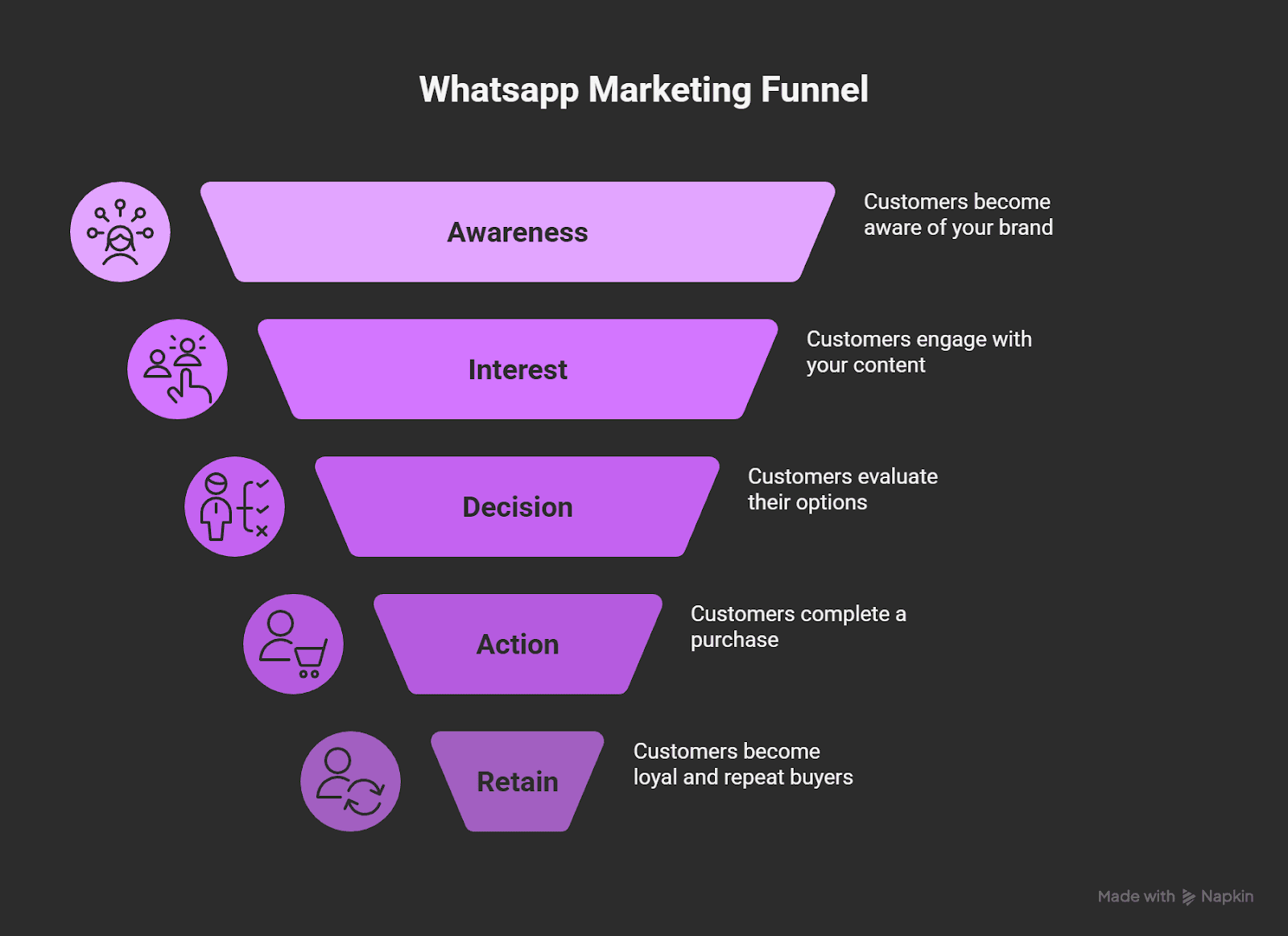
Rather than one-way communication, it is based on real-time conversations that direct users to every stage. The essential steps of a WhatsApp sales funnel are as follows:
Awareness
The awareness stage involves winning the attention of the possible customers and making them familiar with your brand on WhatsApp. Companies usually advertise their use of WhatsApp on websites, social networks, and email newsletters. The users can easily initiate a conversation by clicking on QR codes and the links of a chat.
Interest
After the users are convinced to start a conversation with you, the objective then becomes to keep them interested. At this phase, content sharing is relevant and meeting the customer's needs or challenges. This includes educational materials, product details, special offers, or timely updates to keep the conversation alive.
Decision
Customers are at the stage of decision-making. The necessity to provide real-time answers to product or service-related queries contributes to eliminating sales objections. The businesses can build trust by publishing testimonials, reviews, case studies, or comparisons, which will help the customer in making the decision.
Action
The action stage gives the customers the chance to finalize the purchase. Direct payment links can be shared by businesses, and the confirmation of the orders and delivery updates, which makes the process of buying transparent and seamless.
Retain
The process of retention does not end with conversion. The goal here is to keep the customers interested with continued value, which will lead to repeat purchase and make the customers who have had a good experience with your brand a long time customer who will promote your brand to other customers.
What are the benefits of a WhatsApp marketing funnel?
A properly designed WhatsApp marketing funnel will result in positive changes in business performance. Businesses can also steer customers through the buying process by providing the appropriate messages at the right moment.
Increased sales
A powerful funnel guides the customers to a successful path of making a purchase by giving them the right information at the right time. The conversion rates are bound to increase when the offers, the details of the product, and the support are provided at the appropriate time.
Businesses can use the real-time messaging feature of WhatsApp to respond to urgent inquiries or send specific incentives immediately. This personal communication makes the process less frictional and greatly decreases the possibility of being abandoned.
Better marketing experience
WhatsApp allows personalized conversations, which are natural and not transactional. Customers are pleased with quick replies and two-sided communication that helps customers to feel heard and appreciated.
The frequent queries can be automatically greeted with automated WhatsApp messages and responded to with great speed. While the more serious discussions can be conducted in live chats. This combination results in the creation of a smooth and responsive marketing experience, which makes the overall satisfaction higher.
Improved customer relationships
Clear and frequent communication via WhatsApp will build trust in the long run, which will result in repeat purchases and customer loyalty.
One of the possible methods to enhance this relationship is the use of OTPs through WhatsApp. OTP delivery via WhatsApp is more secure, reliable, and fast, with better verification experiences, and the app is more convenient to use compared to other methods.
Customers feel better engaged when they receive an appropriate response and personal attention on a timely basis. This continuous communication leads to emotional bonds, which lead to improved retention and customer lifetime value (CLV).
Invaluable insights
WhatsApp chats offer feedback that enables companies to know the customer preferences, concerns, and expectations. Such interactions will provide helpful information about the pain points, the popular products, and the areas that need to be improved.
Furthermore, WhatsApp Business Platform provides analytics and reporting functions to trace the engagement and performance. These insights lead to data-driven decision making and allow refining the strategies in relation to real customer behavior.
How to build a WhatsApp marketing funnel?
Creating an efficient WhatsApp marketing funnel requires taking into account numerous things. Follow these steps to build one for your business from scratch:
Set up a WhatsApp Business Account
The first step is to create a WhatsApp Business Account that can be instantly trusted and recognized by customers. Now there are two ways to create a WhatsApp Business Account: using the WhatsApp Business App or the WhatsApp Business API.
For the app, follow these instructions:
- Install the WhatsApp Business application
- Enter your business details like name, logo, WhatsApp business description, contact information, and industry
Once your business profile is completed, you can start sending messages to customers.
The process of setting up the WhatsApp Business API is a little longer. To get started with the API, you need a WhatsApp API provider to act as a frontend for the API.
Check out our guide on how to onboard the WhatsApp Business API using Zixflow.
Promote your WhatsApp
Once your account is set, the next step will be to push users to your WhatsApp marketing funnel. Create a WhatsApp click-to-chat button or a QR code and put it everywhere your customers can see your brand.
Place it in all the header, contact, and checkout processes of your website so that customers can initiate a dialogue easily.
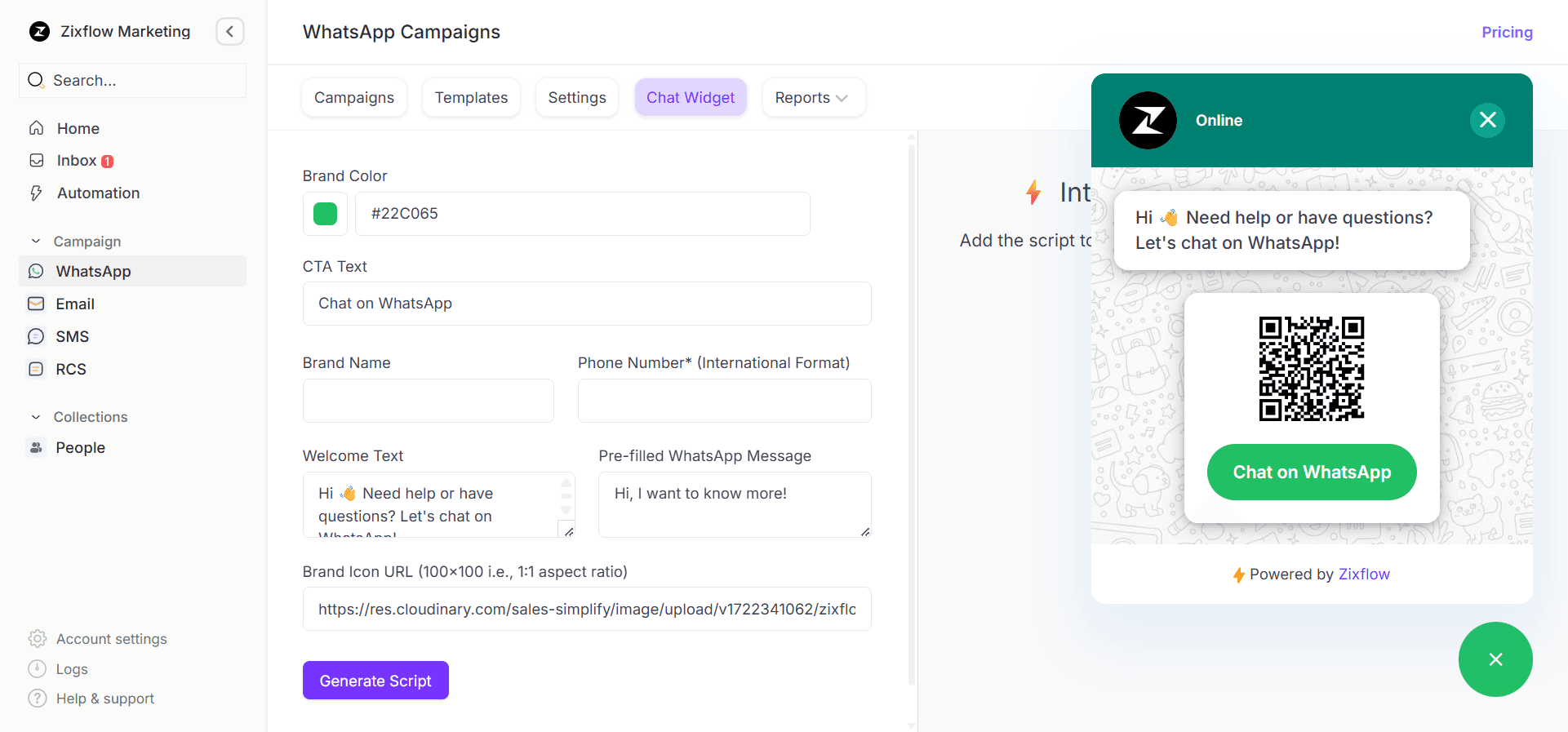
Market your WhatsApp funnel using emails as a channel for more personal interactions. Additionally, on social media sites, you can run advertisements or just organic posts that emphasize a clear benefit of reaching out to you via WhatsApp. The trick is to provide an incentive to make people opt in and not a generic “contact us” button.
Segmenting your audience
When people begin to contact you over WhatsApp, do not treat all the contacts equally. Start dividing your audience according to what they post and what they do. Simple qualifying questions at the beginning of the conversation should be asked to know their industry, interests, or intent.
Add this information to the behavioral information, like the number of pages visited, the number of products looked at, or past purchases. In the long run, the tagged users will be categorized as per their level of knowledge, purchasing stage, and preferences.
This segmentation will enable you to take users through the marketing funnel with relevant messages rather than sending the same message to all of them. The messages that fit the context of the user are engaged to ensure the opt-outs are minimized.
Leverage WhatsApp automation
Automation is essential in growing your WhatsApp marketing funnel without the need to lose speed or consistency. Begin by implementing a WhatsApp chatbot that addresses the typical entry-point interactions like greetings, frequently asked questions, price inquiries, or product discovery.
With WhatsApp automation tools, brands can design conversation automated processes that take users through awareness-focused stages and slowly transition to consideration-oriented actions, such as watching demos, browsing catalogues, or reviewing customer reviews.
Automation enables qualifying leads by gathering the required information and sending users with high intent to human agents when necessary.
This automation maintains the top of the funnel active 24/7 with the sales or support teams only intervening when conversations are prepared to progress.
Deliver engaging content
As the user flows up the funnel, concentrate on the content, which keeps the user interested and takes them to the next step. Rich WhatsApp features like images, short videos, product catalogs, and interactive buttons can be used to make messages more visually attractive and actionable.
Educational content should be shared in the initial stages to build trust, and then the use cases, testimonials, or limited-time offers with the users demonstrating increased intent.
Messages should be very short and informal, and should not burden users with a lot of information at a time. Every message must be purposeful, be it educating, increasing credibility, or focusing on conversions.
Track performance
In order to optimize your WhatsApp marketing funnel in the long run, regularly monitor the interaction of the user with each step.
Track the delivery rates, open rates, and click-through rates to determine what messages are getting attention. Keep track of conversion activities like form submission, purchase, or demo bookings to determine where the users bail. Apply these insights to optimize your messaging and automation flows.
In case users are not clicking on the messages, change your call-to-action. When the discussion is stuck on a specific stage, provide more details. Constant analysis is essential to keep your marketing funnel in optimal shape since customer behavior and expectations continue to evolve every day.
Make the most of outreach with a WhatsApp marketing funnel
WhatsApp marketing funnel is not merely a marketing strategy, but a shift in terms of businesses' communication and their interactions with customers. Through the richness of WhatsApp in the form of direct and conversational communication, companies are able to provide more streamlined customer experiences, create better trust, and concentrate on conversions more efficiently.
By optimizing the individual funnel stages, businesses will be able to build meaningful long-term relationships with the audience and attain sustainable growth.
Zixflow automates this process with a CRM integration and precise targeting. The WhatsApp marketing automation capabilities of Zixflow enables companies to generate more leads and make more conversions by having meaningful, personalized conversations.
Begin to create your WhatsApp funnel and grow your business by signing up for Zixflow’s 7-day free trial today!
Frequently asked questions regarding the WhatsApp marketing funnel
What is a WhatsApp marketing funnel?
WhatsApp marketing funnel is a systematic method that helps potential customers move through the awareness to conversion and retention stages, with the main communication medium being WhatsApp.
How can businesses draw customers to a WhatsApp marketing funnel?
The most common methods of inviting direct conversations in order to fill your WhatsApp marketing funnel include click-to-chat links, QR codes, social media campaigns, web chat buttons, and promotional content.
How can brands customize WhatsApp messages?
WhatsApp messages may be personalized with the help of customer information like names, preferences, browsing history, and past interactions. This enables companies to send targeted messages to particular sections of customers.
What metrics should be tracked in a WhatsApp marketing funnel?
Some of the common performance KPIs are opt-in rates, engagement rates, conversion rates, response rates, and customer retention. The indicators can be used to quantify the funnel effectiveness and suggest improvement areas.
How can WhatsApp assist in providing quality customer support?
WhatsApp also allows companies to provide quick and effective customer service by responding to queries in real time, solving problems promptly, and staying in touch with customers via a direct chat.
Sahil Tyagi
I'm a passionate content writer and SEO enthusiast who enjoys turning ideas into helpful articles. When I'm not busy with content, you'll find me enjoying sports or reading about growth strategies.