WhatsApp Engagement Strategy to Boost Business Growth in 2026
Build a WhatsApp engagement strategy around conversations that keep customers interested and encourage meaningful interactions.
 by Sahil Tyagi
A WhatsApp engagement strategy is a systematic plan for two-way conversations with customers on WhatsApp. It follows an organized approach across lifecycle stages and conversation flows as opposed to traditional WhatsApp marketing.
Building an engagement strategy has six components:
- Segmenting your audience by lifecycle stage
- Designing conversation flows that make customers active participants rather than recipients
- Using behavior-triggered messages at the moment of peak customer intent
- Building a human handoff system with clear escalation triggers and full conversation history transfer
- Measuring conversation quality
- Creating proactive value touchpoints between commercial messages to build relationship trust
Did you know that the open rates on generic WhatsApp templates have dropped to around 12%? That's a collapse most businesses haven't noticed yet because they are still tracking whether messages were delivered successfully or not.
Brands that have noticed are building something different, a WhatsApp engagement strategy that treats the channel as a relationship platform. And conversational flows built on that premise are hitting 60-70% engagement.
In addition to that, over 175 million people interact with a business on WhatsApp every single day. These aren't marketing but conversation numbers. The channel is built for two-way interaction however, most businesses are using it like a one-way broadcast.
With that said, in this blog post, I'll walk you through what a WhatsApp engagement strategy means and why it drives better outcomes than simple broadcast-based approaches. I’ll also tell you specific ways to build a strategy that generates measurable growth through better conversations.
What is a WhatsApp engagement strategy?
A WhatsApp engagement strategy is a systematic plan for having two-way conversations between you and your customers on WhatsApp to build relationships that deepen over time.
Unlike a WhatsApp marketing strategy, which focuses on outbound campaigns and promotional messages, an engagement strategy is fundamentally about conversation quality. It mainly revolves around who receives which message based on their behavior.
The framework of a WhatsApp engagement strategy includes conversation flows built around lifecycle stages. This includes behavior-triggered touchpoints that respond to customer actions in real time to determine which customers receive which conversations.
What sets this strategy apart from generic messaging is the intent behind it. Every conversation in an engagement strategy exists to create value for the customer in the moment they are in. The following steps, such as commercial outcomes, repeat purchases, and lower churn, come as a consequence of better conversations.
WhatsApp engagement strategy vs. WhatsApp marketing: What’s the difference?
WhatsApp marketing is about running campaigns, involving promotional broadcasts, product announcements, and limited-time offers sent to contacts. It's outbound by nature and measured on customer engagement metrics.
A WhatsApp engagement strategy operates across a longer time horizon. It's concerned with what happens between campaigns that makes customers more likely to stay and buy again. The primary metric is conversation depth and what it produces over the customer's lifetime with your brand.
Both of these strategies matter but they require different infrastructure to work properly. Many businesses have a WhatsApp marketing strategy and consider they have an engagement strategy. The gap between them is usually visible in the response rate: a channel with a genuine engagement strategy in place gets replies. A channel running only marketing broadcasts mostly doesn't.
Why is having a WhatsApp engagement strategy crucial for growing business?
A structured approach to WhatsApp engagement produces outcomes that broadcast campaigns can't replicate because it operates at a level of relationship depth that one-way messaging can't reach. Here are some of the significant business outcomes a well-designed WhatsApp engagement strategy creates:
Higher response rates to reflect real customer interest
When customers respond to a WhatsApp message, they are signaling active interest. A response rate of 30 to 40%, which WhatsApp conversational flows consistently achieve, means a meaningful portion of your audience is choosing to engage rather than just reading your message.
This is a fundamentally different data signal from an open rate. Opens can be passive, but responses are not. For brands managing customer engagement pipelines, a high response rate tells you that your audience finds the conversation worth continuing. It's the leading indicator of a healthy relationship, and it's the foundation everything else in your engagement strategy should be built on.
Stronger customer retention
Customers who are in regular two-way contact with you have a significantly lower churn rate than those who only receive broadcast messages. This is because a consistent conversation builds the kind of familiarity and trust that makes customers less likely to switch when a competitor runs a promotion.
For customer retention, this dynamic means that the investment in building a strong engagement strategy compounds over time. Every well-handled conversation is an implicit renewal of the customer's decision to stay.
Higher customer lifetime value
An engagement strategy designed around lifecycle stages generates significantly more value per customer than undifferentiated broadcast programs due to conversations being matched to what the customer needs at each sales pipeline stage.
For example, a customer in their first week with your product needs onboarding support. While a customer who hasn't engaged in 60 days needs reactivation with a relevant promotion. When these touchpoints are handled through WhatsApp conversations, the response rate and the downstream impact are both materially higher.
Better customer satisfaction rates
Customers who get their questions answered quickly give higher satisfaction scores. WhatsApp's speed advantage over other channels and its personal nature are what drive this effect. Businesses using WhatsApp for structured customer conversations report a CSAT score of 4.5 out of 5, and 60% lower cost per interaction compared to phone support.
Not just that. Meta's own data shows that business messaging through WhatsApp can increase customer satisfaction by approximately 50%. This is primarily because the conversational format gives customers a channel that feels direct. The satisfaction lift comes from the structure of the interaction and not from spending more on support staff.
Happier Customers, Faster Replies.
See how real-time WhatsApp conversations lift customer engagement without increasing headcount.
Try for FreeA scalable channel for personalized messages
Personalization on email is largely structural. You can insert a name, reference a purchase, and segment by list. On WhatsApp, personalization extends to the conversation itself, going beyond the timing and tone of the response.
If you are managing WhatsApp customer segmentation at scale, the investment in creating richer customer profiles and using them in conversation design has a measurable return on engagement quality.
Ways to build a WhatsApp engagement strategy that drives growth
A strong WhatsApp engagement strategy isn't built by sending more messages. It's designed by sending better ones, to the right people, at the right moment. Here are the steps to craft an engagement strategy for your business:
Segment your audience by lifecycle stages
The single most important structural decision in a WhatsApp engagement strategy is who receives which conversation and when. Sending the same message to a brand-new customer and a customer who has been with you for six months is the fastest way to underperform on both.
Lifecycle segmentation solves this by matching conversation design to where each customer actually is in their journey with your brand.
The core lifecycle segments for most businesses are:
- New - Subscribed but haven't engaged deeply yet
- Active - Regularly using the product or buying
- At-risk - Engagement or purchase frequency declining
- Dormant - No meaningful activity in 60 to 90 days
- Reactivated - Returned after a period of dormancy
Each of these segments has a different conversation goal and requires different messaging frequency and content.
For new customers, the engagement goal is activation. For active customers, the goal is reinforcing the behaviors that make your product valuable. Meanwhile, for dormant customers, the goal is reaching out with something specific and useful rather than a generic reactivation offer.
A well-structured lifecycle segmentation model that targets customers at the right touchpoints delivers 3 to 6 times the retention outcomes of non-personalized programs. The underlying concept is that customers respond better to messages that are relevant to where they are, not to where you want them to be. Your customer journey map is the most useful input for defining these segments precisely.
Designing conversation flows
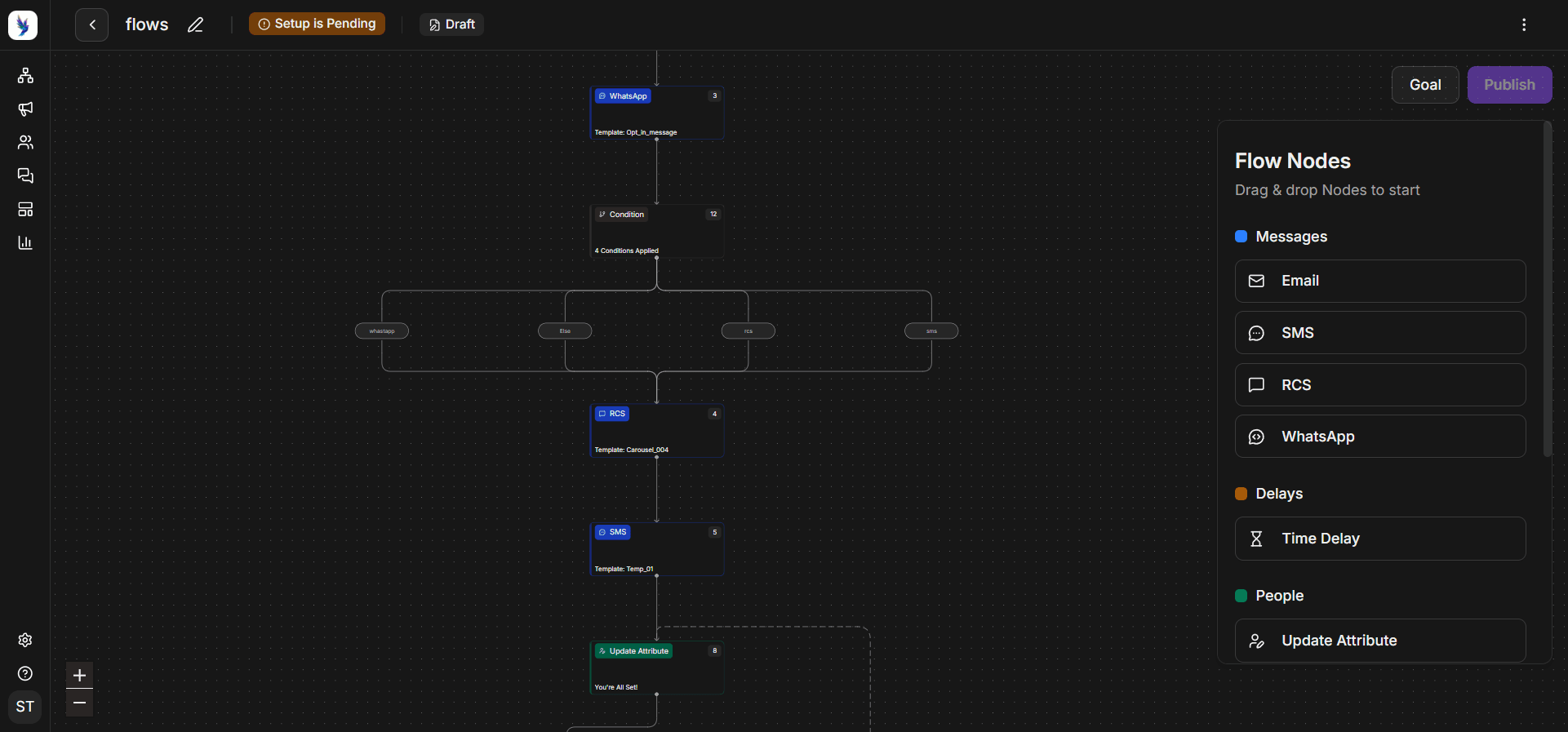
A WhatsApp message template is a single communication until a customer replies to it. A conversation flow is a designed sequence of exchanges. For example, the first message triggers a response option and each response that follows routes the customer to the next relevant message.
Conversation flows work because they make the customer an active participant rather than a recipient. When a customer is given a specific choice, such as "Would you like tips for getting started or do you have a specific question?" they experience the interaction as a service rather than as a notification.
The practical implementation involves mapping the most common customer journeys for each lifecycle stage and then designing a conversation that responds to the natural questions and decisions at each point.
For instance, a new customer onboarding flow might ask about the customer's primary goal to route them to the relevant onboarding track. It then checks in on day three to see how it's going and to further offer a specific resource based on where they are in the process.
Use behavior-triggered messages
The most effective moment to send a WhatsApp message is not a scheduled calendar date. It's the moment right after a customer does something meaningful. Behavior-triggered messages engage customers at the peak of their own intent, which is why they outperform scheduled broadcasts on most engagement metrics.
Behavior triggers work by connecting your WhatsApp platform to the systems that know what customers are doing. Or use a unified WhatsApp API provider, like Zixflow, that includes a native CDP to link WhatsApp messages with customer data.
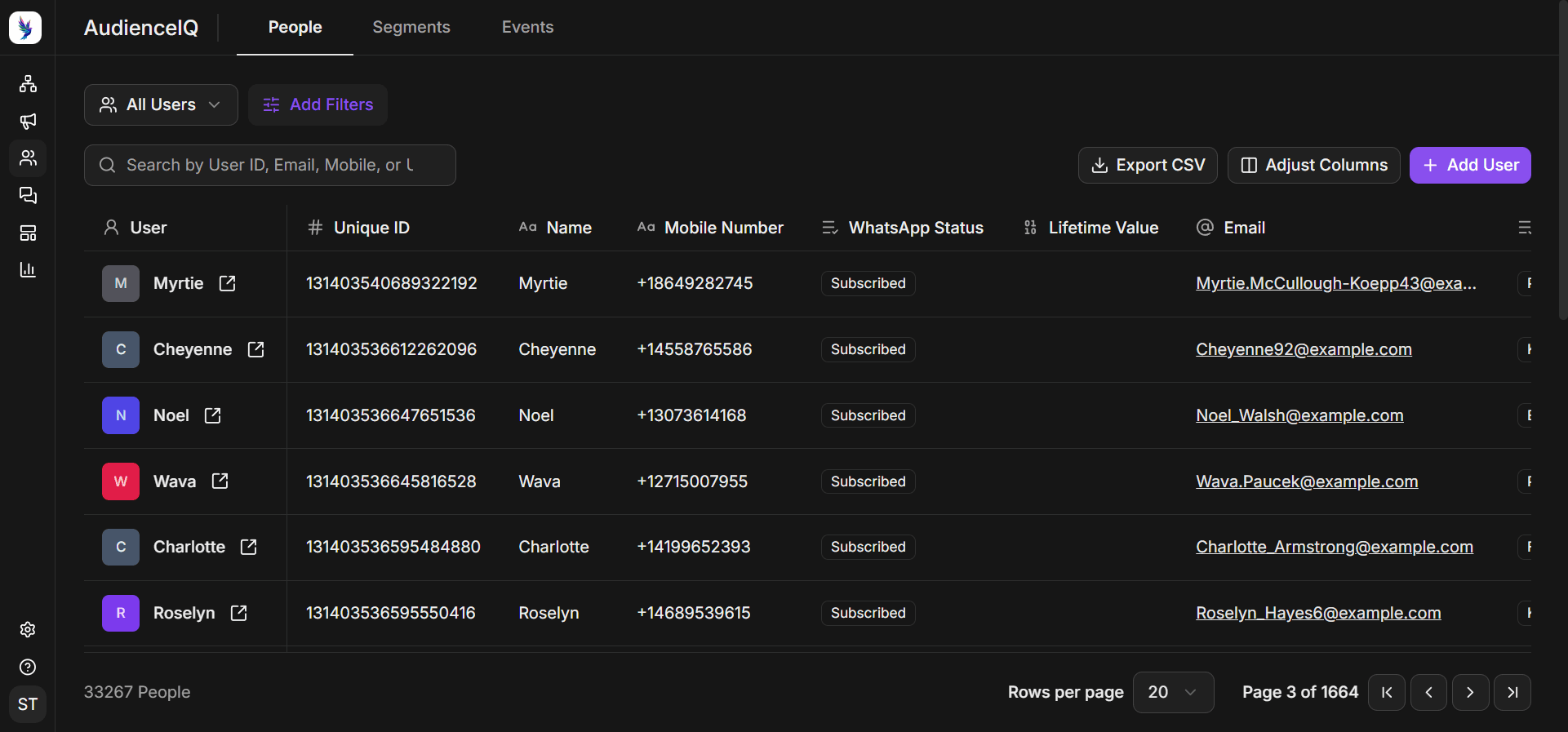
The key to setting up effective triggers is taking into account the customer’s position. For example, a trigger for a user who hasn't logged in for 30 days will be inherently different from the one for someone who hasn’t upgraded their subscription. The second scenario is more relevant and likely to drive a response.
So, it goes without saying that the more precisely you can define the behavioral moment, the more relevant the conversation will feel.
Build a human handoff system
Automated WhatsApp messages handle the majority of customer interactions efficiently. But there's a specific situation where automation isn't enough. Complex support situations that cannot be handled by AI or high-value sales conversations that need a rep to answer niche customer questions. In these kinds of situations, a human must take over the conversation before the customer churns.
This is why, having clear guidelines on how your WhatsApp engagement strategy handles these moments determines whether customers feel their interactions are helpful.
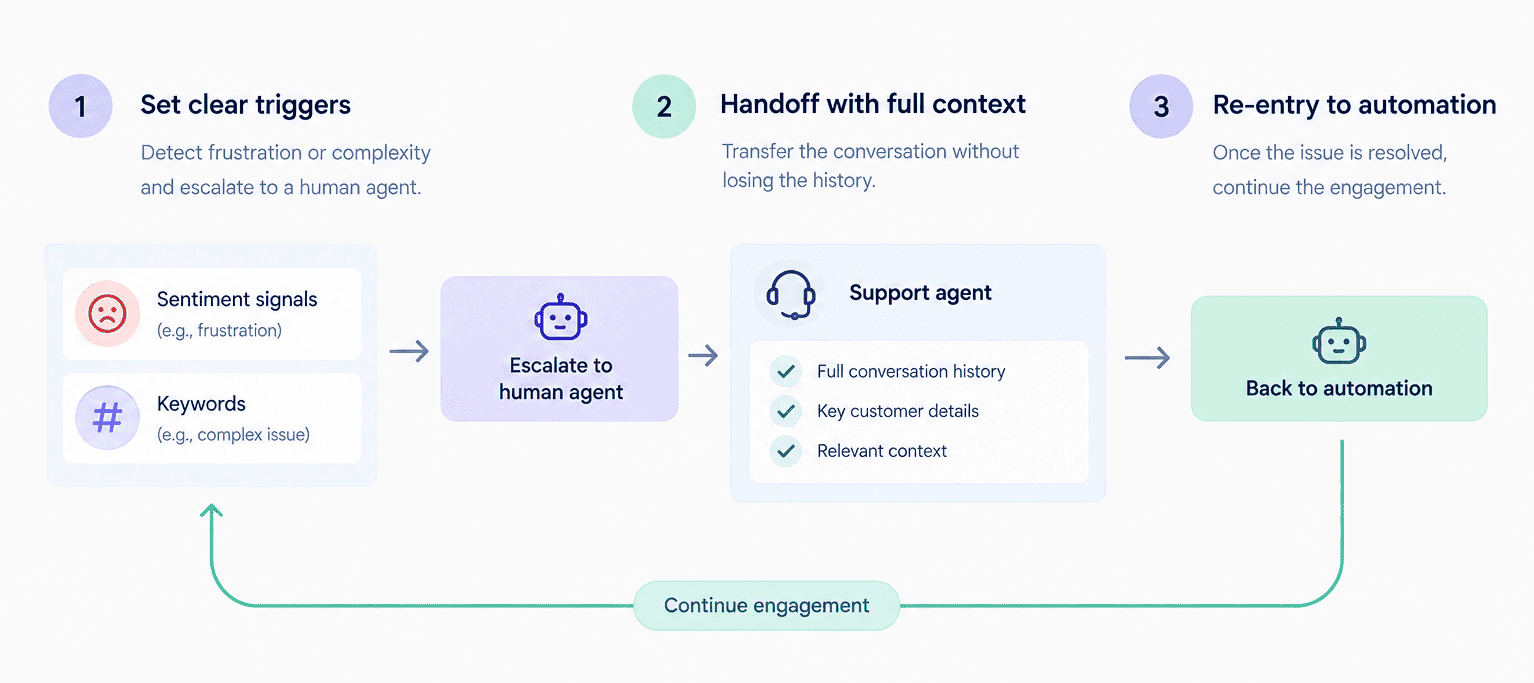
A well-designed human handoff system has three components:
The first is a clear set of triggers that escalate a conversation from automation to a human agent. You can set it up by using sentiment signals that indicate frustration or specific keywords that indicate complexity that AI couldn’t manage. Once these conditions are triggered, the conversation should be immediately forwarded to a support rep.
The second is a handoff mechanism that transfers the conversation to an agent without losing the history. If your agent asks the customer to repeat the entire conversation again, many users, who are already frustrated, will get even more annoyed. To ensure this doesn’t happen, the rep should receive the full exchange history with all the relevant information to continue the interaction smoothly.
The third, and most often overlooked, component is a re-entry path back into automation once the human conversation is complete. If an agent resolves a customer's issue, the conversation ends there. You lose the opportunity to continue the engagement relationship further.
A well-designed system returns the customer to the appropriate track after the human exchange so automated flows can keep them in the loop by either sending a follow-up tip or introducing them to the next lifecycle stage.
Handoffs Without the Repeat-Yourself.
Zixflow passes full conversation history to your team the moment a chat escalates.
Book a DemoMeasure conversation quality
Most WhatsApp reporting dashboards default to delivery and open rates because those are the easiest numbers to produce.
A message with a 98% open rate and a 2% response rate is performing at broadcast level. A message with an 80% open rate and a 45% response rate is performing at engagement level. The difference is enormous but invisible if you're only tracking opens.
The metrics that actually reflect engagement quality are response rate, conversation depth, time to first response, and flow completion rate. These four metrics together give you a picture of whether customers are genuinely engaging or passively receiving.
On top of that, you should track satisfaction at the conversation level and not just at periodic survey intervals. WhatsApp's real-time nature makes it practical to collect a quick CSAT or NPS prompt at the close of specific conversation types.
Building a measurement framework for conversation quality takes more setup than standard campaign analytics, but it's the only way to know whether you're improving. Without these metrics, you can't identify which conversation flows are underperforming or which personalization variables are driving the most response.
Create proactive touchpoints that add value
The most durable WhatsApp engagement strategies include regular touchpoints that exist purely to serve the needs of customers. These proactive value-adds are what build the kind of trust that makes customers receptive to your commercial messages when they do arrive.
A customer who receives useful information from you considers you a helpful aid rather than a customer who only hears from you when you want them to buy something.
Proactive value touchpoints take different forms depending on your business and your customers' needs. For example, for a SaaS product, they could be weekly usage summaries sent via WhatsApp that show the customer what they have accomplished. For an e-commerce brand, they might be care tips sent after a purchase to help customers make the most of their products.
The long-term commercial value of proactive value touchpoints shows up in purchase frequency and NPS. Customers who experience you being genuinely helpful buy more often and recommend more actively.
Building these non-commercial touchpoints into your engagement calendar is an investment in the relationship quality that drives those downstream outcomes. It is the element most often missing from strategies that look good in a campaign report but underperform on retention.
Building a WhatsApp engagement strategy that compounds over time
A WhatsApp engagement strategy is not a campaign you run and measure in isolation. It is a system you build and improve continuously because the data from each conversation tells you something about how to optimize it further.
The approaches I have highlighted in this guide are most effective when they are built together rather than deployed one at a time. The brands that are winning on WhatsApp are not the ones sending the most messages. They are the ones whose customers actually reply.
That response rate is a signal for something deeper, whether the customer experiences the brand's WhatsApp presence as useful or as noise. Building toward the former takes time, but it compounds. Each well-designed conversation makes the next one easier as the customer's expectations are already calibrated upward.
The place to start is with your customer data and a clear map of the lifecycle stages your customers move through. That map is the foundation everything else is built on. Once you can see the stages clearly, the conversation flows and triggers that make sense for each one become much easier to define.
However, to connect everything together, you would need a WhatsApp platform that lets you manage your WhatsApp engagement strategy at scale from a single location. And this is exactly what Zixflow is built for.
The platform serves as a unified solution for all your WhatsApp outreach needs, linking first conversations to post-purchase engagement from a centralized solution without the hassle of tabbing between different tools.
Check out Zixflow’s AI and WhatsApp features by starting a free trial to see how it fits into your WhatsApp engagement strategy.
Frequently asked questions about WhatsApp engagement strategy
What is a WhatsApp engagement strategy?
A WhatsApp engagement strategy is a structured plan for designing and managing two-way conversations with customers on WhatsApp. It is organized around lifecycle stages, behavioral triggers, and conversation flows with the goal of building relationships that improve customer retention.
How is WhatsApp engagement strategy different from WhatsApp marketing?
WhatsApp marketing is about promoting your business through WhatsApp. It usually focuses on sending messages that help you attract customers or drive sales. For example, you might send a product offer to people who have opted in to receive updates from you.
A WhatsApp engagement strategy is broader. It focuses on how you build and maintain conversations with customers over time. Instead of only promoting something, you use WhatsApp to respond to customers. You can also follow up with leads and keep conversations going to retain them in the longer term.
How do I personalize WhatsApp conversations at scale?
Personalization at scale on WhatsApp requires three things:
- Clean, up-to-date customer data in your CDP
- A WhatsApp API provider that can query that data and insert dynamic variables at send time
- Conversation flows designed to use that data meaningfully
Useful personalization references specific facts about each customer's behavior or history. It consists of aspects like their usage frequency, recent purchase, or stated preferences to design WhatsApp messages that resonate with their interests.
How often should I send WhatsApp messages as part of an engagement strategy?
For actively engaged customers, two to three messages per week is the recommended ceiling for non-promotional engagement messages. For dormant customers, one per month is the appropriate frequency. Exceeding these thresholds increases opt-out rates faster than it increases engagement.
Behavior-triggered messages sent in response to specific customer actions don't count toward this frequency ceiling because they are contextually relevant rather than scheduled.
What is a WhatsApp conversation flow and how do I build one?
A WhatsApp conversation flow is a designed sequence of messages that adapts based on the customer's responses or actions. Instead of a single template that ends with delivery, a conversation flow offers the customer choices and continues the exchange through multiple relevant touchpoints.
Zixflow, a Meta-partnered WhatsApp Business API platform, includes a flow builder that lets you map these sequences visually. Effective flows are built from your existing customer journey data so they sound relevant rather than generic.