What is Omnichannel Orchestration and Why Does it Matters?
With omnichannel orchestration, brands can coordinate customer communications based on previous interactions and where customers are in their journey.
 by Sahil Tyagi
Omnichannel orchestration is the real-time coordination of customer communication across every channel using a shared customer data layer so each touchpoint stays consistent and informs the next. Unlike multichannel and cross-channel, orchestration is organized around the individual customer, with a central decision engine choosing what to say, on which channel, and when.
Implementing it takes the following steps:
- Unify customer data under consistent identifiers
- Map the customer journey before building automation
- Design conditional channel sequences with fallback channels
- Set real-time behavioral triggers for high-intent and high-risk moments
- Coordinate marketing and support so open tickets suppress promotions
- Segment dynamically by lifecycle stage
76% of customers expect a consistent experience across every channel they use, but only 29% of companies actually deliver it. That gap is where customers get frustrated and eventually leave.
The solution to this isn't adding more channels. It's connecting the ones you already have into a coordinated system that treats every customer as a single individual across every touchpoint.
That's what omnichannel orchestration does, and it's what separates businesses that retain customers from the ones that keep re-acquiring them.
Companies with strong omnichannel strategies retain 89% of their customers, compared to just 33% for those with weak omnichannel programs. That's not a marginal improvement, it's the difference between a business that compounds its customer base over time and one that runs on a leaky bucket.
The shift is happening because customer behavior has changed in a way that makes channel-by-channel thinking obsolete. If any of your touchpoints don't share context with the others, the experience breaks down.
That said, in this blog, I’ll break down exactly what omnichannel orchestration is, how it works, why it matters for your business, and the practical steps to implement it.
What is omnichannel orchestration?
Omnichannel orchestration is the real-time coordination of customer communication across every channel, including email, SMS, WhatsApp, push notifications, in-app messaging, and in-store, using a shared customer data layer to ensure each touchpoint is consistent.
Rather than managing channels as independent campaigns, orchestration treats every interaction as part of a continuous, cross-channel customer journey where each message informs the next.
The core mechanism is a centralized decision engine that sits above your individual channels. When a customer takes an action, that event updates their unified profile and can trigger a response across whichever channel is most appropriate at that moment.
The platform decides what to say, which channel to use, and when to send it, based on the customer's behavior history and current lifecycle stage.
What sets this apart from traditional marketing automation is its customer-centric architecture. Traditional automation is organized around campaigns. Orchestration is organized around the customer based on what they actually do.
The result is a communication program that adapts in real time rather than executing a pre-scheduled sequence regardless of what the customer is doing.
Omnichannel orchestration vs. Multichannel vs. Cross-channel
These three terms are often used interchangeably, but they describe fundamentally different levels of channel coordination, and the distinction matters when you're deciding what kind of infrastructure to build.
Multichannel means you communicate with customers across multiple channels, but each channel runs independently. Your email team manages email, your SMS program runs separately, and your WhatsApp broadcasts are handled in isolation.
Cross-channel connects some channels for specific journeys. For example, a cart abandonment email that also triggers an SMS 24 hours later if the email goes unopened is a cross-channel sequence. It's more coherent than multichannel, but still organized around campaigns rather than customers.
Omnichannel orchestration treats all channels as a single system organized around the individual customer. Every channel shares real-time customer context so that a support interaction can suppress a promotional message and channel selection is driven by individual preferences rather than campaign defaults.
Why does omnichannel orchestration matter for your business?
The business case for omnichannel orchestration comes down to one compounding effect, every improvement in customer experience reduces churn, increases lifetime value, and lowers the cost of growth. Here are some of the specific benefits that explain why the investment pays off:
Higher customer retention
Retention is where the ROI of omnichannel orchestration is most clearly demonstrated. When customers receive consistent, contextually relevant communication across every channel, they're less likely to disengage from your brand.
The mechanism to do this is straightforward. Orchestrated communication removes the friction points that stop customers from giving up. Retained customers also generate compounding revenue through repeat purchases and higher lifetime value, making retention one of the highest-return activities a business focusing on customer engagement can invest in.
Measurable revenue lift
The revenue impact of omnichannel orchestration is well-documented across both research and real-world implementation. McKinsey estimates that businesses that implement orchestrated cross-channel engagement see a 5 to 15% increase in total revenue, primarily through higher repeat purchase rates and increased average order value among existing customers.
The revenue lift comes from two sources. First, better timing, as an orchestrated program sends messages when customer intent is active. Second, reduced message fatigue by having the channels coordinate rather than compete.
Both effects compound over time as the program accumulates behavioral data and gets smarter about which combination of channel, message, and timing works for each individual customer.
Consistent customer experience across all touchpoints
Consistency is what builds brand trust at scale. When a customer receives different tones, offers, and information depending on which channel they use, the experience signals disorganization.
Orchestration solves this by ensuring every channel draws from the same customer profile and operates under the same communication logic. This is particularly important at moments of friction. For instance, when your support channel can see that a customer has already received an automated email about a delay, your marketing channel suppresses promotional messages to that customer until the issue is resolved.
That kind of coordination is impossible without orchestration, and its absence is one of the most common causes of customer complaints about brands that are otherwise delivering a good product.
Every Channel for Each Customer.
Explore how Zixflow’s omnichannel outreach helps your channels work together.
Try out TodayImproved customer satisfaction scores
The customer satisfaction gap between businesses with orchestrated omnichannel programs and those without is significant. Research shows that omnichannel customer service achieves a CSAT score of 67%, compared to just 28% for companies using a multichannel approach without coordination. The difference isn't the number of channels offered, it's whether those channels work together to create a coherent experience.
From the customer's perspective, the experience of dealing with a brand that knows their history feels better than dealing with one that doesn't. That satisfaction translates into reviews, referrals, and repeat purchases, all of which have measurable commercial value beyond the CSAT number itself.
Higher satisfaction also reduces support volume, as fewer customers reach out with frustrations that orchestrated communication would have prevented in the first place.
How to implement omnichannel orchestration?
Understanding why omnichannel orchestration matters is the easy part. Building it is where most teams get stuck. That’s why these strategies will take you from disconnected channels to a fully orchestrated customer engagement program effectively:
Unify your customer data before orchestration
Orchestration without unified data is just multichannel with better branding. Every channel coordination decision, from which message to send next to which channel to use to whether to suppress a campaign, requires a real-time view of each customer.
The foundation is a unified customer profile that aggregates behavioral events, transaction history, lifecycle stage, and communication preferences into a single record that every channel draws from. This doesn't require a data warehouse on day one but a commitment to consistent customer identifiers across every system, which are curated to a central profile in real time.
To build this foundation, consider these steps:
- Audit your current data sources: Map every system that holds customer data and determine the identifier each one uses.
- Standardize identifiers: Ensure every system uses the same primary key (email or customer ID) to identify the same individual.
- Implement event tracking: Set up server-side event tracking on your website and app so behavioral signals are captured in real time.
- Build or integrate a unified profile layer: Use your customer engagement platform's native data ingestion or connect your CRM and e-commerce platform via API so the profile updates in real time.
- Define your data refresh cadence: Real-time sync for behavioral events, daily sync for CRM updates at minimum.
Starbucks is the most cited example of this principle in practice. Its 34.6 million active Rewards members, who drive 59% of company sales, are all connected to a single profile that reflects their order history, preferences, and reward status across mobile, in-store, and web. The orchestration is only possible because the data is unified.
Map the customer journey before designing automation
Most teams jump straight into building automation flows without a clear picture of what the actual customer journey looks like from the customer's perspective. The result is automation that's designed around what's convenient for your business to build, rather than what the customer actually experiences.
Before you configure a single trigger or flow, map the full journey from first contact to loyal customer. Journey mapping for orchestration is different from traditional journey mapping because you need to map what happens when a customer takes an unexpected path, not just the ideal path.
Think about what happens if a customer opens your welcome email but doesn't make a first purchase? What if they purchase but then contact support within 48 hours? What if they go 60 days without engaging? Each of those scenarios needs a defined communication response, and the only way to design those responses intelligently is to have mapped the journey first.
The practical steps for journey mapping are:
- Identify your key lifecycle stages: Acquisition, activation, first purchase, retention, re-engagement, and advocacy.
- Define the behavioral signals at each stage: What customer action marks the transition from one stage to the next?
- Map the friction points: Where do customers currently drop off or disengage?
- Identify the moments of highest intent: When is the customer most likely to respond to a relevant message?
- Design channel sequences for each scenario: Which channel, in which order, with what message, for each journey path.
A detailed customer journey map is both a strategic planning tool and a blueprint for your orchestration configuration. Brands that skip this step often build automation that performs well for the ideal customer path and fails everyone else.
Design channel sequences for efficient engagement
The shift from campaign thinking to sequence thinking is one of the most significant mindset changes in building an orchestrated program.
A campaign says, "send this email to this segment on Tuesday." On the other hand, a sequence says, "when a customer does X, send Y via the best channel, then wait for their response, then send Z if they haven't converted, using a different channel if the first one didn't get a reaction." This shows that the sequence is dynamic, while the campaign is static.
Designing effective channel sequences requires you to predetermine what the fallback channel is if the primary channel doesn't produce a response, how long to wait between touchpoints to avoid overwhelming the customer, and what signal ends the sequence.
Getting these decisions right requires looking at your own channel performance data to understand which channels your customers are most responsive on, and at which stages of the sales journey.
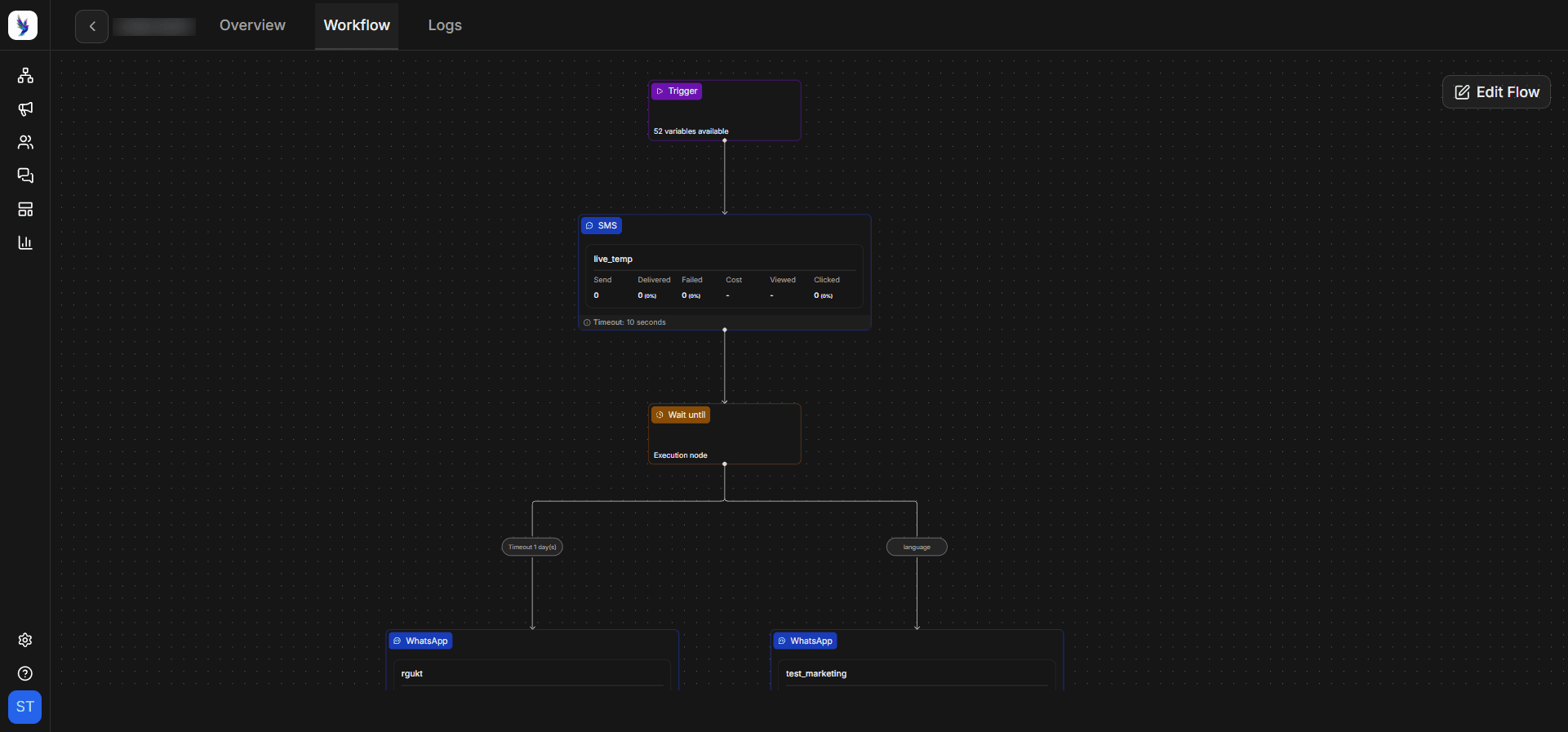
A well-structured channel sequence for a post-signup onboarding journey might look like:
- Day 0 - in-app message: Welcome and feature introduction immediately after signup.
- Day 1 - email: Getting started guide with key activation steps.
- Day 3 - WhatsApp: Check-in message if the customer hasn't completed activation steps.
- Day 7 - SMS: Expiring trial reminder or limited-time incentive if still inactive.
- Day 14 - email: Re-engagement offer or survey for customers who haven't activated.
The key is that each step is conditional. For example, the Day 3 WhatsApp message only fires if the customer hasn't completed activation, and the Day 7 SMS only fires if Day 3 also went unacted upon. This kind of conditional channel sequencing enables you to utilize your unified customer profile to the fullest rather than running an engagement campaign on a standalone channel.
Transition from Campaigns to Sequences.
Try Zixflow’s omnichannel outreach and AI-powered automation hands-on to build personalized sequences.
Try it FreeUse real-time behavior triggers at the moment of intent
The most commercially effective messages in an orchestrated program are the ones triggered by specific customer behaviors in real time.
Take, for example, a customer who abandons a cart, showing purchase intent that decays rapidly. The 15 to 30-minute window after abandonment is when recovery messages convert best. An hour later, the intent signal has weakened. The next day, the customer may have already bought elsewhere. Real-time behavioral triggers are what let you respond within that window, automatically.
The behavioral events worth building triggers around are the ones that signal high intent or high risk.
- High-intent events include cart additions, pricing page visits, product comparison behavior, and repeat category browsing.
- High-risk events include extended inactivity, support contacts, failed payments, and subscription cancellation signals.
Both categories represent moments where the right message can change the customer's trajectory. To set up effective behavioral triggers:
- Define your trigger events: List every customer action that warrants a specific response, across all channels.
- Set recency and frequency rules: Ensure the same customer isn't triggered more than once within a defined window for the same event.
- Build suppression logic: Customers who convert or opt out of a sequence should be immediately removed from it.
- Test trigger timing: For cart abandonment, test 15-minute, 30-minute, and 1-hour delays to find the optimal window for your audience.
- Connect triggers to the right channel: High-urgency triggers work best on WhatsApp or SMS; lower-urgency nurturing works well on email.
Behavioral customer segmentation is one of the highest-performing applications of this strategy. Customers who've shown intent via a specific product category or behavior can be triggered into a targeted WhatsApp sequence that converts significantly better than a broadcast to the full customer list.
Coordinate your marketing and support channels
One of the most common orchestration gaps is the divide between marketing communication and customer support. Marketing sends campaigns while support handles inbound contacts. In most businesses, these two functions operate completely independently, and from the customer's perspective, that's evidence that you aren’t paying attention.
Orchestrated programs treat support interactions as behavioral signals that should influence the marketing communication a customer receives. A customer who had a support issue resolved positively might be the ideal candidate for a satisfaction survey followed by a loyalty reward if their rating is high.
The steps to coordinate marketing and support are:
- Create a support event in your customer profile: Every support contact, and its resolution status, should update the customer's unified profile.
- Build suppression rules based on support status: Customers with open support tickets should be excluded from all promotional campaigns.
- Design post-resolution sequences: A resolved support interaction is an opportunity to confirm satisfaction and, for positive resolutions, request a review or offer a loyalty reward.
- Align support and marketing on the shared customer timeline: Both teams should be able to see the full communication history, not just their own channel's interactions.
The customer feedback loops that make this coordination work are not just tactically useful; they generate the kind of continuous customer insight that improves every other part of your engagement program over time.
Segment dynamically based on lifecycle stage
Static segmentation involving building a list once and sending to it repeatedly is incompatible with orchestration. Orchestration requires segments that update in real time as customer behavior changes, so every campaign automatically goes to the customers who currently match the criteria.
Dynamic lifecycle segmentation means defining segments by behavioral criteria that the platform evaluates continuously. New and current customers who meet specific criteria are automatically added to the segment. This way, your customer engagement campaigns always reach the right audience without manual list management.
To build a dynamic segmentation framework:
- Define your lifecycle stages: Prospect, new customer, active customer, at-risk, lapsed, and re-engaged are a common starting framework.
- Assign behavioral criteria to each stage: What does a customer have to do (or stop doing) to move between stages?
- Build stage-transition triggers: When a customer moves from active to at-risk. This transition should automatically enroll them in a win-back sequence.
- Layer in behavioral signals within stages: Within your active customer segment, identify high-intent subgroups (frequent browsers or high-cart-value customers) for targeted campaigns.
- Review segment health regularly: Track how customers flow between segments over time as a leading indicator of retention health.
Tracking the right metrics and KPIs alongside your segmentation data tells you not just who is in each segment, but whether your orchestration program is moving customers in the right direction over time.
Put Lifecycle Stages to Work.
See how Zixflow handles omnichannel outreach and automation engagement using custom segments.
Book a DemoReady to orchestrate your customer engagement across every channel?
Most brands don’t lose customers because their product fails. They lose them in the gaps between channels. These gaps are a coordination problem, and omnichannel orchestration is how you close them.
You need a unified customer profile that every channel draws from in real time, behavioral triggers that fire at the moments of highest intent, channel sequences that adapt based on what the customer does, and measurement that tracks journey outcomes.
None of that requires a high-end budget, but the right platform and a clear picture of your customer journey. If you can get this right, you don’t just improve your retention numbers but also build a compounding advantage as your customer base grows.
So, if you’re ready to move from disconnected campaigns to a coordinated customer engagement system, Zixflow provides you with omnichannel outreach and AI-powered automation to help you make smarter decisions.
Don’t believe me? Try out the platform yourself or schedule a demo to see how we tackle your omnichannel outreach issues.
Frequently asked questions about omnichannel orchestration
What is omnichannel orchestration?
Omnichannel orchestration is the real-time coordination of customer communication across multiple channels using a unified customer data layer. Unlike multichannel marketing, where each channel operates independently, orchestration treats every touchpoint as part of a continuous, customer-centric journey.
What is the difference between omnichannel and multichannel marketing?
Multichannel marketing uses multiple channels but manages each one independently, so the channels don't share data or coordinate messaging.
Omnichannel marketing treats all channels as a single system organized around the individual customer. Every channel shares real-time customer context, so a purchase event on one channel can suppress a campaign on another, and a customer can switch channels mid-journey without losing context.
What channels does omnichannel orchestration typically include?
Orchestration can include any channel a customer uses to interact with your brand. Common channels are email, SMS, WhatsApp, push notifications (web and mobile), in-app messaging, social media ads, and in-store or call center interactions.
The key isn't which specific channels you include, it's that all of them draw from the same unified customer profile and coordinate their communication logic. Adding more channels to a disconnected system just creates more noise.
How long does it take to implement omnichannel orchestration?
Implementation timelines vary significantly based on data readiness and technical complexity. Basic orchestration consisting of a unified profile connected to two or three channels with three to five behavioral triggers can be live in a week or two with a platform like Zixflow.
Full-scale orchestration across six-plus channels with complex journey logic, cohort measurement, and A/B testing frameworks typically takes three to six months. What metrics should I use to measure omnichannel orchestration success? Measure at both the campaign and journey level. Campaign-level metrics include open rates, click rates, and conversion rates per message. Journey-level metrics are activation rate within a defined window, repeat purchase rate, win-back rate, and customer retention rate.
How is omnichannel orchestration different from marketing automation?
Traditional marketing automation is campaign-centric, while omnichannel orchestration is customer-centric. Orchestration also coordinates across channels simultaneously, but most marketing automation tools are single-channel or require manual connection between channels.
The practical difference is that orchestration adapts to what the customer does, and automation executes what you planned regardless of what the customer does.