8 Best Omnichannel Marketing Tools for Growing Businesses
The best omnichannel marketing tools are Zixflow, Brevo, Insider One, Omnisend, Bloomreach, Dotdigital, Ortto, and Customer io.
 by Sahil Tyagi
An omnichannel marketing tool is a platform that connects marketing channels into a centralized dashboard with a shared customer data layer, so messages across channels work as one coordinated experience rather than arriving fragmented.
The key difference between multichannel and omnichannel tools is that the former lets you send messages on multiple channels but doesn't share data between them, while the latter gives a complete picture of a customer profile in real time across every channel.
Businesses these days send marketing messages across multiple channels. Inherently, this is a great strategy to interact with customers across the channels of their choice. The problem with that is that without the right infrastructure, those messages arrive fragmented.
A customer gets an email, then an SMS, then a WhatsApp message, and each one reads as if it came from a different team that has no idea what the others are doing. This is not the correct omnichannel approach.
According to research, companies with strong omnichannel customer engagement strategies retain 89% of their customers on average; meanwhile, the brands with weak strategies retain only 33%. That gap in customer retention is the business case for investing in the right omnichannel marketing platform.
So, to help you run your omnichannel marketing efforts effectively from a single platform instead of managing outreach campaigns across numerous platforms, I have curated a list of some of the best omnichannel marketing tools.
For each tool, you will find a breakdown of what it does and who it is best suited for so you can pick the perfect one to boost business growth.
What is an omnichannel marketing tool?
An omnichannel marketing tool is a platform that connects your marketing channels, such as email, SMS, WhatsApp, push notifications, and social ads, into a centralized dashboard. The goal is not simply to send messages on multiple channels but to make those messages work together as one coherent experience/
The foundation for an omnichannel marketing tool is unified customer data. Whenever a contact opens an email but does not click, the platform registers that signal and informs your marketing team to adjust the next touchpoint accordingly.
That kind of coordination requires a shared data layer underneath all your customer engagement channels, which is exactly what omnichannel tools are built to provide.
This is different from other customer engagement platforms that let you run campaigns on multiple channels but do not share data between them.
With true omnichannel tools, a purchase on your website can trigger a personalized WhatsApp message. The coordination happens automatically, based on rules and AI you configured.
What to look for in an omnichannel marketing tool?
Before comparing specific platforms, it helps to have a clear idea of what to look for when selecting an omnichannel marketing tool:
Unified customer data layer
Every channel your business uses generates data about customers, for example, what they opened, what they clicked, what they bought, what they ignored. An omnichannel tool must collect this data in one place and use it to inform decisions across all channels simultaneously.
Without a unified customer data platform underneath the surface, channel coordination is manual and unreliable. Look for platforms that build customer profiles in real time, not just sync data on a daily batch schedule.
Native channel breadth
Check which channels are native versus bolted on through third-party integrations. A native WhatsApp channel means the platform gives you access to the WhatsApp Business API and its capabilities directly.
A third-party integration means you depend on a middleware connector that can break when either platform updates its API. For businesses that rely on WhatsApp, SMS, or push notifications as primary channels, native support is not optional. Third-party integrations create friction as you have to manage every channel individually.
Complex automations
The quality of a platform's automation editor determines whether you can actually personalize at scale or whether you are limited to basic sequence triggers. Look for platforms that support behavioral triggers, conditional branching, and holdout groups for testing.
These capabilities are what make the difference between customer engagement automation tools that feel personal and ones that feel like a mass blast with just a first name inserted.
Reporting that connects channels
A common limitation in multi-channel tools is that reporting stays siloed. You get email metrics in one tab, SMS metrics in another, and no view that shows you how a customer interacted with your brand across the full sequence.
Omnichannel reporting shows the customer journey end to end, attributes revenue to the right combination of touchpoints, and gives you data you can actually use to improve campaigns. If you cannot measure it coherently, you cannot optimize it.
Best omnichannel marketing for growing businesses
Now you know what aspects to look for when selecting an omnichannel marketing tool that best fits your brand, here are some of the platforms for you to consider:
Zixflow
Zixflow is an agentic customer engagement platform built for growing businesses that run marketing, sales, and support across multiple channels like WhatsApp, RCS, email, and SMS from a single workspace.
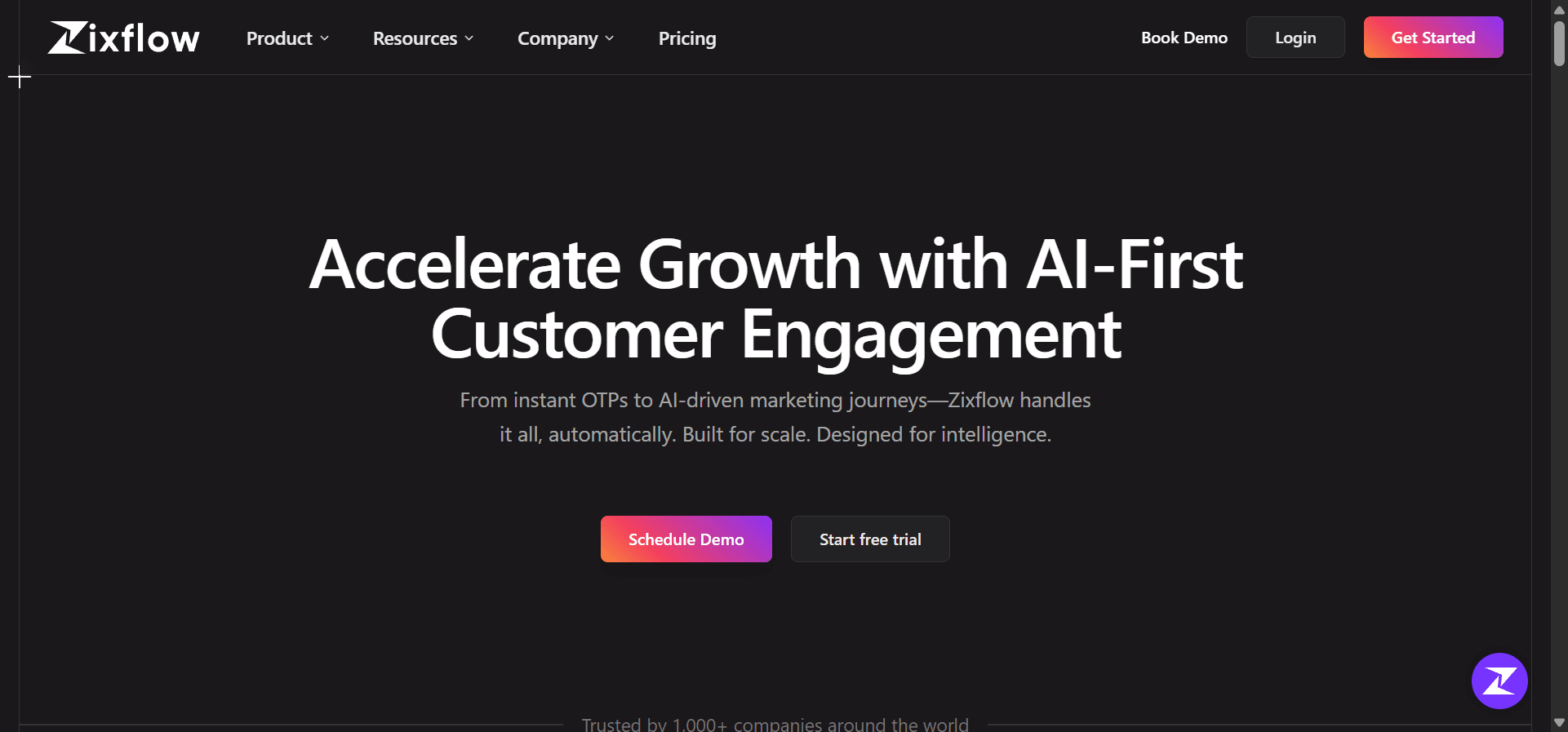
Unlike general marketing automation tools that treat channels as a plugin or add-on, Zixflow was built channel-first for WhatsApp marketing initiatives, email campaigns, RCS catalogs, and OTPs all live natively in the same platform.
In addition to that, the unified inbox allows you to consolidate replies from every channel into a single view. This makes it very easy to stay on top of incoming communication and interact with customers effectively.
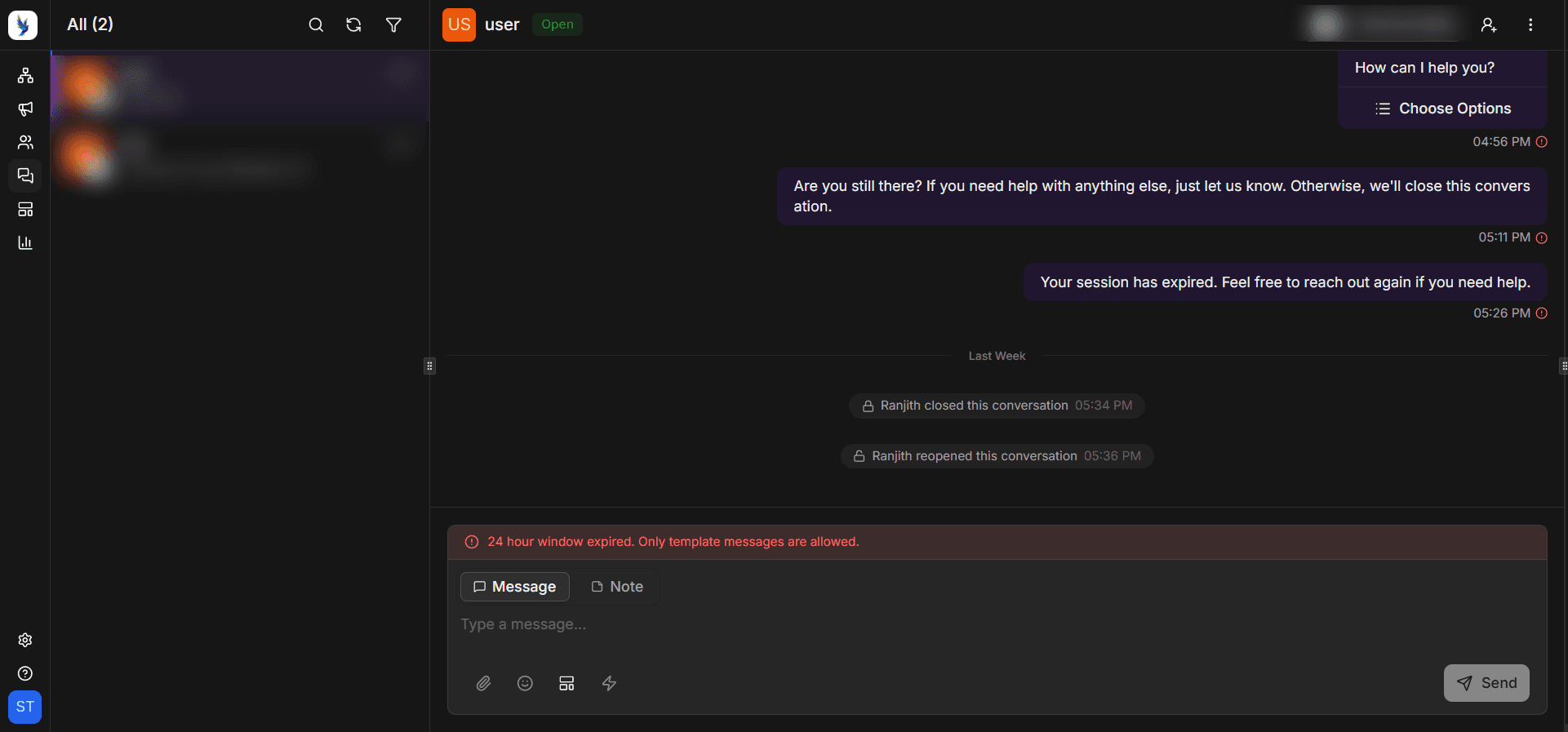
What makes Zixflow distinct from other tools on this list is the connection between its data intelligence and campaign personalization. Customer intent signals from numerous data sources feed directly into campaign logic, which creates a level of product-level relevance that standard automation platforms cannot replicate.
Moreover, Zixflow includes a built-in CDP to customize contact collections, which means growing teams do not need to connect a separate CRM to manage their contacts. Plus, Zixflow's automation supports trigger-based cadences, which are personalized with an AI layer so you can run marketing campaigns that don’t sound forced.
Key Features:
- WhatsApp, SMS, and email campaigns from a single dashboard
- Unified inbox for managing replies across all channels in one place
- Real-time customer data platform with 360-degree behavioral profiles
- AI-powered personalization with custom field generation
- Trigger-based workflow automation and drip cadences
- Native CDP with customizable customer profiles
Pros:
- Intuitive interface for non-technical teams to run campaigns without any developer involvement
- The pay-per-use campaign wallet makes the platform genuinely cost-effective for scaling businesses
- The centralized inbox meaningfully reduces response times for support teams managing conversations across WhatsApp, RCS, email, and SMS simultaneously
Cons:
- Third-party app integrations are fewer in number than established platforms with longer integration libraries
- Initial WhatsApp Business API setup requires coordination with the support team for first-time configuration
Pricing
Zixflow’s pricing is based on your usage volume and not contact list size. If you have large lists but only actively message a fraction of your contacts each month, this pricing model is meaningfully cheaper than contact-based alternatives. That said, Zixflow offers three pricing plans as follows:
- Free: Up to 3 users who can send broadcast messaging across all the channels that the platform supports
- Marketing Stack: $39/month (annual), starts with 3 users and includes inbox, chatbot, and flows for setting up automated messaging workflows
- Business Stack: $69/month (annual), full access to the platform with CDP (Companies, Deals, Collections), shareable lists, and LinkedIn extension.
Best for: Zixflow is best for growing businesses who have outgrown the capabilities of basic marketing tools and need a centralized platform that lets them manage every customer interaction from one place.
Insider One
Insider One is a cross-channel growth management platform that unifies customer data from every digital touchpoint and uses AI to orchestrate personalized experiences across different channels.
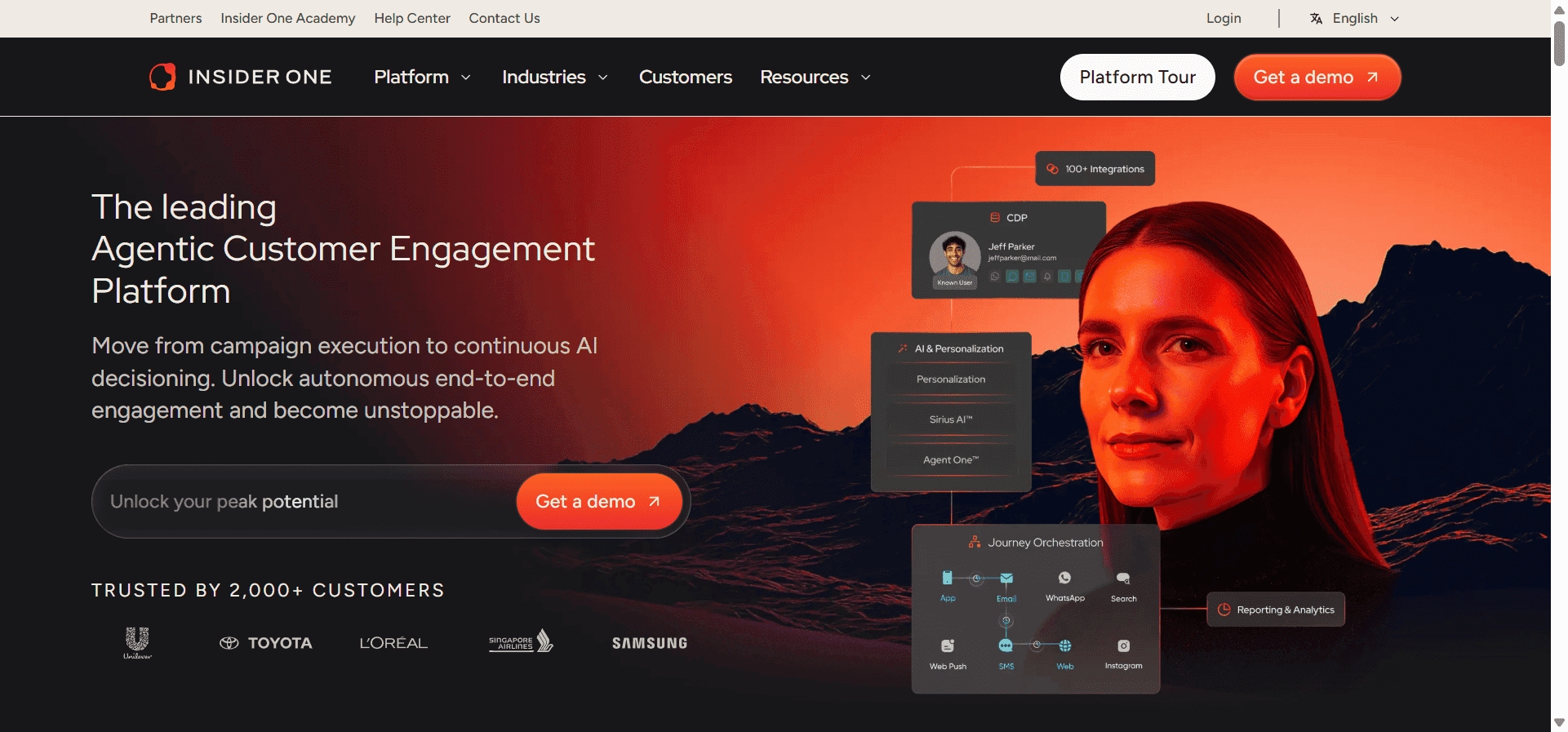
Its core strength is a real-time customer data layer that makes its segmentation and personalization significantly more dynamic than traditional marketing automation tools. Rather than applying segment-level assumptions to everyone in a bucket, Insider One’s AI predicts optimal send times, channel preferences, and content variations for individual users based on behavioral signals.
The platform's journey builder allows marketing teams to design complex multi-step flows across channels without needing developer support.
Key Features:
- AI-powered predictive segmentation and channel-preference optimization
- Web and app personalization with A/B and multivariate testing
- Cross-channel campaigns across email, SMS, push, WhatsApp, and web
- Send-time optimization at the individual user level
- Pre-built templates for e-commerce and subscription use cases
Pros:
- Sophisticated AI segmentation which surfaces behavioral patterns that manual segmentation would not catch
- The journey builder allows automation of complex multi-step sequences across channels without needing a developer or a separate workflow tool
Cons:
- Implementation timelines are longer than simpler alternatives, particularly for teams without a dedicated marketing operations resource
- Pricing is enterprise-oriented, which makes it a difficult choice for businesses that are not yet at that revenue scale
- The AI features have a learning curve before teams understand how to configure and interpret them correctly
Pricing
Insider One does not provide pricing information on its website. It's a quote-based platform where your pricing is determined depending on your use case. You have to book a demo with its sales team to get a quote.
Best for: Mid-market and enterprise teams that need AI-driven personalization for all their marketing channels.
Brevo
Brevo is a marketing and CRM platform that covers email, SMS, WhatsApp, live chat, and marketing automation in a unified solution. It has carved out a strong position in the SMB market by offering multi-channel capability that does not require an enterprise procurement process.
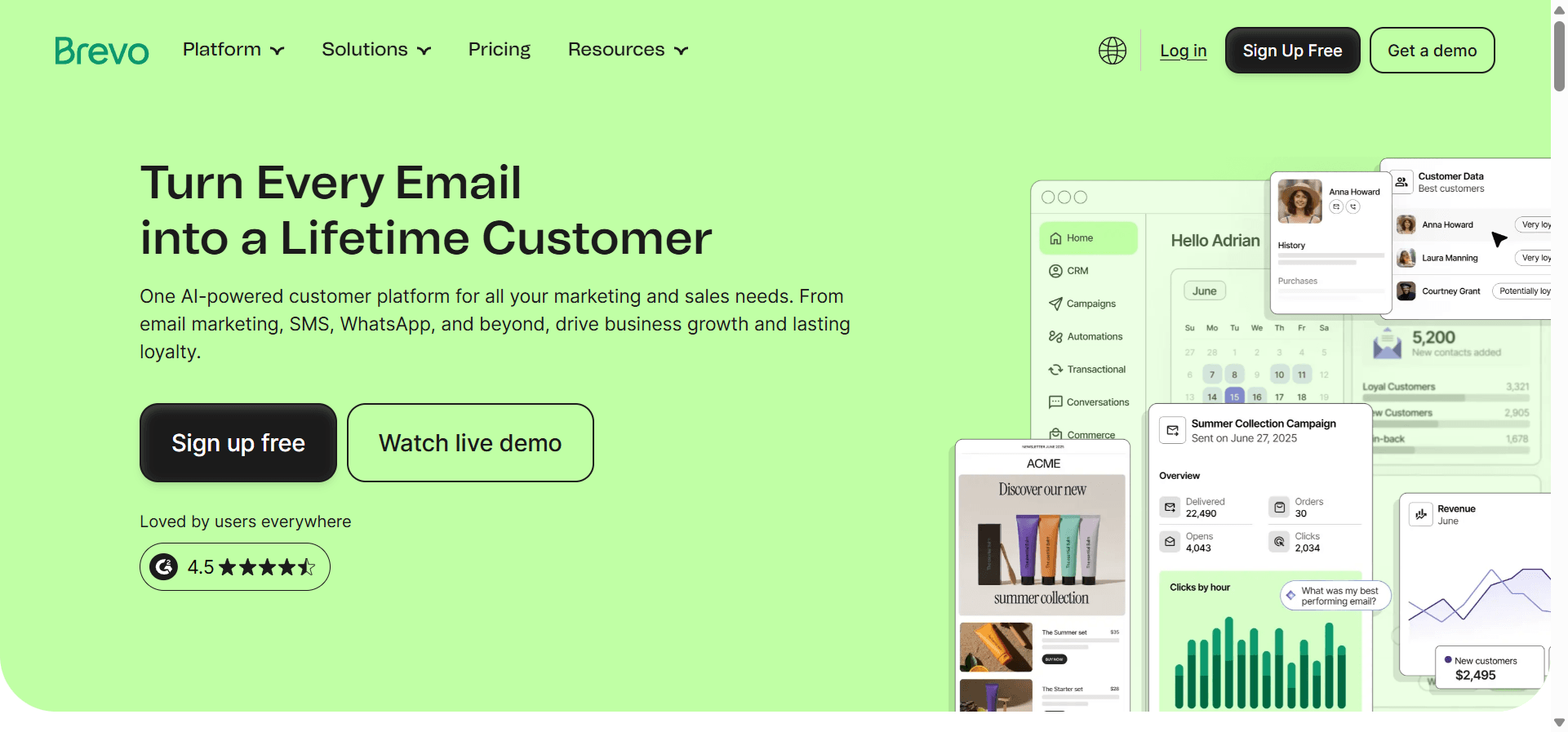
Brevo's email deliverability is one of its most consistently praised attributes, with strong transactional email performance through its SMTP relay.
The platform also includes a visual automation workflow builder along with a built-in CRM for contact management, making it a realistic all-in-one option for smaller teams that cannot handle five separate tools.
Key Features:
- Email campaigns, transactional email, and SMS from one dashboard
- Marketing automation with visual workflow builder
- Native CRM for contact and deal management
- WhatsApp Business integration for marketing campaigns
- A/B testing for email subject lines and content
Pros:
- The free plan, which includes 300 emails per day, is an operational start for early-stage businesses
- Email deliverability consistently scores well in independent reviews, particularly for transactional messages that need to reach inboxes reliably
- The interface is simple enough that small teams can run campaigns without dedicated marketing operations support
Cons:
- Reporting and analytics are less granular than other alternatives, especially for multi-touch attribution across channels
- Advanced automation features hit functional limits as workflow complexity grows beyond basic sequences
- Live chat and CRM modules are functional but not as deep as dedicated tools in either category
Pricing
Brevo offers five payment plans which you can choose from depending on your messaging needs:
- Free Forever: 300 emails/day with SMS campaigns charged on a per-message basis
- Starter: $8.08 per month. It comes with 5,000 emails/month, drag-and-drop editor, segmentation, basic reporting
- Standard: $16.17 per month. It includes everything in Starter plus marketing automation, A/B testing, AI send-time optimization, and landing page builder
- Professional: $449.08 per month. It starts from 150,000 emails/month and adds WhatsApp, push, popups, contact scoring, AI segmentation, and phone support
- Enterprise: Custom pricing. Best suited for brands with 1M+ contacts, dedicated IP, SSO/SAML, and multi-account management
Best for: Growing SMBs that need email, SMS, and live chat in a single platform
Omnisend
Omnisend is an e-commerce-focused omnichannel marketing platform that connects email, SMS, and web push notifications into automated workflows designed specifically for online retail. The platform is built with the Shopify and WooCommerce ecosystem at its center, and the integration with both platforms is among the most seamless available.
For e-commerce marketing tools, Omnisend stands out because its automation templates are built around the revenue-critical moments in e-commerce, such as abandoned cart recovery, post-purchase sequences, browse abandonment, welcome series, and win-back campaigns. Teams can deploy these flows in minutes rather than building them from scratch.
The platform's segmentation is built on purchase behavior, frequency, and customer value, which means segments reflect real commercial patterns rather than just demographic attributes.
Key Features:
- Email, SMS, and web push notifications from one unified workflow builder
- Native Shopify, WooCommerce, and BigCommerce integrations
- A/B testing for subject lines, content blocks, and send times
- Product picker for embedding catalog items directly in emails
- Revenue attribution reporting across campaigns and automations
Pros:
- The Shopify integration is near-instant to set up, requiring minimal technical configuration
- Automation templates for standard e-commerce flows are ready to activate without modification, reducing time-to-live significantly
- Revenue attribution reporting makes it straightforward to identify which campaigns and automations are actually driving sales
Cons:
- Pricing scales steeply as the contact list grows, which can produce unexpected cost increases during rapid audience growth
- The platform is heavily optimized for e-commerce and less flexible for B2B or non-retail use cases that need different segmentation logic
- SMS availability is restricted to certain countries, which limits usefulness for businesses with globally distributed customer bases
Pricing
Omnisend’s pricing scales by contact list size. For 251–500 contacts (base tier), it costs:
- Free: $0/month. 500 emails/month, 250 contacts, 500 web push notifications
- Standard: $11.20/month. 6,000 emails/month, 500 contacts, unlimited web push
- Pro: $41.30/month. Unlimited emails, up to 2,500 contacts, SMS from $0.007/SMS, AI-powered personalization
SMS is an add-on, priced separately at $0.007–$0.0085/SMS depending on volume and country.
Best for: E-commerce businesses running on Shopify or WooCommerce that want email, SMS, and push in one workflow.
Bloomreach
Bloomreach is a commerce experience platform that combines AI-powered product search and discovery, content management, and marketing automation into a unified suite. Its marketing automation module, Bloomreach Engagement, handles cross-channel campaigns and is fed by a real-time customer data layer.
For businesses with hundreds or thousands of SKUs, product discovery and marketing automation are competitive differentiators. A customer who searched for a specific product category but did not purchase can automatically receive a targeted campaign for the most relevant items in that category, without manual segmentation.
Key Features:
- AI-powered product search and discovery engine with merchandising controls
- Cross-channel marketing automation across email, SMS, push, and web
- Real-time customer segmentation with behavioral and transactional data
- Predictive product recommendations based on browsing and purchase signals
- Advanced A/B and multivariate testing across campaigns and site experiences
Pros:
- The AI-powered search and discovery layer improves on-site conversion rates directly alongside campaign performance for large product catalogs
- The real-time data layer fires triggered campaigns based on very recent behavior
- Analytics and data visualization capabilities reduce the need for a separate BI tool, which simplifies the overall data stack
Cons:
- Implementation typically requires dedicated technical resources or paid professional services, making time-to-value longer than simpler alternatives
- The campaign building interface is less intuitive than newer platforms designed with simpler UX conventions
Pricing
Bloomreach does not provide exact pricing information on its website. It offers plans like Autonomous Marketing, Autonomous Search, and Conversational Shopping. You can request a custom quote by entering your business details in the form available on the page.
Best for: Mid-market to enterprise e-commerce businesses with large product catalogs that need search, personalization, and marketing automation in one suite.
Customer io
Customer io is a marketing automation platform built specifically for product-led growth teams and subscription businesses. Its core design principle is event-based triggering including campaigns fired based on what customers actually do inside your product, not just on list membership or a scheduled date.
For SaaS companies that want to activate free trial users, onboard new subscribers, or re-engage accounts that have stopped using a key feature, this event-driven architecture is a fundamental advantage over tools that treat behavioral signals as optional add-ons.
The data integration ecosystem is strong, with native connections to Segment, Amplitude, and Snowflake, which makes it a natural choice for businesses already invested in a modern data stack.
Key Features:
- Event-triggered messaging across email, push, SMS, and in-app channels
- Visual and code-based workflow editor for technical and non-technical users
- Real-time segment builder based on behavioral events and user attributes
- Broadcast campaigns for one-time sends to filtered audiences
- A/B testing and holdout groups for controlled experiment design
Pros:
- Event-based segmentation is substantially more flexible than list-based systems, enabling campaigns to trigger on specific in-product behaviors that list imports cannot capture
- The code-based workflow option gives technical teams complete control over logic and conditional formatting without UI restrictions
- Webhook support makes it straightforward to trigger actions in external systems, which extends the automation beyond its own channel set
Cons:
- The email template design editor feels limited compared to platforms with purpose-built visual email editors
- Support response times on lower-tier plans are slower than users on higher-tier plans, which can be frustrating when debugging live campaigns
Pricing
Customer io comes with three pricing options:
- Essentials: Starts at $100/month, consisting of 5,000 profiles, 1M emails/month, 2 object types, AI agent with core skills, email + community support
- Premium: Starts at $1,000/month, including custom profile and email volume, 10 object types, HIPAA compliance, 90-day onboarding, premium chat + email support
- Enterprise: Custom pricing with dedicated hardware, audit logging, dedicated CSM and technical implementation specialist
Best for: SaaS and subscription businesses that need behavior-triggered messaging across email, push, and SMS.
Dotdigital
Dotdigital is a cross-channel marketing automation platform with a long track record in the email marketing space that has evolved into a broader engagement suite covering SMS, push notifications, live chat, and social ad retargeting.
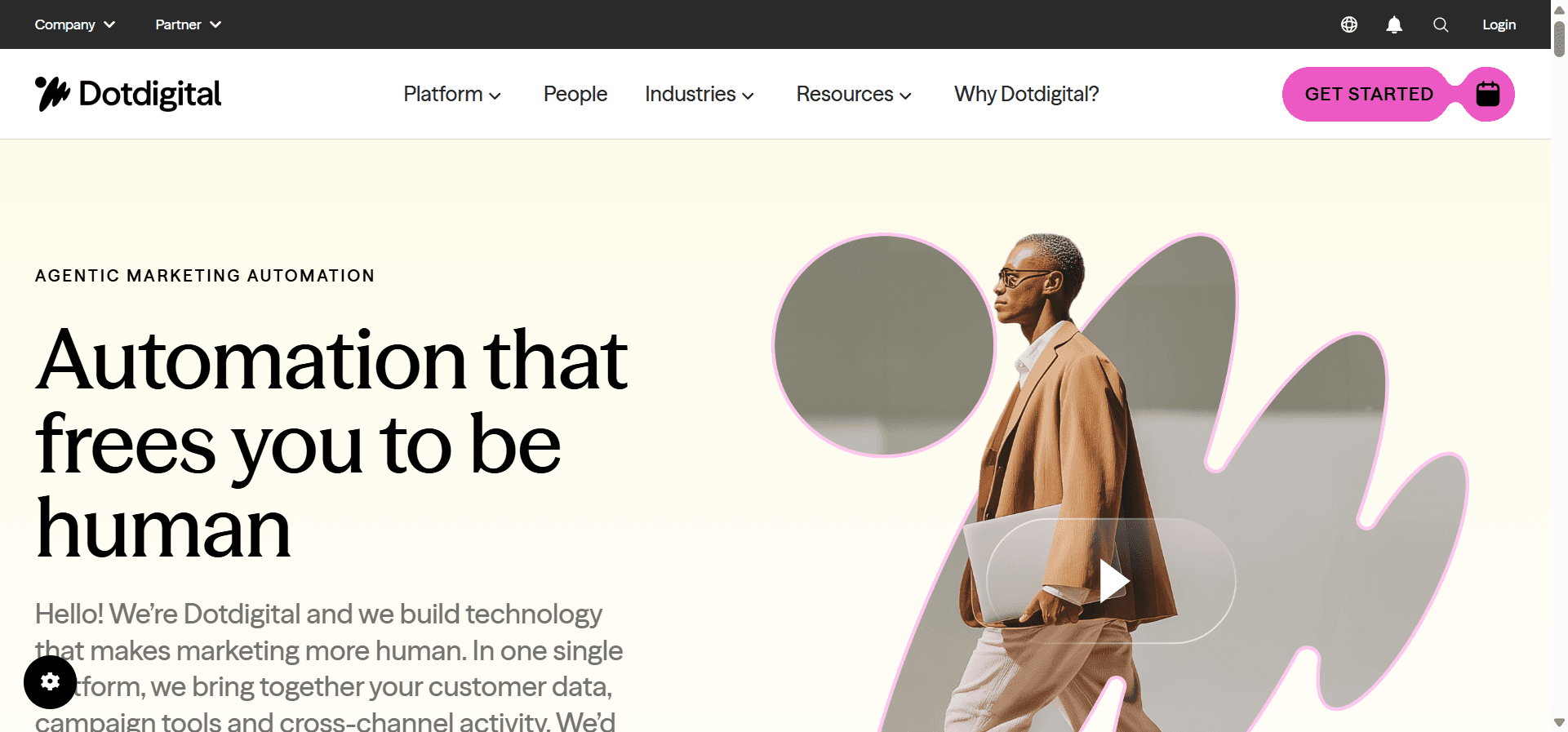
The platform is particularly well-regarded in the retail sector, with native integrations into Magento, Shopify, and Microsoft Dynamics 365 that are among the most reliable available for businesses running on those platforms.
The platform's strength is in its combination of email sophistication and usability. The drag-and-drop email editor is flexible enough to produce professional designs without requiring HTML knowledge.
Dynamic content blocks and personalization tokens allow significant message customization at scale, and engagement scoring helps teams prioritize their most and least active contacts for different treatment.
Key Features:
- Email, SMS, push notifications, and social ad retargeting from one platform
- Visual drag-and-drop journey builder for cross-channel automation
- Transactional email and SMS delivery via API
- AI-powered product recommendations based on behavioral data
- Engagement scoring and contact lifecycle management
Pros:
- The Magento and Microsoft Dynamics 365 integrations are among the most stable and available for businesses on those platforms
- The drag-and-drop email editor is the right balance of ease and flexibility. It is easy enough for non-designers and flexible enough for professional output
- Campaign reporting shows engagement at the individual contact level. It makes it practical to identify which audience segments are performing and which need different treatment
Cons:
- The platform's AI-driven automation features could be more evolved as compared to newer omnichannel marketing tools
- Parts of the admin interface feel dated compared to more recently built platforms
Pricing
Dotdigital does not offer pricing information publicly. The platform pricing is quote-based and dependent on the number of contacts. You need to request a demo or contact its sales team for more information.
Best for: Mid-market retailers and B2B companies using Magento or Microsoft Dynamics that need cross-channel automation with strong email at the core.
Ortto
Ortto is a customer data and marketing automation platform that combines a native CDP, visual journey builder, and multi-channel messaging in one interface.
The central design decision that distinguishes Ortto is its built-in data layer. Instead of requiring a separate customer data platform to feed campaign logic, Ortto handles all the marketing initiatives from the same platform.
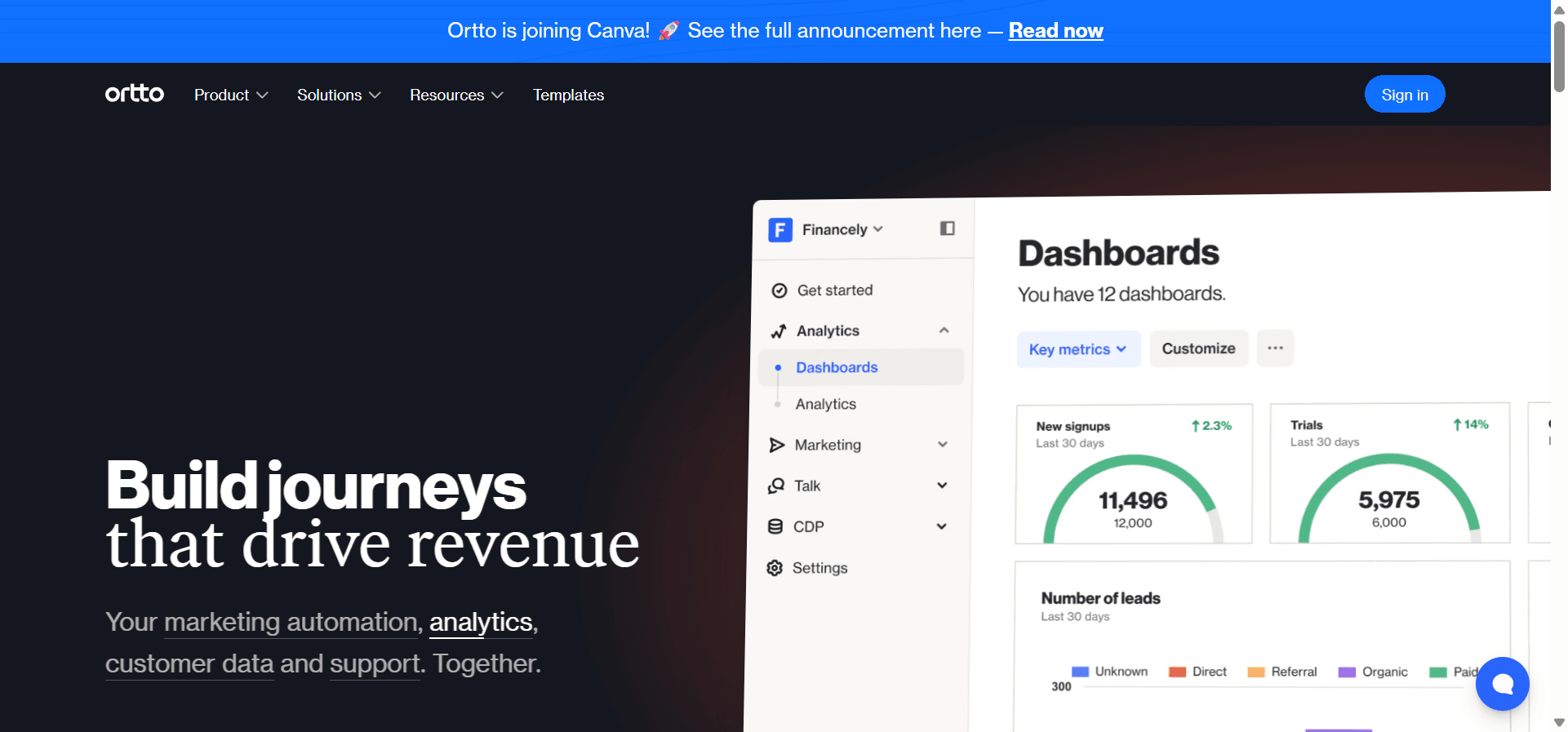
The platform covers email, SMS, push notifications, in-app messaging, and live chat. Its visual journey builder is one of the most intuitive in this category.
Ortto also ships Playbooks, which are pre-built automation templates to get started with your marketing campaigns by having a reference point for lifecycle scenarios that matter the most for your business.
Key Features:
- Native customer data platform with event tracking built in
- Visual journey builder with conditional branching and merge nodes
- Pre-built templates for getting started
- Analytics dashboards and funnel visualization built into the platform
Pros:
- The native CDP removes the dependency on third-party data connectors
- The visual journey builder is the most intuitive in this category
Cons:
- Email deliverability occasionally needs some warming up for new sending domains
- The SMS channel is less mature than email and push in terms of available automation features and trigger options
- The built-in contact management can be more sophisticated. It may not be enough for teams with complex sales pipelines
Pricing
Ortto does not provide pricing information. You have to sign up for the platform to see your plan and billing details within your profile.
Best for: B2B SaaS and subscription-first businesses that want unified customer data and visual journey automation without a separate CDP.
Select the right omnichannel marketing tool to boost business growth
Omnichannel marketing tools are not all the same. Choosing the right one for your business depends on your channel mix, team size, technical resources, and budget.
Enterprise teams with complex personalization needs and large catalogs will gravitate toward platforms like Insider One or Bloomreach. E-commerce businesses on Shopify will find Zixflow and Omnisend the fastest path to co-ordinated automation. SaaS and subscription businesses with event-rich product data will get the most from Customer io or Ortto.
For growing businesses that need an omnichannel marketing tool with a variety of channels along with a built-in CDP and without the complexity of enterprise setup, Zixflow is built specifically for that use case.
You can set up multi-channel sales engagement from day one and run campaigns across channels your customers prefer without connecting multiple tools. If that matches where your business is headed, start a free trial and see how it fits.
Frequently asked questions about omnichannel marketing tools
What is the difference between omnichannel and multichannel marketing?
Multichannel marketing means using multiple channels to reach customers, but each channel operates independently. Omnichannel marketing means all channels are connected through shared customer data, so the experience is coordinated across every touchpoint. The key difference is whether the channels talk to each other.
Which omnichannel marketing tool is best for small businesses?
Zixflow and Brevo are the most accessible options for small businesses. Zixflow's pay-as-you-go campaign wallet means smaller businesses pay for what they use rather than worry about contact-based pricing where you are charged based on the number of contacts you add to the platform.
Brevo offers a free plan with 300 emails per day and volume-based pricing. Both are designed for teams without dedicated marketing operations resources.
Do omnichannel marketing tools include WhatsApp?
Not all of them. WhatsApp Business API integration is native in Zixflow, Brevo, and Insider One. Other platforms support WhatsApp through third-party connectors, which adds a dependency and potential point of failure. If WhatsApp is a primary channel for your business, native support matters.
How many channels should my omnichannel marketing platform support?
There is no universal answer. Start with the two or three channels your customers actually use most, then expand. Running three channels well beats running six channels poorly. The right platform should support your current channels natively and have a credible roadmap for the ones you plan to add.
Can omnichannel marketing tools integrate with my existing CRM?
Most platforms on this list offer CRM integrations, though the depth varies. Zixflow has a strong native CDP for maintaining a unified customer profile. Omnisend connects well with Shopify's customer data. Before committing to any platform, verify the specific CRM integration you need is native and not just a Zapier connector, which can introduce reliability problems at scale.
How do I measure the success of omnichannel marketing campaigns?
Effective measurement requires tracking performance across channels in one view rather than reading siloed reports per channel. Look for revenue attribution that ties specific campaigns to sales and measuring customer engagement metrics that show how customers move across channels in a single journey. The best omnichannel tools provide these reports natively without requiring a separate analytics tool.