Braze Alternatives: 7 Cost-Effective Options for Engagement in 2026
The best Braze alternatives are Zixflow, Customer io, CleverTap, OneSignal, Klaviyo, Iterable, and MoEngage, compared on pricing, channels, and team fit.
 by Sahil Tyagi

Braze is a powerful platform, but its pricing grows with your audience. Additionally, the add-ons can quickly push up the bill even more. With Salesforce set to acquire Braze, many brands are also rethinking their options.
So, here are some of the best Braze alternatives to help you find the right fit for your outreach:.
- Zixflow: WhatsApp, RCS, and SMS outreach with automatic fallback
- Customer io: Event-driven messaging for product-led teams
- CleverTap: Mobile-app retention and analytics
- OneSignal: Push-first apps on a budget
- Klaviyo: E-commerce brands running on email and SMS
- Iterable: The closest like-for-like Braze replacement
- MoEngage: Large brands that need feature depth
Reaching customers at the right moment, on the right channel, is what keeps them coming back. That's why most companies rely on one of the many customer engagement platforms. These tools run their emails, push notifications, SMS, and WhatsApp messages from one place.
Braze is one of the best-known names in this space. It's a powerful platform, but it's priced for enterprises with complex engagement needs. The bill grows with your audience whether your results do or not.
So if you're a marketing manager wondering whether you're paying for more tools than your outreach needs, you're not alone. There are several solid tools that can do the job at a lower cost and better fit the channels your customers actually use.
On top of that, Salesforce has just agreed to acquire Braze, and a lot of brands are asking what comes next.
That's why in this blog, I’ll cover the best Braze alternatives to help you decide which one is most suitable for your requirements. I’ll go through each tool’s pros and cons along with the brands that use it. So, let's get into it!
Why should you switch from Braze?
You should consider switching from Braze if your bill is growing faster than your results. If most of your outreach runs on a particular channel or if your team struggles to make use of its more technical features, then looking for a Braze alternative might be a good choice for you.
Pricing follows your audience
Braze charges based on monthly active users, message volume, contract length, and feature tier. That means every audience you grow and every channel you add pushes the invoice up. However, you have to consider whether engagement or revenue is matching this cost or not.
For businesses with large but mostly inactive databases, this can be especially painful. You end up paying for reach you aren't converting, and the gap between cost and results widens with every renewal.
Add-ons raise the real bill
The platform fee is rarely the whole cost. Braze Currents data streaming can cost somewhere from $10,000 to $50,000 or more a year depending on volume.
On top of that, Predictive Analytics and advanced segmentation features can further drive up the base contract cost by 15 to 25%. So when you compare Braze to an alternative, compare the full 12-month cost, not just the headline quote.
Messaging costs can add up
Braze uses its own usage currency called Action Credits. It is a pool of all the credits within your account and will be used when you send messages across channels or use features like Braze Agent Console or AI Designing Studio.
In the context of messaging, SMS and WhatsApp can use varying amounts of Action credits depending on the country and message type. So high-volume international SMS campaigns can become materially more expensive than the platform fee suggests.
Salesforce acquisition of Braze
On October 20, 2026, Salesforce announced a definitive agreement to acquire Braze for about $5.66 billion in enterprise value. The deal isn't complete yet, but it’s expected to close in Salesforce's fiscal year 2028, subject to Braze shareholder approval and regulatory approvals.
Salesforce plans to bring Braze together with Marketing Cloud, Data 360, Agentforce, and CRM. Marketing Cloud's cross-channel personalization is expected to get a boost from Braze.
What does it mean for current Braze users?
For now, nothing changes day to day. Your contract data and support stay the same until the deal closes, and Braze has said it will keep building its platform post finalization.
What's less clear is what happens after the close, such as how Braze fits into Salesforce's product bundles, roadmap, and pricing.
So if your renewal date falls in the next 12 to 18 months, it's worth asking these practical questions:
- Can you lock in existing pricing and exit clauses for after acquisition?
- How will the product roadmap and integrations change once Braze becomes part of Salesforce?
- Will your support team and account contacts stay the same?
You don't need to switch just because of the acquisition. But a renewal during an ownership change is a good moment to compare quotes and make sure you're on the right platform.
What does it mean for new users?
If you're evaluating Braze for the first time, you'll be buying into a platform whose long-term direction will be shaped by Salesforce. If you already run Salesforce Marketing Cloud or CRM, the addition of Braze can be a plus.
Conversely, if you don't use Salesforce, factor this uncertainty into your decision. Also, keep a few alternatives in your back pocket should you need to switch before finalizing a contract.
How did I choose these tools for this blog?
I picked these tools by looking at the factors that matter most when you're replacing Braze on a budget, and we only used publicly available data from sources and review sites. Here's what I looked at for each tool:
Pricing and contract data
Since cost-effective outreach is my primary objective, pricing came first. We checked each tool's published plans and contract data, which tracks real purchases rather than list prices.
This lets me compare each tool against Braze's average contract. Where a tool doesn't publish pricing, I've said so in the tool's section.
Channel coverage
Next, I looked at which channels each tool supports. I paid extra attention to WhatsApp, SMS, and push, because these channels drive most outreach costs and are where carrier fees add up. A tool that's cheaper on paper but missing a channel you rely on can end up costing more once you add a second platform. That's why I've called out channel gaps.
User ratings and reviews
Every tool on this list holds a rating of 4.4 or higher on G2. I also used G2's review summaries to pull out the strengths and weaknesses for each Braze alternative. This way, the information you read here comes from real users rather than the tool’s website.
Proven customers
I only included tools with published customer stories or named customers. Knowing which brands use a platform gives you a sense of the industries and scale it's built for. For instance, a tool used mainly by Shopify brands will suit a DTC business better than an enterprise bank. So I've listed each tool's top customers to help you find one that serves businesses like yours.
Fit for Braze-style use cases
Each tool on this list can run lifecycle journeys, campaigns, and segmentation. This means it can replace Braze for at least part of your customer engagement strategy, and not just for a single channel.
Free plan or free trial
Finally, I checked whether you can try each tool before you buy. A free plan or trial lets you test a real journey with your own data, which tells you far more than a sales demo.
Where a tool only offers a demo, I’ve marked it in the comparison table. That way, you know which platforms you can pilot right away and which ones need a sales conversation first.
Best Braze alternatives for cost-effective outreach
As capable as Braze is, it's not the only option for running cross-channel customer engagement at scale. Below are the best alternatives worth a look. Some offer a lower entry price. Others bring better WhatsApp support, or a platform your team can run without a lifecycle engineer.
| Tool name | Best for | Free trial / free plan |
|---|---|---|
| Zixflow | Omnichannel marketing with cascading fallback for B2C brands | 7-day free trial with no payment details |
| Customer io | Event-driven messaging for product-led teams | 14-day free trial, no card |
| CleverTap | Mobile-app retention and analytics | Free trial offer via G2; otherwise demo |
| OneSignal | Push-first apps and publishers on a tight budget | Free plan |
| Klaviyo | E-commerce brands driven by email and SMS | Free plan (up to 250 active profiles) |
| Iterable | Marketer-led journeys at a modest discount | No free plan. Demo on request |
| MoEngage | Large brands that want feature depth | No free plan. Demo on request |
Zixflow
Zixflow is an agentic customer engagement platform. It works as a complete customer engagement loop that runs verification, lifecycle journeys, campaigns, and replies for every customer profile across WhatsApp, RCS, SMS, email, and push. It's built for outreach where delivery and replies decide the result.
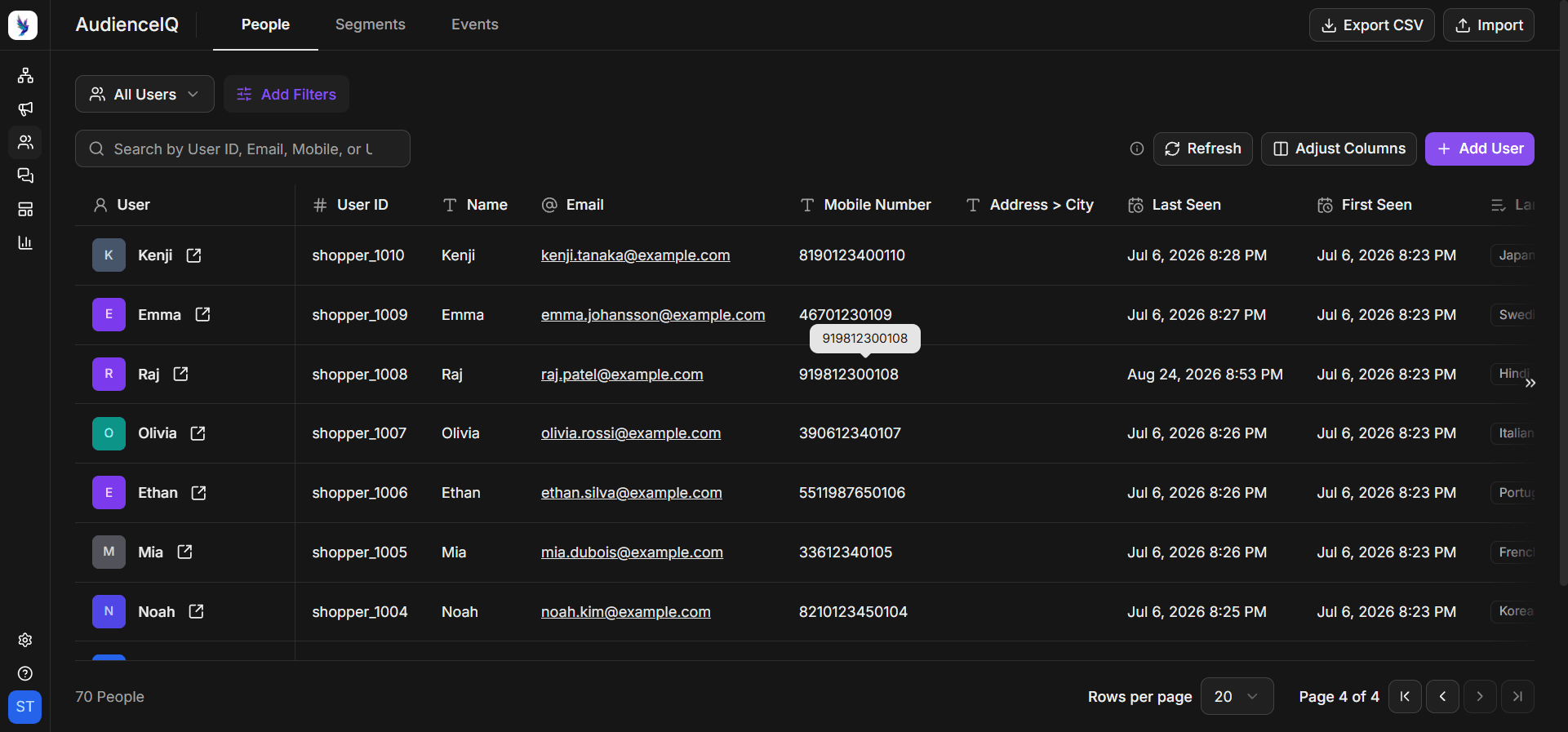
The biggest difference between Zixflow and other engagement tools is how Zixflow handles failed messages. When a message can't be delivered on one channel, a fallback cascade moves it to the next one automatically. This feature alone lets Kuku recover 77.09% of messages that had previously failed.
On top of that, Zixflow lets you get started with your customer engagement within hours if you already have DLT verification or a WhatsApp Business Account. After connecting your accounts with Zixflow, you can start building communication workflows instantly without worrying about an approval period.
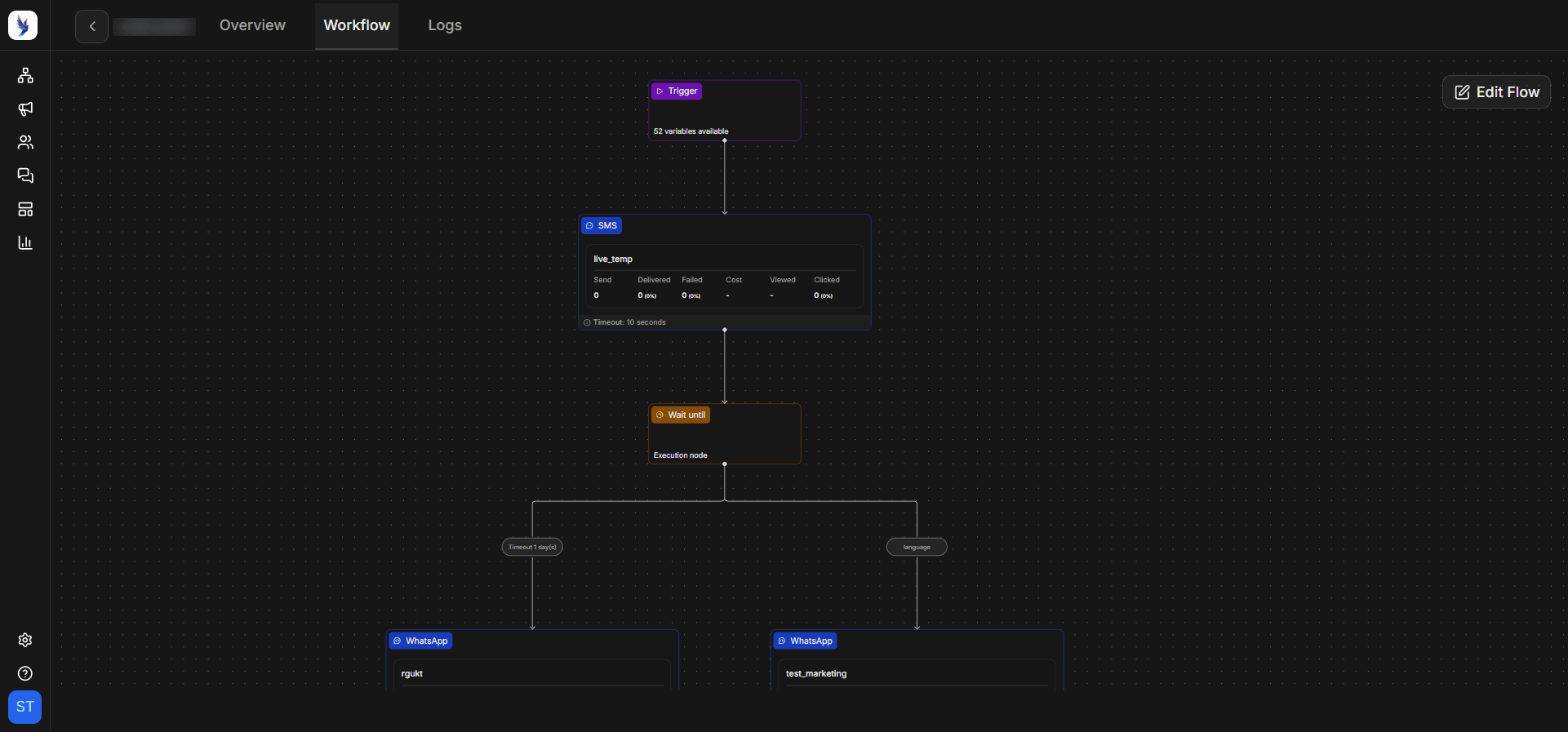
Also, the platform comes with a native unified inbox, where replies are consolidated from every channel. Your team can pick up conversations in one place instead of switching inboxes.
Best suited for
Zixflow is best suited for B2C brands, consumer apps, and fintechs that rely on WhatsApp, RCS, and SMS. Typical uses include one-time passwords (OTPs), marketing campaigns, and lifecycle messages. It works especially well in WhatsApp-first markets, where message delivery directly affects sign-ups and revenue.
Notable clients
Tata Consumer Products, Dabur, Kuku, TJSB Bank, SDCC Bank, Sharekhan, IndoSpace, Shapoorji Pallonji, and Seekho. You can read our customer success stories on the case studies page.
Pros
- Automatic fallback across WhatsApp, RCS, SMS, and email to recover failed messages
- Free tier that doesn't need a credit card
- In-built CDP for effective contact management
- Customized journeys to engage customers at the right time
Cons
Platform is not suited for single-channel-focused businesses Setting up APIs and the software integrations might take time at first Relatively newer platform with fewer reviews than older platforms
Pricing
7-day free trial with no card required to check out the platform in action before committing. Paid plans are based on your outreach needs, depending on your channels and volumes. You can set up a tailored demo to talk to sales.
Rating
4.9 out of 5 stars (29 reviews) G2
Customer io
Customer io is a customer engagement platform built for product-led companies. It lets you trigger messages based on what users actually do in your product. Channels include email, SMS, push, in-app, WhatsApp, and webhooks for sending automatic alerts to other tools.
The visual workflow builder lets you create journeys from events and attributes. You can send an onboarding nudge when a user skips a step, or a win-back email when activity drops. The platform also includes an AI agent that handles repetitive campaign work, so your team can focus on timing and strategy.
Best suited for
Customer io suits SaaS, marketplace, and app-based businesses with modest audience sizes and technical teams that want fine control over event-based messaging.
Notable clients
Notion, StuDocu, ZEN, TryHackMe, and WIN Reality.
Pros
- An easy-to-use interface that makes building campaigns simple
- Strong automation for campaigns triggered by what users do in your product
- Helpful and responsive customer support when you need it
Cons
- A steep learning curve for detailed workflows
- Reporting is a little limited and often needs workarounds or exports
- New users might find the navigation and segmentation confusing
Pricing
The Essentials plan starts at $100 per month for 5,000 profiles, and Premium starts at $1,000 per month. The Enterprise plan is tailored based on your usage. A 14-day free trial needs no credit card.
Rating
4.4 out of 5 stars (976 reviews) G2
CleverTap
CleverTap is an engagement and retention platform with a mobile-first framework. It combines analytics, segmentation, and campaign orchestration across multiple channels like push, in-app, email, SMS, and WhatsApp. An AI decisioning engine helps personalize your outreach based on customer behavior.
I like how CleverTap gives you access to analytics and engagement side by side. The same team that tracks an engagement funnel can act on it with a targeted campaign.
Best suited for
CleverTap works best for mobile app brands in gaming, fintech, retail, and media. It is a good choice if you want strong analytics and retention tooling in the same category as Braze, at a lower price point.
Notable clients
CleverTap serves clients like TD Bank, AirAsia, Tesco, Papa John's, the English Premier League, and Carousell.
Pros
- Clear, easy-to-read analytics that make campaign tracking simple
- Responsive customer support that helps you get the most out of the platform
- Strong personalization and automation for targeted campaigns
- Push, SMS, email, and WhatsApp campaigns from one dashboard
Cons
- It takes time to learn your way around the platform, especially for new users
- The interface can feel technically complex if your marketing team doesn't have tech support
- The platform can get pricey as you add modules and scale up
Pricing
The platform offers four tiers: Essentials, Advanced, Cutting Edge, and Enterprise. Pricing isn't available on its website, so you'll need to ask for a quote. Also, clarify which modules are bundled with what, because CleverTap offers several products separately.
Rating
4.6 out of 5 stars (681 reviews) G2
Paying for More Platforms than You Use?
Zixflow lets you run WhatsApp, RCS, SMS, and email outreach with automatic fallback until your message is delivered.
Get StartedOneSignal
OneSignal started as a push notification service but has grown into a customer engagement platform covering numerous channels, such as mobile push, web push, email, in-app messaging, SMS, RCS, and Apple's Live Activities.
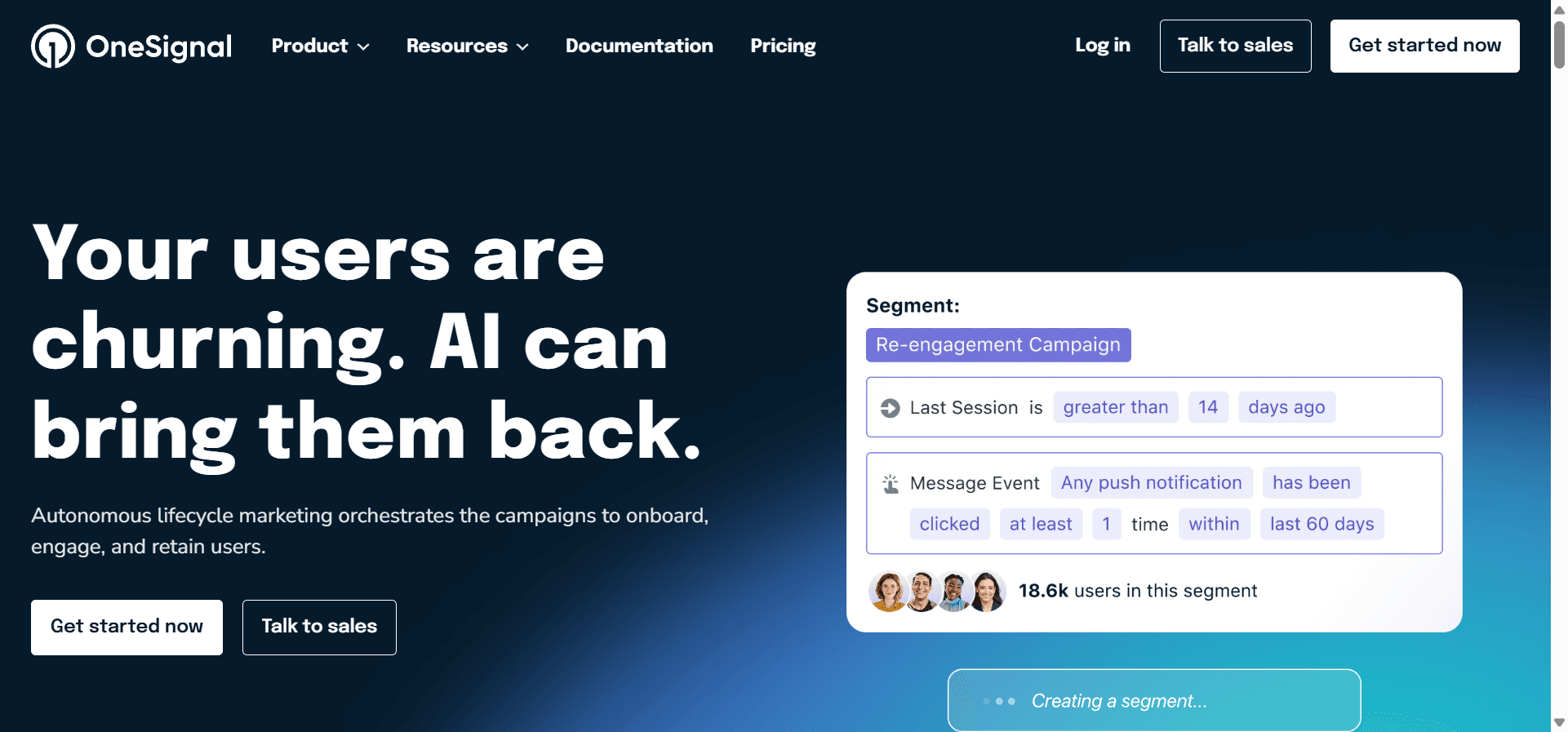
It's known for being quick for developers to set up and easy for marketers to use afterward. The Journeys feature lets you build automated flows. Plus, an open API gives developers room to customize your outreach the way you want.
Best suited for
OneSignal suits app and web publishers that work in industries like gaming and media brands where push notifications are the main retention channel. It's less suited for WhatsApp-first outreach, as WhatsApp is not a native channel in the platform.
Notable clients
OneSignal's published case studies include BetterMe, TAG Heuer, Product Hunt, and Kinsta.
Pros
- Quick to set up and easy to use day-to-day
- A generous free plan to get started with push notifications
- Simple integrations and API connection
Cons
- Segmentation and some advanced features are limited compared to bigger platforms
- Integrations can take some getting used to at first
- Many advanced features sit behind paid plans
- No native WhatsApp channel
Pricing
OneSignal offers a free plan, a Growth plan starting at $19 per month, and a Professional plan with custom pricing. SMS and email are billed based on usage.
Rating
4.7 out of 5 stars (1,243 reviews) G2
Klaviyo
Klaviyo is a B2C solution built for e-commerce. It brings email, SMS, RCS, mobile app messaging, WhatsApp, and social marketing together with a customer data platform. You can segment shoppers based on real purchase behavior to send timely messages.
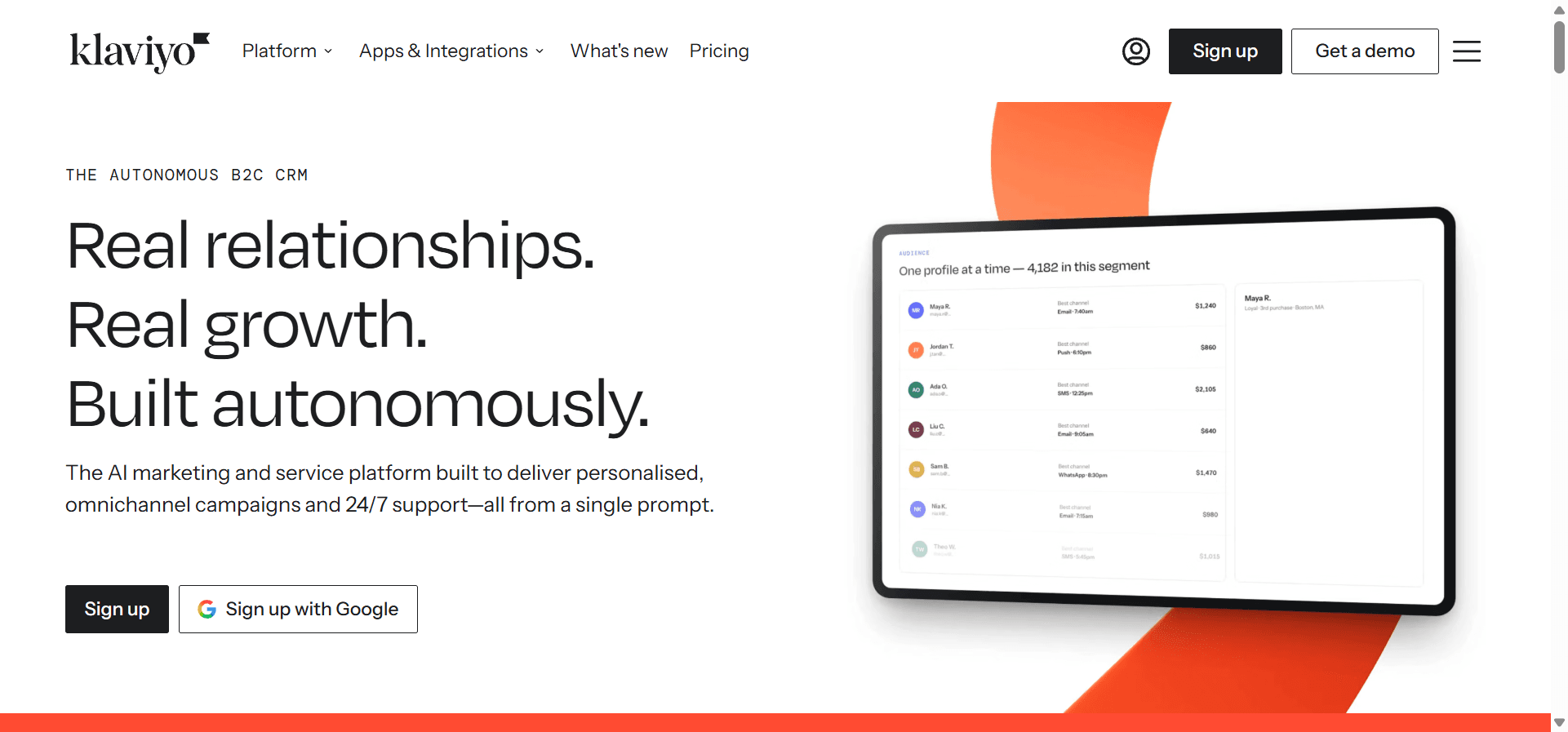
Klaviyo is built for e-commerce brands with deep integrations with Shopify, WooCommerce, and other e-commerce platforms. It allows you to set abandoned cart and post-purchase follow-ups that trigger easily from store data.
Best suited for
Klaviyo fits direct-to-consumer (DTC) and e-commerce businesses, especially on Shopify, whose revenue is driven by email and SMS. It's less of a fit for app-first businesses that need deep mobile journeys.
Notable clients
Dollar Shave Club, Dermalogica, ThirdLove, Marc Fisher Footwear, Hint Water, and Proper Hotels appear too.
Pros
- An easy-to-use interface for building campaigns and flows
- Powerful automation for revenue-driving flows
- Strong e-commerce integrations, especially with Shopify
- Rich segmentation built on purchase data
Cons
- Costs climb as your list grows
- Advanced flows and segments take time to master
- Its messaging features across other channels are less developed than its email tools
Pricing
Klaviyo offers a free plan that covers up to 250 active profiles and lets you send 500 emails per month. Apart from that, Klaviyo has multiple pricing options that each handle different use cases, like marketing, data analytics, and customer service.
Rating
4.6 out of 5 stars (1,370 reviews) G2
Iterable
Iterable is an AI customer engagement platform and the closest like-for-like swap for Braze. It uses a similar MAU and message-volume pricing model. A visual journey builder that covers email, SMS, push, in-app, and web push.
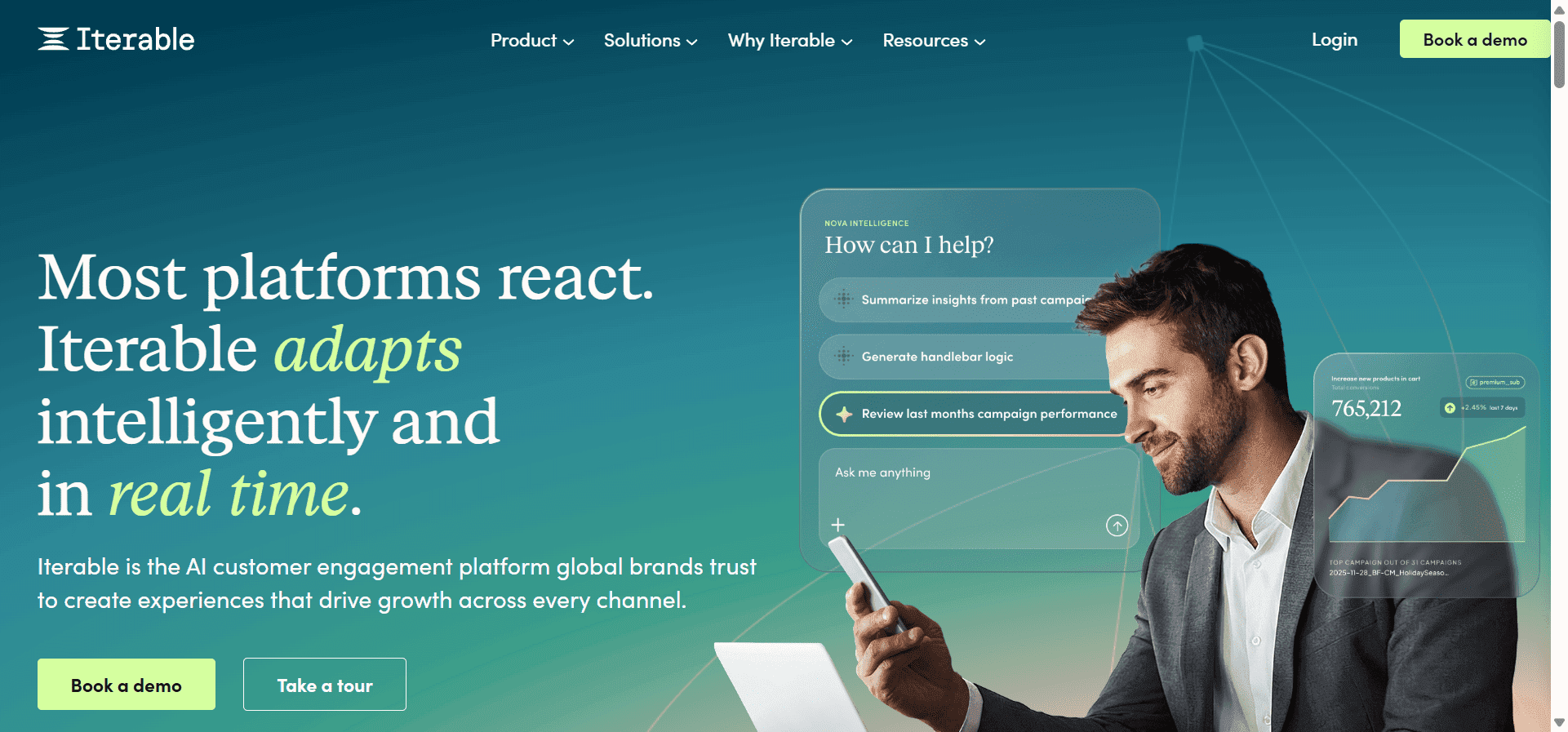
Brands particularly like how much they can do with Iterable without requiring heavy engineering support. Also, its features like Catalog, embedded messaging, and AI optimization help you personalize campaigns at scale.
Best suited for
Iterable suits mid-market and enterprise consumer brands that like how Braze works. They want a slightly lower price and a marketer-friendly interface.
Notable clients
Zwift, Babylist, Superhuman, Therabody, TodayTix, and 99designs.
Pros
- A clean UI for campaigns and journeys
- Hands-on support during onboarding
- Quick to set up for marketing teams
- Effective automation across channels
Cons
- Some features, like advanced filtering, are missing from the platform
- Advanced segmentation and journey analysis take time to learn
- Reporting and conversion tracking can be limited for deeper analysis
Pricing
Iterable doesn't publish pricing. However, based on the earlier comparison, the Growth plan runs $25,000 to $50,000 a year for 10,000–50,000 MAUs, and the Scale plan runs $70,000 to $180,000 for 200,000 MAUs. For brands with bigger audiences, the Enterprise plan lets you get a tailored quote that suits your business.
Rating
4.4 out of 5 stars (840 reviews) G2
Want Outreach that Recovers Failed Messages?
Try Zixflow and see how fallback across channels changes your deliverability, ensuring each send generates an outcome.
Build CampaignsMoEngage
MoEngage is an agentic customer engagement platform used by brands in more than 60 countries. It unifies data and engagement across more than 16 channels. Its Merlin AI agents help teams build segments, campaigns, and insights to craft tailored outreach campaigns.
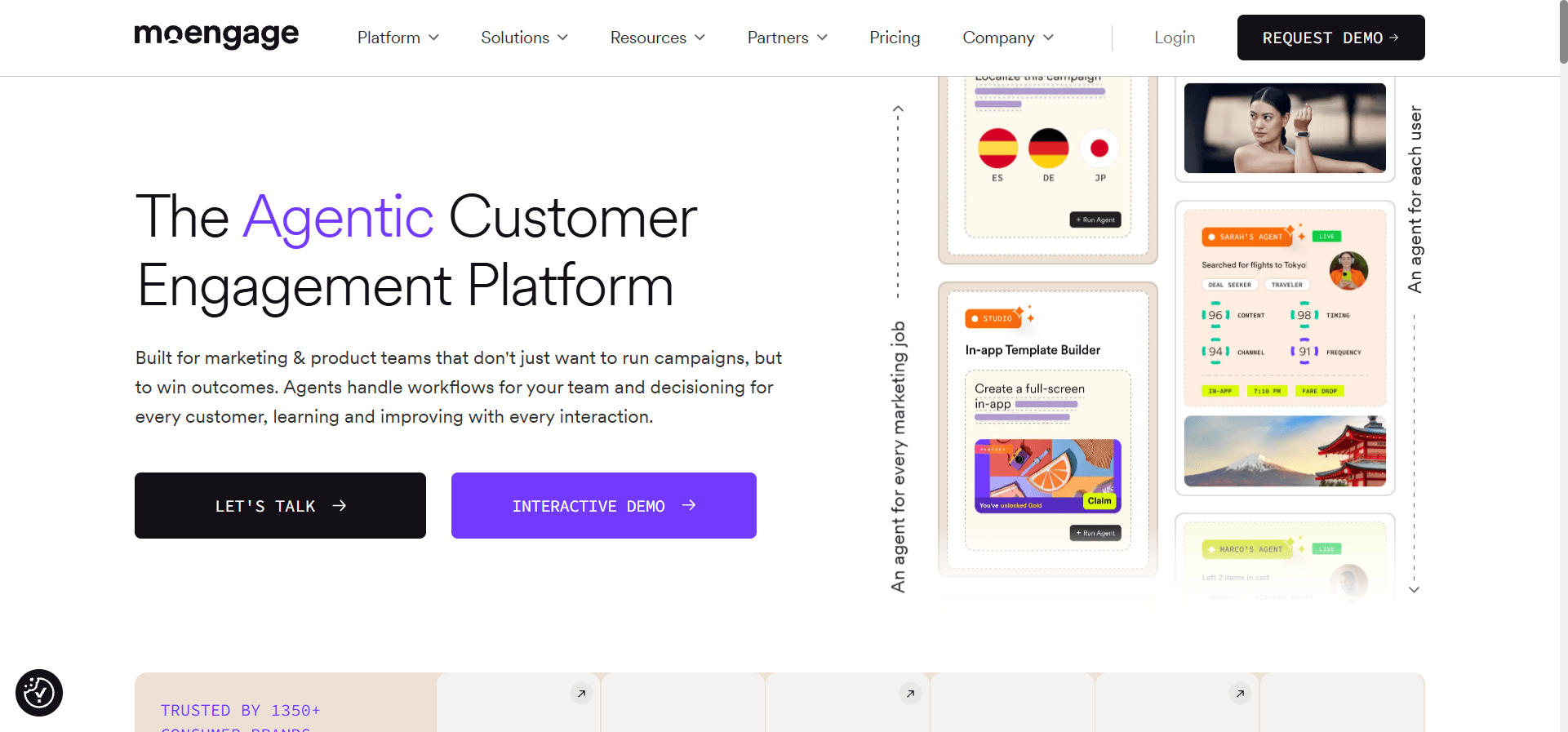
MoEngage also offers AI-powered features that help you optimize campaigns. This can be useful for businesses managing large customer bases, where sending the same message to everyone is unlikely to deliver the best results.
Best suited for
MoEngage suits large consumer brands in retail, media, and BFSI (banking, financial services, and insurance) that want feature depth and analytics. It's the pick where cost isn't the only driver.
Notable clients
Coca-Cola, Flipkart, Starbucks, Citibank, Domino's, T-Mobile, and OYO.
Pros
- Managing data and running campaigns are easier
- Real-time analytics that help you make faster decisions
- Powerful segmentation with detailed campaign stats
- Campaign management across a wide range of channels
Cons
- Some session-level attributes need technical help to set up
- New users can face a learning curve
- API usage can get costly as you scale
Pricing
MoEngage offers Growth and Enterprise tiers, with add-ons such as Cards, native WhatsApp, AI recommendations, and dedicated email IPs (private email-sending addresses). Its pricing is quote-based, and you’d have to talk to its sales team for more information.
Rating
4.5 out of 5 stars (534 reviews) G2
Who is Braze best suited for?
Braze is best suited for large B2C brands with big mobile-app audiences and complex cross-channel journeys, but you'll also want a technical team that can make full use of its data streaming and personalization tools. If you send high volumes of in-app, push, and email messages and have the budget for an enterprise contract, it's a strong fit.
Having said that, Braze is not a great fit for you if:
- Your audience is small or mid-sized, and the MAU-based pricing outweighs the value you get
- WhatsApp and SMS carry most of your outreach, since carrier fees sit on top of the platform price
- You don't have a lifecycle engineer or data team to run the more technical features
Choose the right Braze alternative for your outreach
So there you have it. These Braze alternatives can help you find a suitable alternative that is the best fit for your current and future engagement needs without losing reach, particularly as Braze heads into its next chapter under Salesforce.
Before you pick one of these tools, price your actual audience and channel mix in each vendor's own unit, whether that's monthly costs or MAUs. Then compare 12-month totals. The lowest sticker price rarely wins once SMS and WhatsApp volume is counted. Running one journey as a pilot and measuring customer engagement against your current setup will tell you more than any feature list.
Having said that, if WhatsApp, RCS, and SMS drive your outreach, I'd suggest giving Zixflow a try. Its relatively low entry cost and advanced deliverability allow you to recover failed messages that would otherwise be a waste of your outreach cost.
The best part is you can create a free account without any financial details and test your first flow before committing fully.
Frequently asked questions about Braze alternatives
What are the best Braze alternatives?
The most commonly compared Braze alternatives are Zixflow, Customer io, CleverTap, OneSignal, Klaviyo, Iterable, and MoEngage.
How much does Braze cost?
Braze doesn't publish its pricing on its website. However, data from external sources show that the average cost is about $88,507 a year, with contracts from roughly $20,000 to more than $476,000.
The core deployments typically cost $30,000 to $60,000, and Pro runs $80,000 to $250,000. Your quote depends on monthly active users, message volume, tier, and add-ons.
What is the best Braze alternative for WhatsApp?
Zixflow covers WhatsApp with session-window awareness and cross-channel fallback. It supports native WhatsApp API integration, giving you access to your WhatsApp messaging templates along with all the necessary features to run WhatsApp outreach effectively.
How hard is it to switch from Braze?
It depends on how much logic lives inside Braze. Most teams move one journey first and run it against a holdout. Once the results prove that it’s working, they begin consolidating their infrastructure. Plan for data and event mapping, template re-approval for WhatsApp, and a period of running both platforms in parallel.