6 Ways To Use AI in WhatsApp Marketing in 2026
Use AI in WhatsApp marketing to personalize customer interactions, automate routine tasks, and improve campaign performance.
 by Sahil Tyagi
AI in WhatsApp marketing uses machine learning and natural language processing on top of the WhatsApp Business API to decide which customers to contact, with what message, at what time, and how to respond when the conversation continues.
The primary uses of AI in WhatsApp marketing are:
- Behavioral segmentation - dynamic micro-segments based on purchase history and engagement
- Automated abandoned cart recovery - AI-triggered sequences that stop if the customer converts elsewhere
- Lead qualification - scoring inbound leads before they reach sales
- Send-time and A/B testing optimization - segment timing and message testing
- Churn prediction - detecting drop-off signals before a customer goes silent
- Post-purchase recommendations - product suggestions calibrated to lifecycle stage
Personalization drives a 10 to 15% revenue lift for companies that execute it well, with outperformers growing up to 40% faster than those that don't. But to achieve these results at scale, requires a well-planned roadmap. This is where businesses take assistance using AI.
Personalization that once required large marketing teams running complex operations can now run automatically, inside a WhatsApp thread, without human intervention for every message.
WhatsApp, as a channel where customers check messages several times a day, is where that personalization reaches people at moments of genuine intent.
Most businesses are still using WhatsApp the way they use email broadcasts, such as sending the same message at the same time to the same list of contacts.
That's the gap AI closes.
So, in this guide, I'll walk you through practical ways to use AI WhatsApp marketing so you can see where the biggest opportunities are and how to act on them.
What is AI WhatsApp Marketing?
AI WhatsApp marketing is the use of machine learning and natural language processing to be more responsive marketing through the use of WhatsApp Business API.
Rather than sending the same message to every contact on a scheduled broadcast, businesses use AI to decide which customers to contact, with what message, at what time, and how to respond when the conversation continues.
The key difference from standard WhatsApp automation is decision-making. Basic automation fires a message when a trigger is met. AI determines whether the trigger should fire for that specific customer, what content serves them best, and what action to take based on how they respond.
For brands already running WhatsApp marketing campaigns, AI capabilities can be layered onto existing flows without rebuilding the setup from scratch. The infrastructure is already there. AI just adds the intelligence on top.
Best ways to use AI in WhatsApp marketing
With that said, let's look at each of these ways to adopt AI into your WhatsApp marketing efforts to improve the overall efficiency of your initiatives:
Personalize at scale with behavioral segmentation
It’s a known fact that generic broadcast messages lose engagement. The same offer sent to every contact ignores the reality that a customer who bought twice last month responds to different messaging than someone who hasn't purchased in 90 days.
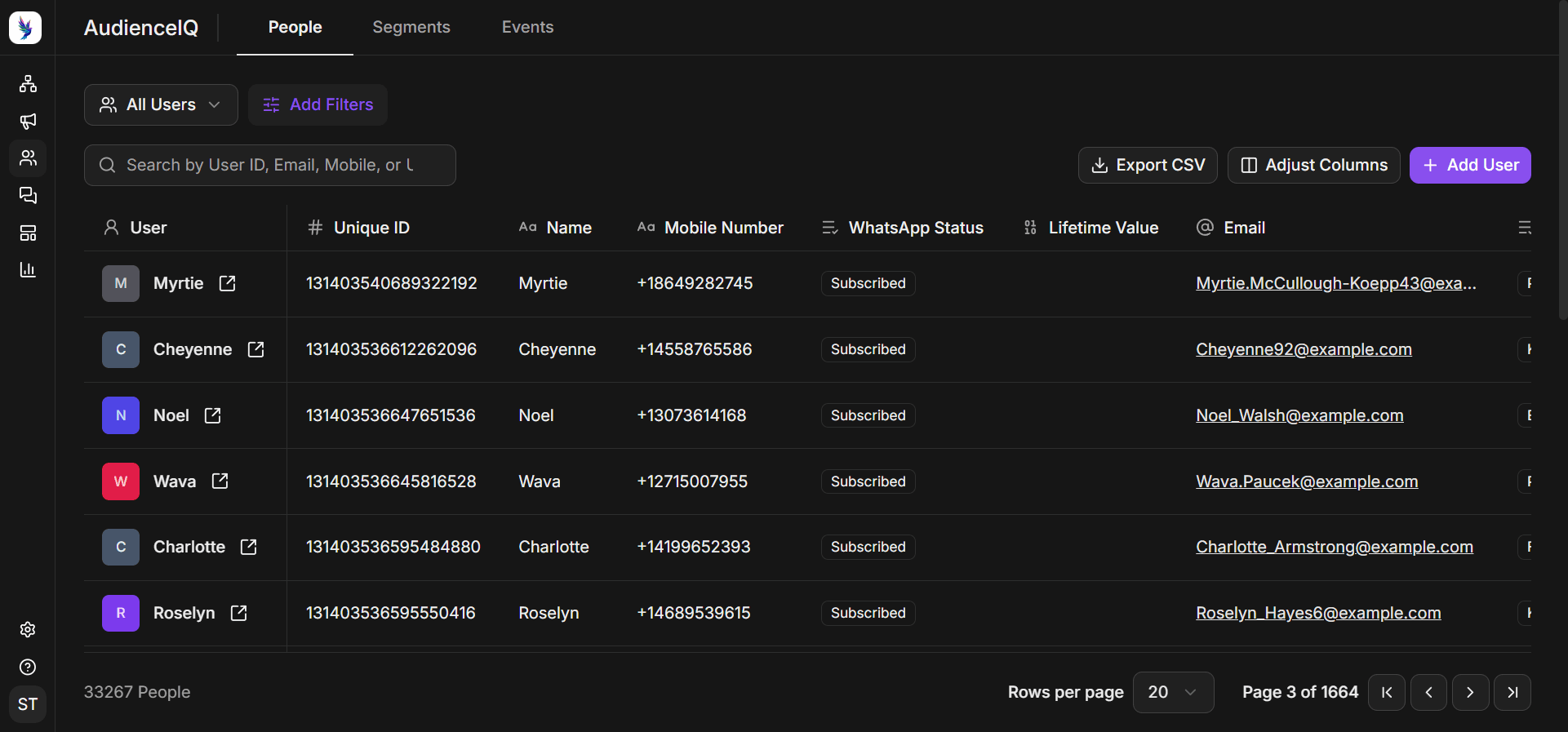
AI changes this by analyzing purchase history and engagement patterns to create dynamic micro-segments, each mapped to a specific message strategy.
To achieve this practically, the starting point is connecting your CDP or importing your e-commerce data to WhatsApp. AI models analyze each customer's purchase recency, frequency, and behavior and assign them to segments automatically. Each segment receives messaging calibrated to where that customer sits in their lifecycle.
On WhatsApp, where messages are opened at rates that far outpace traditional marketing channels, that personalization reaches customers while they're actively engaged.
Not just that. The same AI that builds the segment refines it over time as customer behavior changes, so the segmentation improves with every campaign cycle. WhatsApp customer segmentation done this way transforms a broadcast list into a precision marketing channel.
Automate abandoned cart recovery
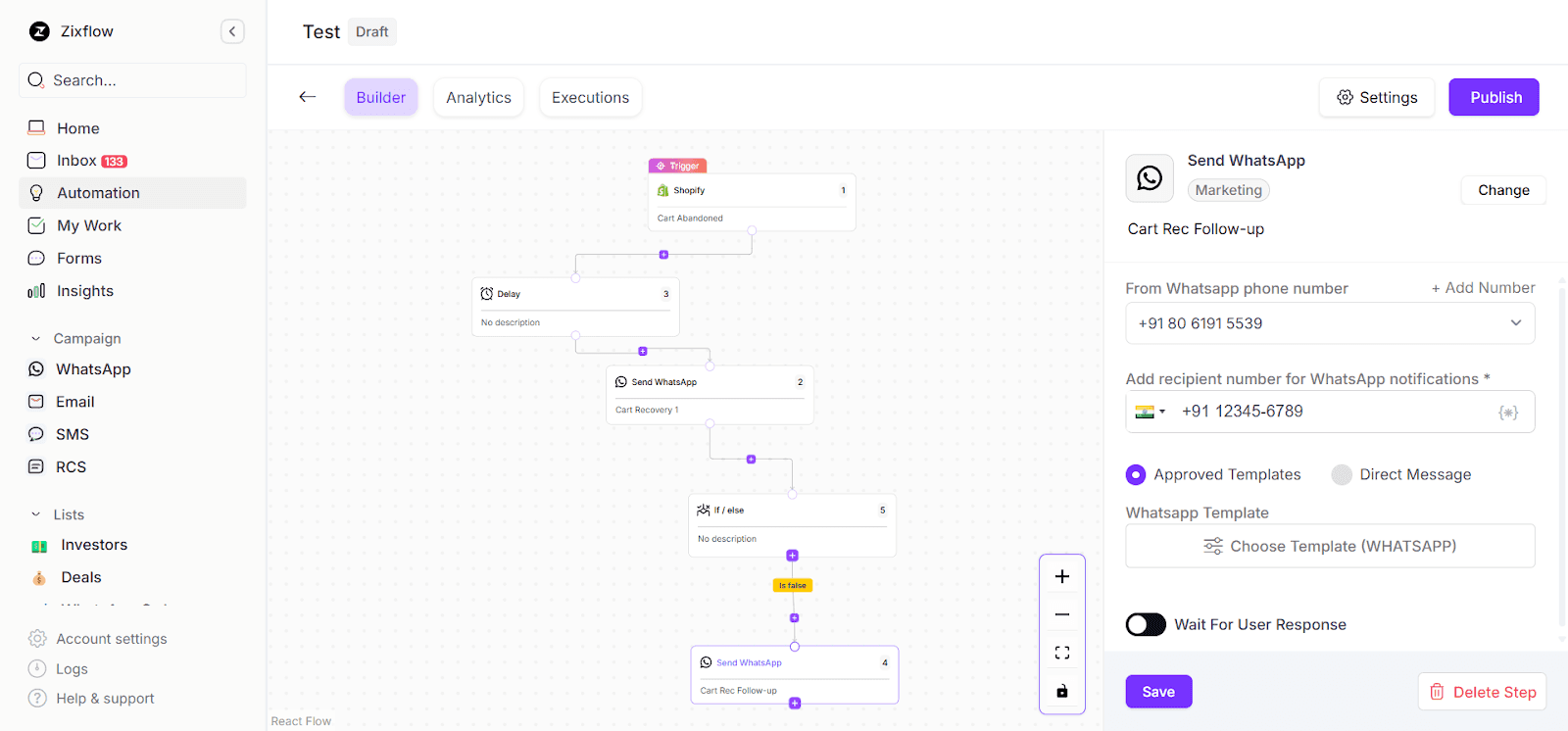
Cart abandonment is one of the most predictable revenue recovery opportunities for most D2C brands. When a customer adds items to a cart and doesn't complete the purchase, the window to recover them back is short. AI-powered WhatsApp sequences are well-suited for this moment because they reach customers immediately.
AI handles both the trigger and the content. When a user adds an item to a cart but doesn’t complete the purchase, AI identifies the customer's segment and purchase history and determines the right message.
For example, a first-time visitor gets a simple reminder with the cart contents. But a returning customer gets a more tailored follow-up that might include a time-sensitive offer based on their previous purchase behavior.
The sequence is also smart enough to stop if the customer purchases through another channel. Over-messaging someone who has already converted is one of the fastest ways to generate opt-outs, and AI removes that risk by monitoring cross-channel activity.
Qualify leads before they reach sales team
Not every inbound WhatsApp message deserves immediate sales attention. If you are getting hundreds of inquiries daily, you can't have a rep evaluate each one manually.
AI-powered WhatsApp chatbots solve this by running an initial qualification conversation to gather the information a sales rep needs and scoring the lead before any human gets involved.
The qualification flow collects what your team needs to prioritize like the lead's use case, company size, timeline, and budget. An WhatsApp AI then qualifies these leads against your qualification criteria and assigns a score.
Leads above a certain threshold get routed to a rep with the conversation summary already attached. Leads below the threshold enter a nurture sequence automatically, so they don't go cold while the team focuses on higher-priority conversations.
This approach protects your sales team's time without letting potential revenue slip through the cracks. It also gives lower-intent leads a structured follow-up experience rather than being ignored.
Optimize your marketing campaigns
Sending the right message at the wrong time is a missed opportunity. Most marketing teams apply a single send time to an entire list, based on general industry benchmarks. However, AI finds the pattern inside your specific customer data.
Send-time optimization works by analyzing when individual segments historically engage with WhatsApp messages. For instance, customers who open messages at 10 AM on weekdays behave differently from ones who respond to weekend evening messages. AI tracks this behavior at scale to build a segment-specific timing profile which adjusts as customer habits change over time.
Additionally, A/B Message testing runs alongside timing optimization. AI helps you test different opening lines and call-to-action phrasing across audience segments to figure out which variant performs better.
This removes the manual testing cycle that most teams run infrequently. On top of that, AI can assess historical response rates to determine the optimal message frequency per segment so high-engagement customers get more touchpoints while low-engagement contacts get throttled before they opt out.
WhatsApp automation platforms that include these optimization layers reduce the ongoing manual work of campaign management significantly.
Retain customers by detecting patterns
Waiting until a customer goes silent to try re-engaging them is already too late. By the time someone hasn't purchased in three months, the relationship is harder to revive than it would have been weeks earlier. AI changes the timing by identifying churn signals before a customer fully disengages.
Common churn signals includes:
- A drop in message open rates
- A longer-than-usual gap since the last purchase
- A shift from interactive responses to no response at all
AI monitors these signals across your customer base in real time and flags contacts who are trending toward churn before they cross the threshold.
Once flagged, those customers automatically enter a re-engagement WhatsApp sequence calibrated to their history with your brand.
WhatsApp drip campaigns built around churn prediction models consistently outperform generic win-back blasts because the timing is earlier and the content is more relevant. Retaining an existing customer costs significantly less than acquiring a new one, and AI makes retention proactive rather than reactive.
Automate post-purchase interactions
The moment after a purchase is one of the highest-intent windows in the customer relationship. The customer just validated trust in your brand. AI can use that moment to recommend a product that complements what they just bought, delivered through WhatsApp while the purchase is still fresh.
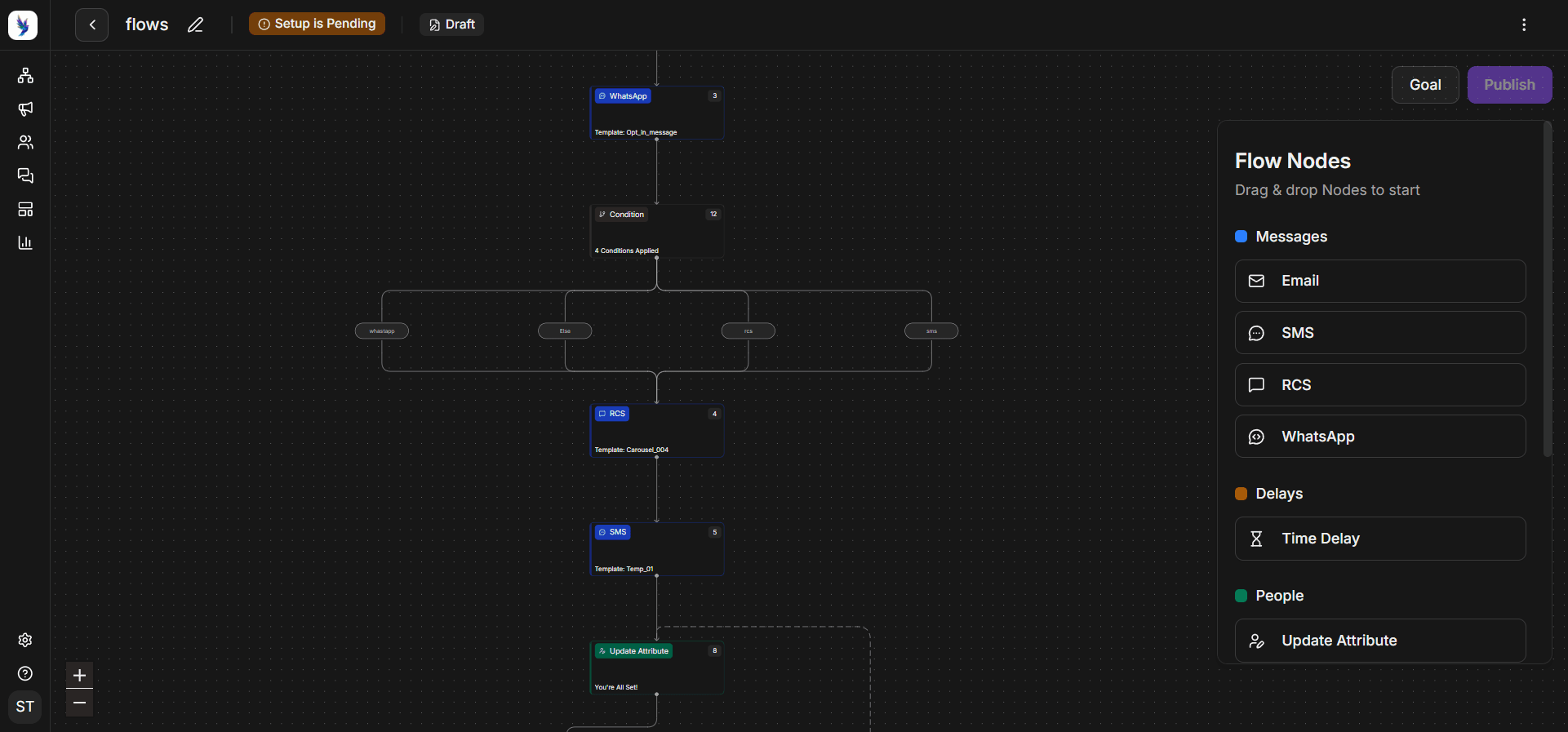
Post-purchase AI logic works by analyzing what similar customers bought together, then generating a tailored recommendation for the individual based on their specific purchase. Rather than sending a generic 'you might also like' email that gets buried in an inbox, the recommendation arrives as a WhatsApp message at a moment of active engagement.
The suggestion also shifts based on the lifecycle stage. An example of this is a first-time buyer gets a message designed to drive a second purchase. A repeat customer gets an upgrade or a premium version of what they've bought before.
For teams building this capability, integrating your order management system with WhatsApp and connecting AI recommendation logic to your product catalog is the core setup. This is one of the most practical WhatsApp e-commerce growth hacks available because it operates on customers who have already converted and doesn't require acquisition spend.
AI WhatsApp marketing in practice
The strategies above aren't theoretical. Here are a couple cases of businesses that implemented AI WhatsApp marketing and improved their revenue:
Domino's Pizza Indonesia
Domino's Pizza Indonesia integrated the WhatsApp Business Platform with its CRM and lifecycle marketing operations. The strategy centered on behavioral segmentation. The customers who typically ordered in-store received daily WhatsApp messages to drive app purchases, while newer customers received personalized messages every two weeks to build purchase frequency.
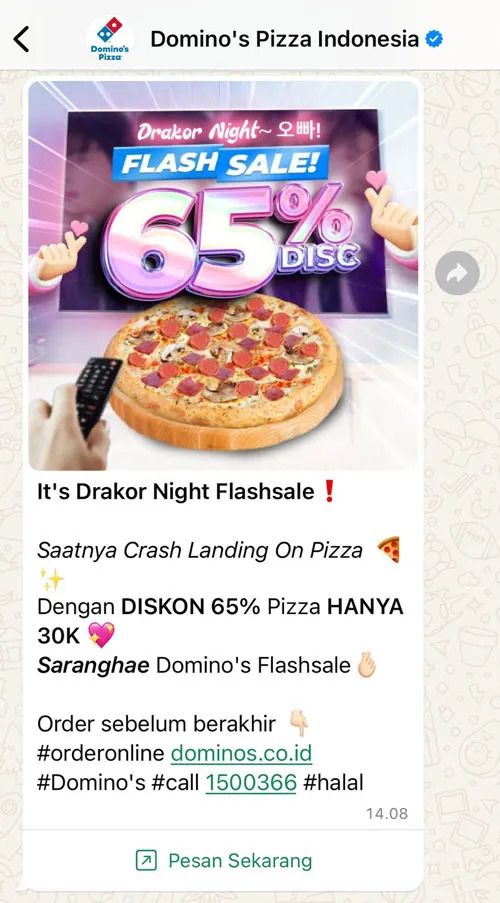
The team also ran a loyalty program through WhatsApp, using QR codes on pizza boxes to verify purchases and deliver vouchers directly in the app. This resulted in a 72% increase in sales with a 6.3x return on investment from WhatsApp messages.
The mechanism behind the result was relevance, CRM segmentation made WhatsApp marketing meaningful enough to change customer behavior. Relevance is what AI enables at scale, and Domino's Indonesia is a direct illustration of what that produces when the system is built properly.
Maggi Germany
Maggi Germany built their AI WhatsApp campaign around a cooking assistant named Kim. Rather than promoting Maggi products directly, the campaign invited users into a free cooking course delivered through WhatsApp, with the assistant answering questions and providing step-by-step guidance in real time.
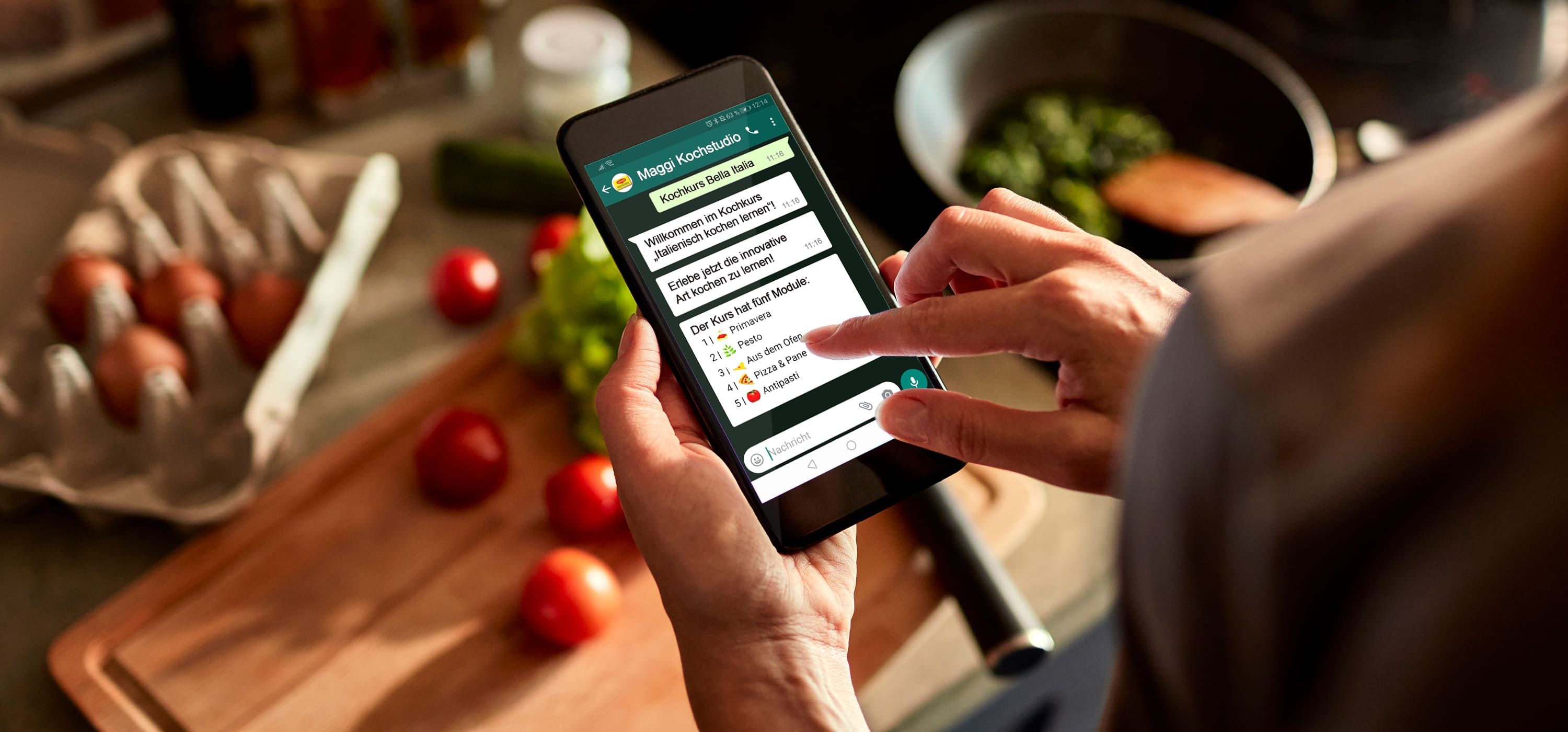
Over eight weeks, the campaign generated more than 200,000 messages exchanged between users and Kim. The campaign produced a 4.2-point lift in ad recall and a 3-point rise in campaign awareness.
The approach is replicable across any category where product knowledge has value. A great example of this is a fitness brand building a workout guidance assistant or a skincare brand building a routine advisor. The outcome Maggi achieved came from making the interaction genuinely useful, not from pushing a message.
Enhance your WhatsApp marketing with AI
AI and WhatsApp marketing are a natural combination. The channel gives you near-universal daily reach in the markets that matter most for growth-stage businesses. AI gives you the decision-making layer to make that reach relevant for each individual customer.
The most useful thing you can do with this guide is identify the one or two strategies that map most directly to the revenue or efficiency gap you're trying to close right now. Start there, measure against a defined baseline, and then expand. Each additional AI layer compounds on the last, and the businesses building those layers now are the ones that will be hardest to compete.
If you want to put any of these strategies into practice, try out Zixflow for free for 7 days and explore how our AI-powered WhatsApp marketing features allows you to elevate your WhatsApp outreach to the next level.
Frequently asked questions about AI WhatsApp marketing
What is AI WhatsApp marketing?
AI WhatsApp marketing is the use of machine learning and automation to personalize and optimize marketing messages on WhatsApp. It goes beyond basic scheduling by using behavioral data to determine which customers to contact, with what message, and at what time. AI also enables chatbots to handle conversations without requiring a human agent for every interaction.
How does AI improve WhatsApp marketing campaigns?
AI improves WhatsApp marketing by enabling behavioral segmentation, automated personalization, send-time optimization, and real-time response handling. That relevance drives better conversion outcomes than generic marketing campaigns.
Can small businesses use AI in WhatsApp marketing?
Yes. Most AI WhatsApp marketing capabilities are available through the WhatsApp Business API and Business Solution Provider platforms without requiring in-house AI or engineering expertise. A small business can use these capabilities to boost its growth without needing technical know-how. Starting with one use case that addresses a clear revenue problem is the practical approach.
How do I get started with AI WhatsApp marketing?
You need access to the WhatsApp Business API through an approved WhatsApp automation tool. Using it, you can connect your existing stack with an AI layer to optimize your operations. Most platforms support no-code setup for initial campaigns, which makes the first deployment accessible without a development team.