A Guide on How to Qualify WhatsApp Leads using a WhatsApp AI Agent
Qualify WhatsApp leads by asking the right questions, identifying buyer intent, and routing high-potential prospects with a WhatsApp AI agent.
 by Sahil Tyagi
A WhatsApp AI agent is a software layer built on the WhatsApp Business API that automatically qualifies incoming leads through natural-language conversations. By asking questions about budget, authority, need, and timeline, you can route purchase-ready prospects to your sales team. If the lead scores lower, then they are sent into a nurture sequence without any manual screening.
Unlike a basic chatbot with numbered menus, an AI agent understands responses in plain language and adapts follow-up questions based on what the lead says. It runs 24/7 and applies the same qualification criteria to every lead, eliminating the inconsistency of rep-by-rep screening.
WhatsApp Business now has nearly 967 million MAU globally, and more than 175 million people message a business on the platform every single day. For sales teams, that volume represents a real opportunity, but it also represents a real problem.
Capturing a lead on WhatsApp is the easy part. However, what happens next is where most businesses lose ground. Sales reps manually screen every incoming message to figure out whether the person has a genuine need for their offerings or whether they're just browsing.
At any meaningful volume, that screening process becomes the thing that slows everything else down. A WhatsApp AI agent solves this. It lets businesses qualify every lead by asking the right questions and routing only the purchase-ready prospects to your sales team.
With that said, I'll walk you through exactly how WhatsApp lead qualification works and what a WhatsApp AI agent does to help you streamline this process to drive revenue.
What is WhatsApp lead qualification?
WhatsApp lead qualification is the process of evaluating an incoming lead through a structured conversation on WhatsApp to determine whether they meet your sales criteria. It typically involves asking targeted questions about the lead's need, budget, timeline, and decision-making authority. Using this information to route them to the appropriate next relevant step.
The key difference from a standard lead form is conversational depth. A form gives you whatever the lead chooses to fill in. A WhatsApp qualification conversation adapts to what they say and asks follow-up questions based on their responses for collecting more nuanced information in a format that feels like a natural conversation rather than data collection.
That distinction matters more than it sounds, because the quality of what you learn in the conversation directly determines the quality of your sales pipeline.
What is a WhatsApp AI agent?
A WhatsApp AI agent is a software layer built on top of the WhatsApp Business API that manages incoming conversations using natural language understanding and predefined logic.
Unlike a basic WhatsApp chatbot that walks leads through a numbered menu, an AI agent can understand what someone is saying in their own words and guide the conversation toward a qualification goal without requiring the lead to follow a rigid script.
In a lead qualification context, the AI agent's job is to gather the information your sales team would otherwise collect manually. It does this through a structured but conversational flow that feels natural to the person on the other end.
Not just that.
AI agents don't have office hours. A lead who messages at midnight gets the same quality of first response as one who messages during lunch on a weekday. For businesses running ad campaigns that generate traffic at all hours or serving customers across time zones, this round-the-clock availability is what prevents qualified leads from going cold before a human ever reaches them.
Why use a WhatsApp AI agent for lead qualification?
When it comes to qualifying leads at volume, a WhatsApp AI agent brings advantages that manual processes cannot replicate. Here are the ones that make the biggest difference:
Speed of first response
According to research, companies that respond to a lead within the first hour are seven times more likely to qualify that lead than those who wait longer. Respond within five minutes, and the odds of qualification improve 21 times compared to waiting 30.
An AI agent on WhatsApp responds in seconds, every single time, regardless of what's happening on your sales floor. This matters most in the window right after a lead submits their information. That's when their intent is at its peak, and they're still actively thinking about the problem they want to solve.
A qualification conversation that starts in that window has a structurally higher chance of producing a sales-ready outcome than one that starts the following morning, when the moment has passed.
Consistent qualification every time
Manual qualification by a sales rep varies depending on who handles it. Some reps ask all the right questions. Others skip the budget conversation because it feels uncomfortable. Some push leads into the pipeline that have no real intent. The result is a WhatsApp CRM full of contacts at inconsistent stages, based on inconsistent information.
An AI agent runs the same qualification flow for every lead. The same questions, the same sequence, the same scoring logic across all the leads. This ensures the information your team receives is structured and reliable. That consistency is what makes pipeline forecasting accurate and what makes your sales team's time worth spending on the leads they do receive.
Filters out unqualified leads before they reach sales
According to research from MarketingSherpa, only 27% of leads sent to sales are actually qualified to buy. That means the majority of your sales team's time is spent talking to leads that were never going to convert, simply because no one screened them before the handoff.
A WhatsApp AI agent changes this ratio. Leads that don't meet your criteria go into a lead nurturing sequence instead of a sales rep's calendar. Those who show genuine intent but need more time get tagged for re-evaluation after a few weeks.
Only leads that score above your defined threshold, with the right company profile, the right budget range, and a real timeline, land in the queue for a human.
The entire process is an application of conversational marketing on WhatsApp, where the conversation itself does the filtering your team would otherwise do manually.
Qualification happens where the lead already is
This is the friction point most businesses underestimate. Asking a WhatsApp lead to fill out a form or switch to a different channel creates a drop-off that has nothing to do with whether they're interested.
They were interested enough to message you. Keeping the qualification on WhatsApp means it happens in the channel they chose, without asking them to do something additional.
Take Click-to-WhatsApp ads as an example: a lead who clicked one of these ads has already signaled a preference for WhatsApp. Routing them to a landing page form immediately after the click adds friction.
Starting the qualification in the same conversation results in the least resistance for the lead, which is exactly why completion rates are higher on WhatsApp than on any form-based qualification flow.
How to qualify WhatsApp leads using an AI agent?
With the foundation clear, here is a practical step-by-step guide to building a WhatsApp lead qualification system using an AI agent.
Define your qualification criteria before building anything
The most common mistake teams make when setting up AI-based lead qualification is designing the conversation flow before defining what a qualified lead actually looks like.
Every element of the system, including the questions the agent asks, the scoring weights, and the routing logic, depends on this definition being precise. If it's vague, everything downstream is vague.
Start with a qualification framework your sales team already trusts. BANT is the most widely used framework, consisting of:
- Budget (can they pay for your solution?)
- Authority (are they the decision-maker or close to one?)
- Need (do they have the specific problem your product solves?)
- Timeline (are they looking to act soon?)
For each aspect, document what counts as a qualifying answer and what counts as a disqualifying one. A lead who says "we have a budget but need director approval" is different from "I'm the VP and the budget is approved for Q3." Your AI agent needs to know that difference.
Also, define what happens to each lead type after qualification. High-intent leads route to a sales rep immediately. Mid-intent leads enter a WhatsApp drip campaign for nurturing. Low-intent leads get disqualified with a polite message and a resource.
Without these paths defined in advance, you'll end up with qualified leads sitting in a queue with no next step attached.
Build your AI agent conversation flow
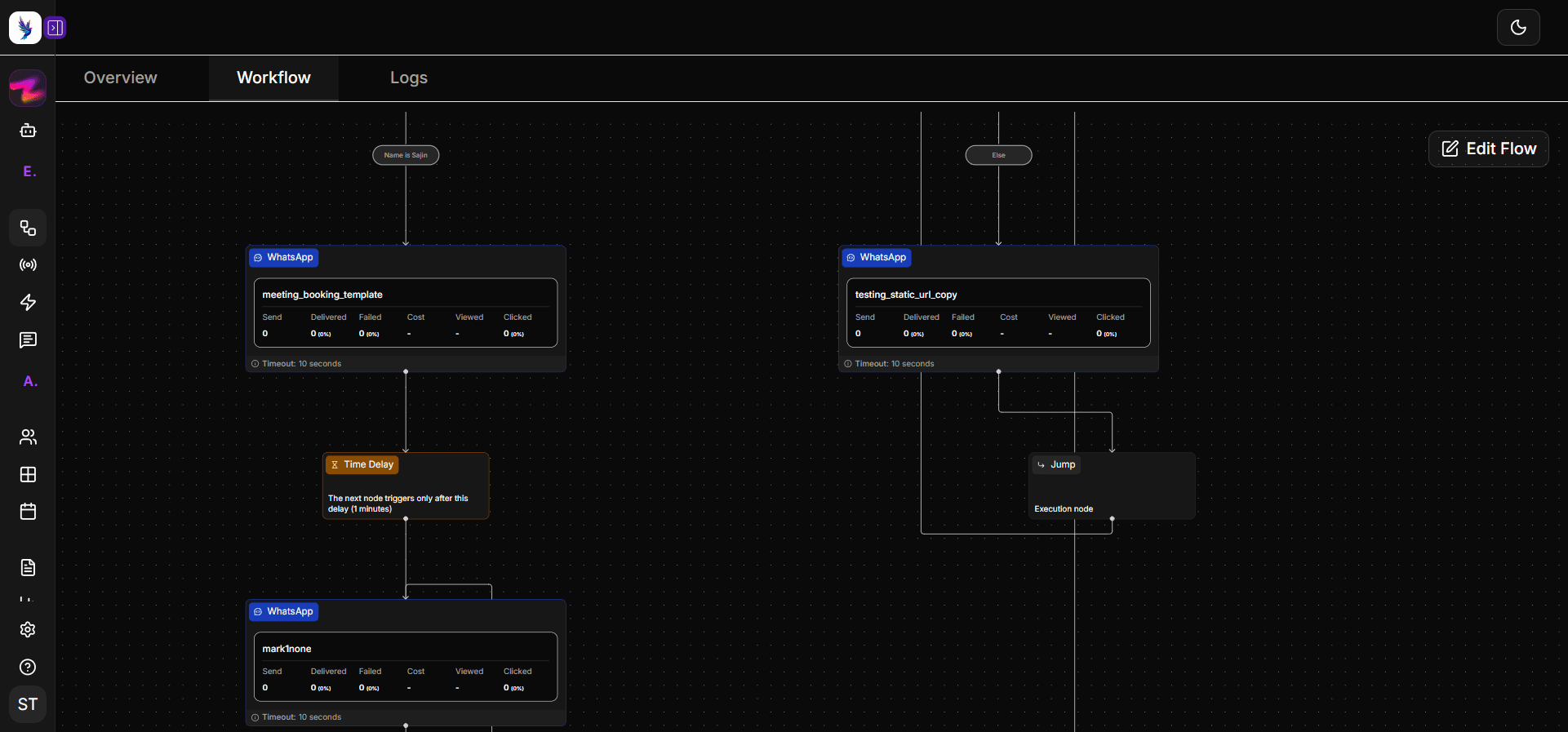
With your criteria defined, map out the conversation your AI agent will run. The goal is a sequence that collects what you need while feeling like a helpful, natural exchange rather than a questionnaire read aloud by a robot.
A solid WhatsApp lead qualification flow typically opens with a warm acknowledgment: "Thanks for reaching out. To connect you with the right person, I have a few quick questions."
Then it moves through your qualification dimensions sequentially, starting with the question most likely to be answered freely (usually the nature of their need) and moving toward the most sensitive questions (budget and authority) later in the conversation. This sequencing matters because Asking for the budget in the first message kills completion rates.
Also, each question needs a defined branching logic. For instance, if the lead says they're looking at an implementation window of 7 days, the flow branches toward urgency and immediate routing. If they say they're researching options for next quarter, it branches toward a longer nurture path.
However, keep in mind that the total number of questions is between four and six. Above six questions, completion rates drop sharply as leads lose patience with the exchange before you've collected enough to make a qualification decision.
Set lead scoring rules and handoff triggers
Once the conversation flow is built, configure the scoring logic that evaluates what each lead says. Lead scoring here means assigning weighted values to specific responses and setting a threshold score that triggers the human handoff.
For example, a sample scoring structure can use the following values for specific actions:
- Confirmed budget range scores 25 points
- Decision-making authority scores 25 points
- A specific relevant problem scores 30 points
- A timeline within 90 days scores 20 points
A lead who scores 80 or above triggers an immediate notification to the sales team to get assigned to an available rep with their qualification data attached. A lead who scores 40 to 79 enters your mid-intent nurture flow. Below 40 means a disqualification message and additional resources they can return to later.
This threshold approach is what protects your sales team's time at scale. Instead of reviewing every incoming message, they receive only the conversations the AI agent has scored above your threshold.
More importantly, when they open that conversation, the lead's answers are already there. The first human message is an informed one. The whole handoff structure connects naturally to your WhatsApp sales funnel and ensures no qualified lead gets lost between the AI and human handoff.
Connect your WhatsApp AI agent to your CRM
A qualification process that lives only inside WhatsApp is a data silo. Everything the WhatsApp AI agent learned about the lead needs to flow into your CRM so the teams using the tool get the accurate information.
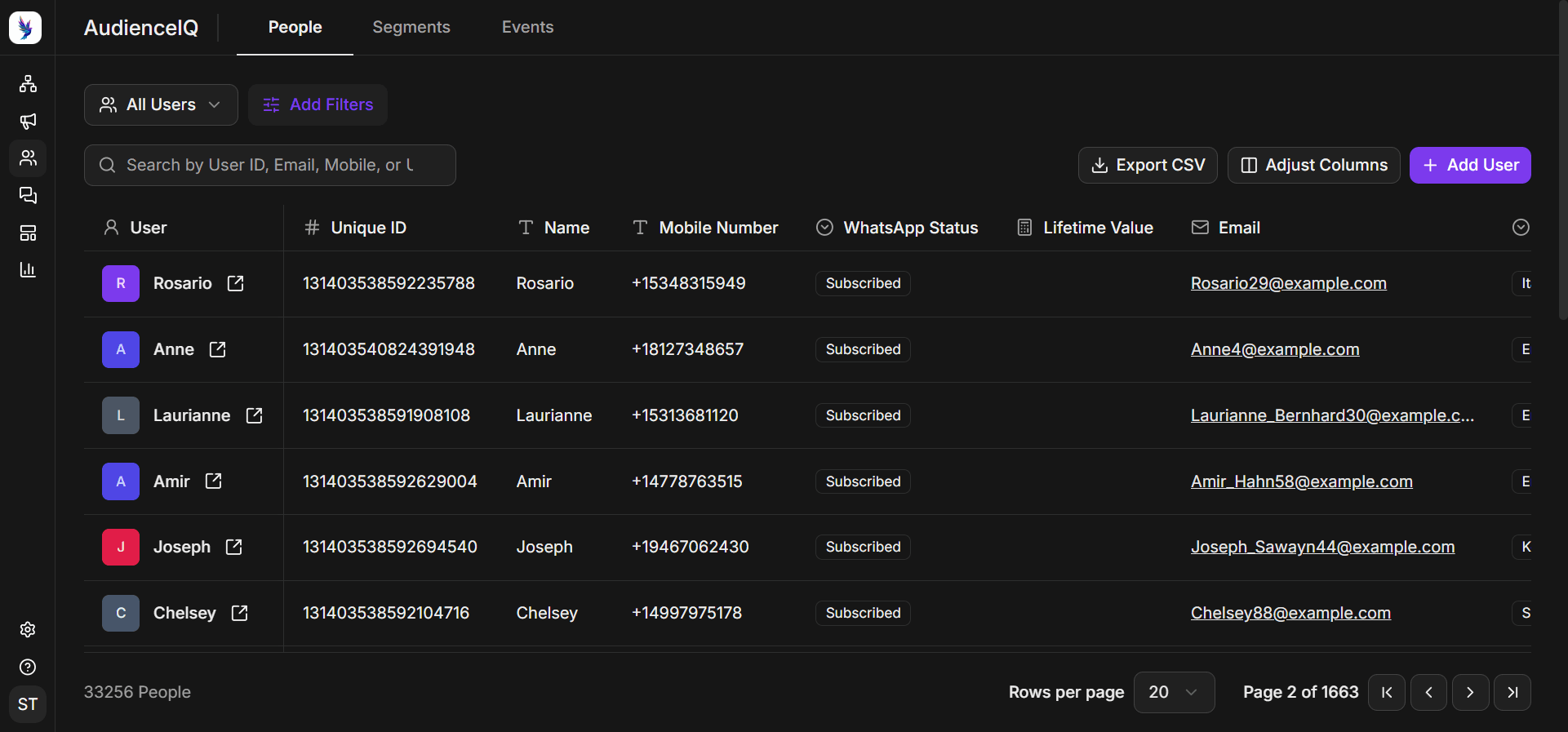
Set up a CRM integration that automatically creates or updates a contact record when the AI agent completes a qualification conversation. Map the qualification fields from the WhatsApp flow directly to the corresponding CRM fields. That mapping is the difference between a qualification system and a manual process with an AI layer on top.
On top of that, CRM integration opens the door to automated scheduled WhatsApp messages. A lead tagged as high-intent in WhatsApp can automatically trigger a workflow that assigns them to the right rep, sends an intro WhatsApp, and schedules a follow-up reminder.
Optimize the flow for improvement
Once the first version of WhatsApp flow is live and handling real leads, the data will show you how it's working.
Track four metrics from day one:
- Conversation completion rate
- Qualification rate
- Drop-off point
- Pipeline contribution
Each metric points to a different type of problem. Low completion rate means the flow is too long or too transactional. A high qualification rate of 80% often means your criteria are too loose. A clear drop-off point at a specific question means that question needs to be repositioned in the sequence.
Treat the qualification flow as a living document. The WhatsApp marketing automation layer makes these adjustments fast to deploy, so testing iterations does not require a full rebuild each time. A qualification flow that has not been touched for months is not a stable system. It's a system nobody is paying attention to.
Qualifying inbound leads from Click-to-WhatsApp campaigns
For a SaaS business running Click-to-WhatsApp ads, incoming lead volume can be high, but quality is always uneven.
Prospects range from ready-to-buy decision-makers to competitors checking features to marketers filling out contact forms with no purchase intent whatsoever. Without a qualification layer, the sales team handles all three in the same pipeline, with no way to tell them apart until they've already spent time on a call.
A WhatsApp AI agent that qualifies on company size, role, current tool setup, and evaluation timeline sorts this traffic automatically. Decision-makers at companies with 20 or more seats who are evaluating tools for the current quarter get routed to a sales rep within minutes of the conversation ending. Everyone else enters a tiered nurture track based on their score.
The sales team's demo-to-close rate improves not because they became better at selling, but because the leads they're now spending time on are genuinely worth selling to. The AI agent did the sorting that used to consume their usual schedule.
Ready to improve lead success with a WhatsApp AI agent?
WhatsApp lead qualification is now easily possible due to modern AI engines being able to understand user intent pretty quickly and accurately.
With their ability to run automatically, at scale, across every lead that comes in, regardless of the time of day or the availability of your sales reps.
The step that matters most when setting up a WhatsApp AI agent is defining what a qualified lead actually looks like before writing a single conversation message. It is what determines whether the entire system produces unreliable results. The following steps are only as reliable as the qualification definition it's built on.
If your team is still manually qualifying every WhatsApp lead, Zixflow's workflow builder can take that process off their plate entirely. With Zixflow, you can set up your routing logic inside the platform, and every lead gets qualified the moment they message in. Start a free 7-day trial to see how it handles your pipeline.
Frequently asked questions about the WhatsApp AI agent for lead qualification
What is WhatsApp lead qualification?
WhatsApp lead qualification is the process of evaluating an incoming lead through a structured conversation on WhatsApp to determine whether they meet your sales criteria.
It involves asking questions about the lead's needs, budget, and timeline, then using their responses to route them to a sales rep or a nurture sequence. When automated through a WhatsApp AI agent, this process runs instantly for every lead without any manual intervention.
How does a WhatsApp AI agent qualify leads?
A WhatsApp AI agent qualifies leads by running a structured conversation flow the moment a lead messages in. It asks predefined questions based on your qualification criteria, evaluates the responses using scoring rules you configure, and routes the lead to the next appropriate step.
High-scoring leads are routed to a sales rep with qualification data attached. Mid-scoring leads enter a nurture sequence. Those who don't meet your threshold are disqualified with a relevant resource or redirect.
What qualification framework works best for WhatsApp?
BANT (Budget, Authority, Need, Timeline) is the most commonly used framework for WhatsApp lead qualification because its four dimensions translate naturally into conversational questions. MEDDIC and CHAMP are better fits for complex enterprise sales cycles.
For most SMBs and mid-market businesses, a simplified three-question version of BANT focusing on need, budget range, and timeline keeps the qualification flow short enough to maintain high completion rates without sacrificing the information your sales team needs to make a routing decision.
How many questions should a WhatsApp qualification flow have?
Four to six questions are in the practical range. Below four, and you're not collecting enough information to make a reliable qualification decision. Above six, and completion rates drop significantly as leads disengage before the conversation reaches the scoring point.
If your product requires more information to qualify a lead accurately, prioritize the questions most likely to produce a disqualification early in the flow and save the lower-priority questions for a follow-up sequence after initial qualification is confirmed.
Can a WhatsApp AI agent qualify leads around the clock?
Yes. This is one of the primary reasons teams invest in AI-based WhatsApp lead qualification. Unlike a human sales team, an AI agent runs at all hours including weekends and public holidays. Every lead who reaches out to you receives the same quality of immediate first response, regardless of the time of day.
For businesses running paid campaigns that generate leads outside business hours, a 24/7 qualification layer prevents high-intent leads from going cold while waiting for a human to respond the next morning.
How is WhatsApp lead qualification different from a contact form?
A contact form is static. It presents the same questions to every visitor and collects whatever they choose to fill in, with no ability to adapt based on what they say.
A WhatsApp qualification flow is dynamic in nature. It responds to the lead's answers, branches based on their responses, and gathers more accurate information through a conversational exchange.