How To Use AI In B2B Marketing: New Ideas & Examples?
Table of Contents
The launch of ChatGPT by OpenAI was a breakthrough in understanding how tech can be perceived and applied within many industries. Marketing was among the few functions that experienced the impact, and for a good reason as well.
AI is not a far-off idea or an experimental feature. It is already influencing the way businesses are done in today’s world, and B2B marketing is not an exception. With marketers trying to balance innovation with responsibility, the leading organizations are moving quickly and putting money into AI-driven capabilities.
Almost 89% of the leading firms today are heavily investing in generative AI in order to fast-track revenue growth. AI is already transforming the way marketing teams operate, whether it is processing large chunks of customer data in a few minutes, creating marketing copy, or simplifying content workflows, so that marketing teams can work more effectively.
Although AI brings along new opportunities and justifiable challenges, there is one new fact to consider: an AI marketing strategy is no longer a choice when it comes to long-term success in B2B marketing. The organizations that learn to implement it rationally and ethically are in a stronger position to enhance brand presence, generate better ROI, and drive sustainable revenue growth.
The data analysis, pattern detection, customer behavior prediction, and the creation of an in-depth buyer profile are just some of the ways AI has become one of the most effective assistive technologies B2B marketers can use today.
What does AI in B2B marketing mean?
AI in B2B marketing is the application of next-gen technologies based on artificial intelligence to automate, optimize, and enhance most marketing tasks. They take care of tedious tasks like data analysis, customer segmentation, customer persona development, personalization, content creation, advertising, and larger-scale marketing efforts.
The AI-powered algorithms reveal insights that can assist marketers to make quicker, more knowledgeable, and precise judgments.
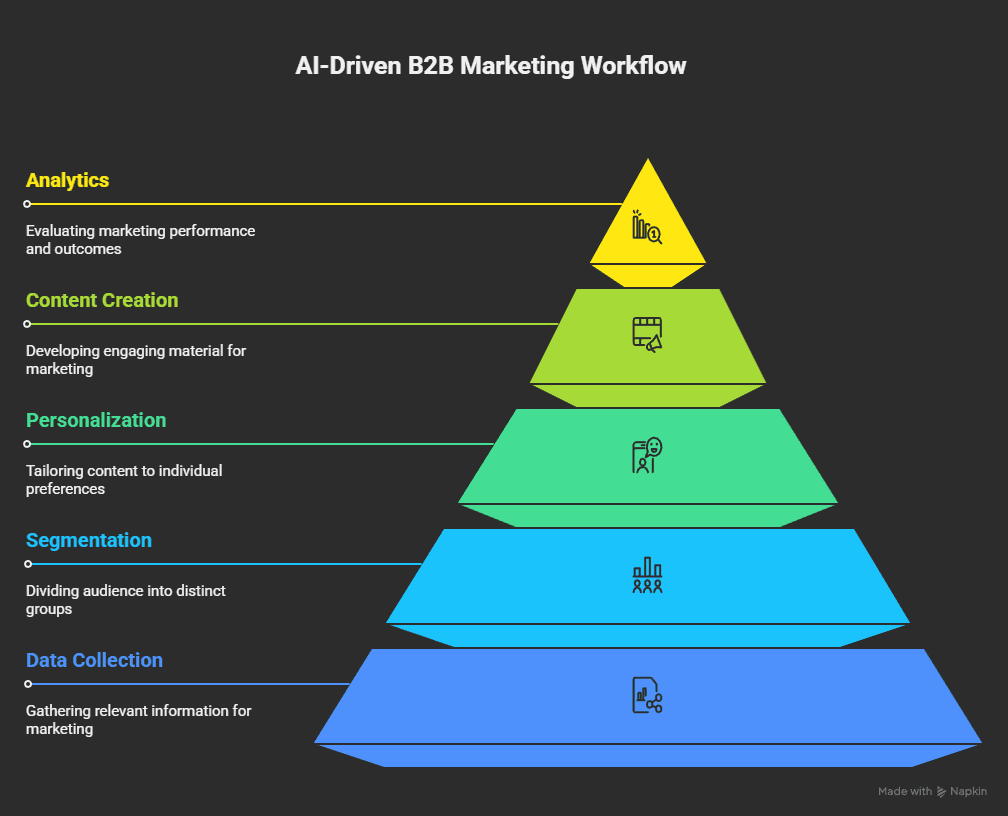
B2B companies start embracing AI technologies like machine learning and robust algorithms to help facilitate the marketing processes. AI can help brands stay on top of their marketing campaigns with content generation and performance measurement analysis, but also predictive evaluation and personalization.
To illustrate, because of AI, it is now possible to integrate CRM data from both online and offline sources to provide a 360-degree view of every customer. On such a basis, businesses can divide the prospective customers according to demographics, location, objectives, and buying habits.
When these segments are identified, marketers have the ability to provide an extremely personalized experience using blog content and landing pages, PPC ads, email campaigns, and newsletters.
In addition to content generation, social media monitoring systems driven by AI are also useful in tracking trending keywords, hashtags, and brand conversations in real time.
The most recent McKinsey survey indicates that 65% of organizations use AI on a regular basis in their operations. Marketing and sales teams, especially, are putting AI at the forefront of their marketing budgets and are actively making investments in these technologies to be central in their tech stacks.
Although AI can be both promising and difficult, the conclusion is obvious: to remain competitive in B2B marketing, it is necessary to embrace AI. Those who use it in a responsible and strategic manner will be better placed to promote awareness and revenue, as well as long-term ROI in an ever-more data-driven marketplace.
Want to Apply AI in Your B2B Marketing?
Develop AI-based processes that assist you in reaching high-intent accounts quickly and enhance the quality of leads in each campaign.
Automate with Zixflow6 different ways to use AI in B2B marketing
AI has opened up the possibilities of B2B marketing well beyond simple automation. Modern-day marketers do not merely save time, but they also work with more accuracy, stability, and on a larger scale using AI. What used to take hours can be intelligently and reliably performed by AI systems.
What is more important, AI-based marketing is no longer something superficial. It enhances the targeting of the audience, increases the accuracy of lead generation, and is capable of personalization that would not be possible manually at its scale.
Get a complete picture of your buyers
B2B clients today engage with brands in a myriad of touchpoints. A prospect may learn about you in a LinkedIn post, as a search ad on Google, in a blog, during a webinar, or in an in-person sales meeting. You have to have a view of all these interactions, offline and online, to be able to market effectively.
However, it’s not all that simple.
Customers’ information is stored on websites, ad platforms, CRM, social media, reviews, surveys, POS systems, and behavioral analytics systems. Manually compiling all this information is complicated and time-intensive. It is in this area that AI provides real value.
AI systems have the ability to consume vast amounts of structured and unstructured data, sort it, and detect patterns that drive purchasing. They are used to turn the disjointed information into valuable customer profiles.
The outcome is a better, more precise insight into who your customers are, how they act, and what motivates them.
AI-driven personalization
B2B marketing no longer needs personalization as a differentiating factor; it is a requirement. The modern clients desire to have experiences that are equally relevant and smooth in the same way as the top B2C interactions.
Accenture’s research indicates that 73% of B2B customers currently demand personalized and consumer-like experiences, and AI is the one that makes it possible on a large scale.
Through behavioral information and browsing history, as well as previous interactions, AI helps marketers customize every touchpoint to the particular context of a buyer.
AI-marketing tools have the potential to divide audiences down to the individual-account level and change content and messages dynamically. For example:
- The experience of websites may vary depending on the industry/type of account
- Dynamic user-behavior subject lines and content blocks can be used in email campaigns
- ABM platforms have the ability to identify intent signals to make timely and relevant outreach
In the case of smart suggestions of websites to tailor sales enablement content, AI-based personalization has become a fundamental feature of B2B teams that wish to compete in competitive markets.
Adopting a multichannel marketing approach
The emergence of generative AI has transformed the production of content radically. GenAI tools are used by marketers today to help in the creation of:
- Social media content
- Blog posts
- Email campaigns
- Product descriptions
With that being said, AI is not substituting human creativity; it is facilitating it. The best B2B teams apply AI to make generation faster, come up with ideas, and scale the production, while the humans perfect this messaging by adding their expertise to make the brand authentic.
Here, personalization is a significant factor. Almost 90% of marketers claim that they achieved a positive ROI on personalized campaigns, but generic content no longer captures the audience or the search engines. AI is used to develop customized drafts within a short period of time, whereas human judgment provides uniqueness.
Ready to Turn AI Ideas Into B2B Results?
Automate lead nurturing and follow-ups to keep your sales and marketing teams on the same step at all times.
Optimize with ZixflowPredicting customer behavior
Imagine being able to know which leads are most likely to turn into customers. Or which of your clients are set up to take an upsell before they do? This is made possible by predictive analytics that is driven by AI.
Using both historical and more recent data with signals, AI models can tell trends that predict buyer behavior with remarkable precision. Such insights can be used by marketers and sales teams to become proactive rather than reactive.
The main predictive applications include:
- Churn prediction: Usage and sentiment analysis are used to identify instances of the first signs of disengagement to enable teams to act before accounts are lost.
- Lead scoring: AI prioritizes leads in order of probability of conversion, enabling sales teams to target high-intent leads and reduce sales cycles.
- Market trend forecasting: AI will assist in predicting demand changes and the new needs of customers by analyzing external sources of data.
- Next action recommendations: AI recommends the best next step, i.e., when you should send a particular offer, share content, or focus on outreach.
Predictive intelligence eliminates speculation in B2B marketing. By focusing teams on the right accounts, providing timely messaging, and driving better results across the funnel, teams can achieve higher conversions and more efficient growth.
Crafting well-defined buyer journeys
The personalization of individual touchpoints is not the only way AI can be used. It also facilitates end-to-end journey orchestration. As opposed to presenting prospects as fixed profiles, AI will modify experiences depending on history and sentiment over the lifecycle.
AI systems keep learning, starting with awareness and ending with post-purchase engagement. They determine the customer, along with the reason behind the interaction, and what they require next. All you have to do is just send the appropriate message at the appropriate time.
Introducing the aspect of sentiment and emotional analysis, AI also brings the human aspect of automation, so the contacts do not seem like robots.
Conversational marketing with the help of AI
Conversational marketing is one of the rapidly expanding AI applications in B2B. Chatbots powered by AI are able to handle repetitive questions, screen leads, and direct visitors in real time without necessarily needing human involvement.
Advanced AIs are much more than scripts. These AI tools have the ability to change tone and recommendations depending on the context. As an example, when a visitor is spending time on a product page, AI agents may recommend the resources, demos, or case studies for that specific product.
The AI-powered strategy will enhance the interactivity. For example, WhatsApp conversational marketing is an approach that enables B2B teams to offer a smooth experience to clients through high-speed, convenient interactions at scale to transform visitors into customers.
Some examples of AI in B2B marketing
These examples show how AI is applied in practical B2B marketing scenarios to solve common challenges and drive measurable outcomes.
How Adobe uses AI to optimize B2B content performance
Adobe uses an AI system, Adobe Sensei, to examine the channel and segment performance of content. Analyzing the engagement indicators, Sensei understands which assets appeal to certain groups of buyers or sales funnel stages.
B2B organizations rely on these insights to optimize the messaging, enhance the performance of landing pages, and increase the scale of conversion rates. Instead of doing slow and manual A/B testing, teams are able to constantly optimize content experiences based on AI-based recommendations that can be updated over time.
Notably, marketing leaders stress that the role of AI in this process is supportive. According to Chad Gilbert, the VP of Content Marketing in NP Digital:
“AI tools are not meant to take the place of human creativity.”
This is in accordance with the use of AI to augment strategic thinking, but rather to refine content, personalize content, and analyze performance, making it simpler to provide teams with high-performing experiences.
How LinkedIn uses AI for B2B account-based marketing
LinkedIn is a company that incorporates AI in its account-based marketing and advertising capabilities. The platform employs predictive models to determine the most likely companies, decision-makers, and buying committees to engage at any specific time.
In the context of B2B marketers who utilize ABM campaigns, it implies that content can be dynamically optimized according to indicators of engagement throughout the lengthy buying cycles. AI assists in deciding the stakeholders in a target account who ought to receive this and at what time, making it more relevant to various touchpoints.
LinkedIn makes AI a core component of its advertising system. According to research by its Marketing Collective, 95% of B2B marketers use AI weekly, and 65% use it daily, as AI has become part of the daily workflow, particularly when targeting accounts and paid media approaches.
How can Zixflow help you run an end-to-end B2B marketing on autopilot?
Zixflow uses AI as a layer that connects the entire B2B marketing lifecycle. It integrates the customer data of a variety of sources, like websites, product use, APIs, and interaction channels, into a living customer profile.
All interactions, including page views, feature adoption, open email, message clicks, in-app behavior are analyzed in real time to bring to the intent signals like readiness to upgrade, churn risk, or reactivation.
Unlike static, rule-based systems, Zixflow’s AI continuously updates segments and user tags as behavior evolves. This allows B2B teams to respond dynamically instead of relying on outdated assumptions or manual list updates.
Using these insights, Zixflow automatically coordinates personalized journeys across channels, including email, WhatsApp, SMS, push notifications, and in-app messaging. AI determines the most effective channel, timing, and message sequence for each user.
Meanwhile, the built-in fallback logic ensures delivery even if a primary channel fails. This enables consistent, relevant engagement without the need to design or maintain complex workflows manually.
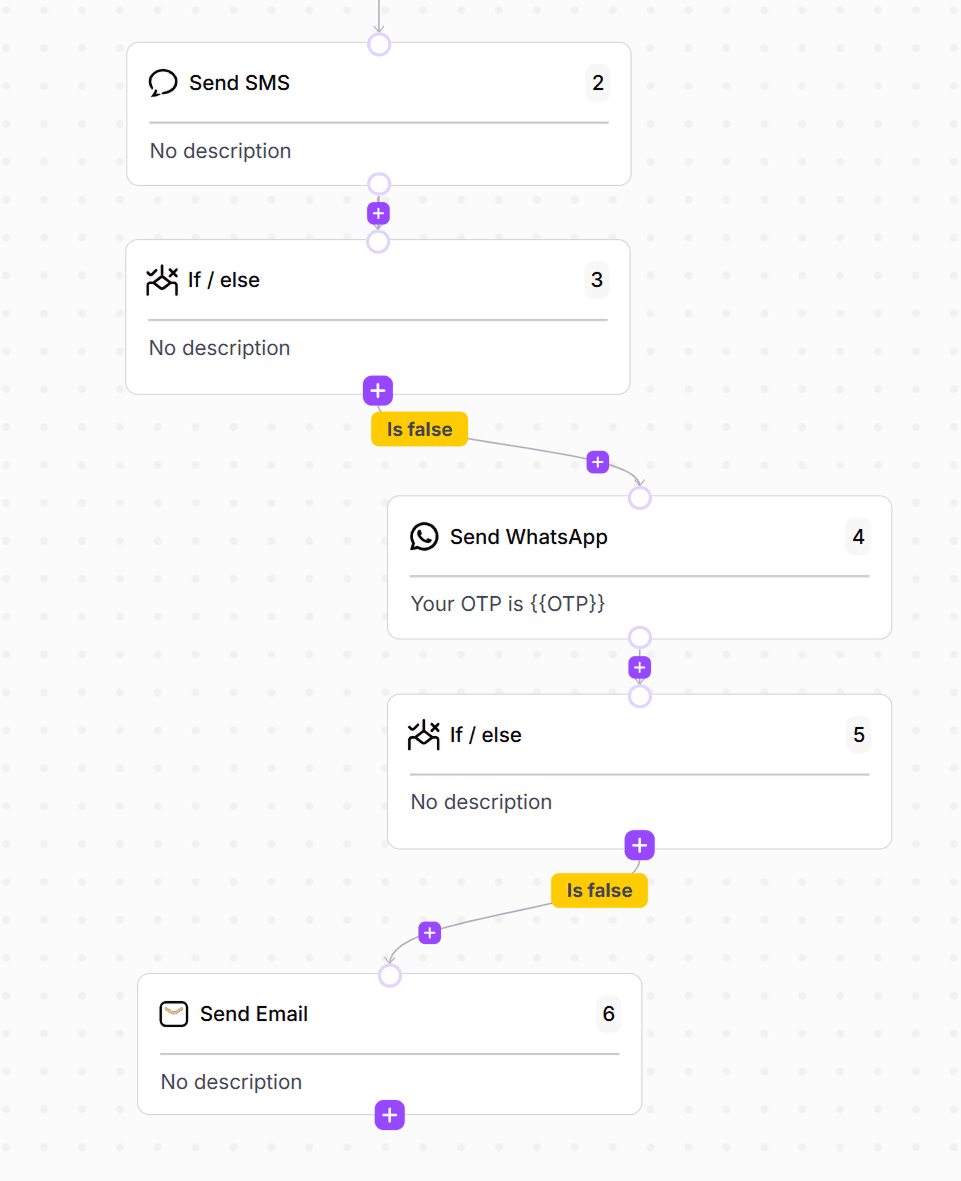
This allows marketers to focus on strategy, while AI manages execution and optimization. This combination of human mind and AI capabilities illustrates how AI is already functioning as an operational layer in modern B2B marketing.
Enjoy a streamlined process by adopting AI for B2B marketing
The core redefinition of AI in B2B marketing and sales departments is not only providing highly personalized customer experiences but also anticipating consumer behavior.
Nevertheless, the most successful organizations acknowledge that the actual utility of AI lies in the way individuals use it. The insights do not just reside in the technology. It is the marketers who know how to read between the lines and craft the strategy to keep the customers satisfied.
The first step to take is usually to pick the correct marketing and sales tools that have in-built AI features that complement your existing strengths, instead of redesigning the workflow completely.
When used correctly, AI can assist B2B businesses in scaling the infrastructure that already exists and eliminating friction or guesswork from the process.
Schedule a demo to see how Zixflow helps your B2B business streamline marketing outreach effectively.
Frequently asked questions about AI in B2B marketing
This section will discuss the questions that B2B marketers usually face when adopting and using AI successfully. Regarding the practical implementation of AI in the modern context and its constraints and opportunities, these FAQs give a realistic insight into the role of AI in B2B marketing approaches.
How is AI used in B2B marketing today?
AI is used to complement several processes of the B2B funnel, such as data analysis, predicting buying intent, personalization, workflow automation, and performance optimization.
What are the main benefits of AI in B2B marketing?
AI enhances the precision of the targeting and lessens the human input to expedite decision-making. It allows personalization at scale by assisting teams in targeting high-intent accounts and running real-time optimized campaigns.
Can small or mid-sized B2B companies use AI effectively?
Yes. Numerous AI-based marketing applications are currently available to even small businesses, without big budgets or technical departments. Even simple applications, like automated marketing campaigns, can provide tangible engagement and conversion improvements.
How does AI improve lead generation and qualification?
AI focuses on behavioral indicators that emerge from engagement trends to model high-quality leads more precisely. It ranks accounts by intent using past data to figure out forecast conversions and assists in sending leads to selling teams at the appropriate time.
What challenges should B2B marketers expect with AI adoption?
Such issues as low quality of data, lack of internal expertise, and excessive automation are common. AI works best in situations where it is backed by clean data and human supervision with clear objectives set that are well defined.
Will AI replace human B2B marketers?
No. AI is not replacing the capabilities of humans. Although AI is a very efficient tool in analysis and automation, it still lacks the ethical judgment that humans possess. The most robust B2B groups consider AI as an aid and not as a replacement.
Sahil Tyagi
I'm a passionate content writer and SEO enthusiast who enjoys turning ideas into helpful articles. When I'm not busy with content, you'll find me enjoying sports or reading about growth strategies.