WhatsApp AI Agent vs. Chatbot: Which One to Pick for Business in 2026
A comparison of WhatsApp AI agents and chatbots covering their strengths, limitations, and the business scenarios each is best suited for.
 by Sahil Tyagi
A WhatsApp chatbot is a rule-based system that responds to predefined inputs using decision trees, keyword triggers, and button menus. Still, it only handles conversations it was explicitly configured for.
A WhatsApp AI agent is powered by a large language model (LLM) that understands natural language intent, reasons through multi-step problems, and takes actions across connected systems to complete a task end-to-end.
The practical difference between them is that a chatbot tells a customer their order is delayed, but an AI agent, after telling them that, checks whether expedited shipping is available and sends a follow-up with the new delivery estimate.
The debate between WhatsApp AI agents and chatbots has become one of the most practically confusing questions in business automation. Not because the technology is hard to explain, but because the terms are used interchangeably.
An AI chatbot might refer to a simple decision-tree bot with keyword triggers, or it might refer to a sophisticated LLM-powered system that checks contact information and sends a follow-up message without a human in the loop. The difference matters enormously for how you build and what you can realistically expect.
The stakes around this choice are higher than ever. According to TechCrunch, Meta launched its Business Agent globally on WhatsApp with over one million businesses already using AI-powered agents to handle customer conversations around the clock.
Meta also updated its platform policy to explicitly prohibit open-ended general-purpose AI chatbots on the WhatsApp Business Platform, a move that clarified the line between a task-specific AI agent and an unconstrained bot. If your business uses or plans to use automation on WhatsApp, that distinction is now both commercially and policy-critical.
So, in this guide, I'll break down exactly what separates a WhatsApp AI agent from a chatbot, how each works in practice, and when to choose which one for your business.
What is a WhatsApp chatbot?
A WhatsApp chatbot is a rule-based or flow-based automation built using the WhatsApp Business API that responds to customer messages based on predefined decision trees, keyword triggers, or button-based menus.
The user selects an option or types a specific phrase, and the bot responds with the corresponding pre-written message. No language understanding is required on the bot's part as it matches input to output based on rules you've configured.
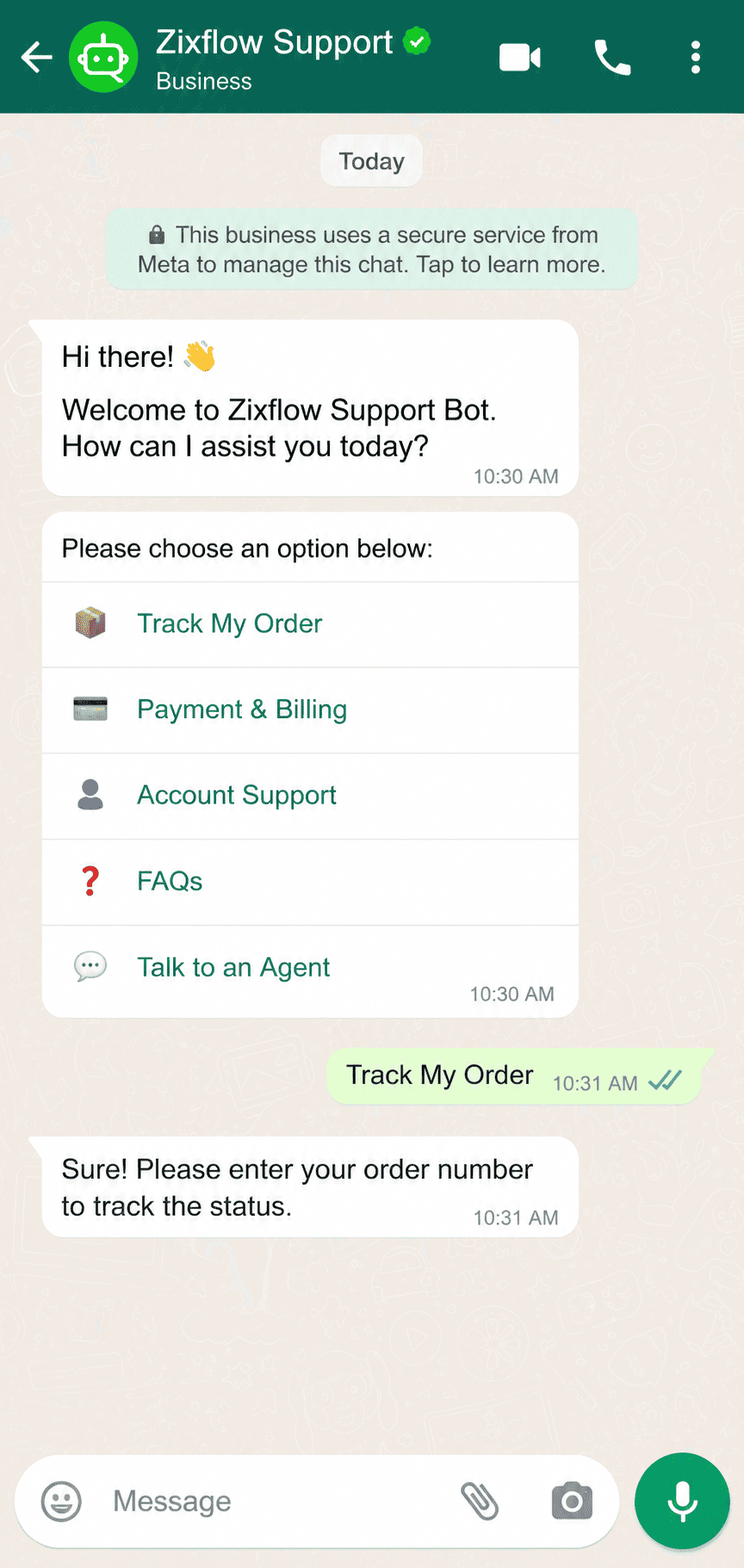
The chatbot relies on predefined types of WhatsApp messages to trigger each response. For example, utility templates for transactional confirmations and marketing templates for promotional follow-ups. These are all structured, predictable interactions where the range of possible inputs is known in advance.
The defining characteristic of a chatbot is its dependency on anticipation. It performs well when customers do exactly what the flow expects, and it fails when they don't. A customer who types 'my package hasn't arrived and I'm really frustrated' instead of selecting 'Track Order' from a menu will get a response that doesn't match their intent.
What is a WhatsApp AI agent?
A WhatsApp AI agent is a system powered by a large language model (LLM) that can understand natural language intent, reason through multi-step problems, and take actions across connected systems to complete a task on behalf of the customer or business.
Rather than matching inputs to predefined outputs, an AI agent interprets what the customer is trying to accomplish and works toward that goal, using available tools and integrations to complete it.
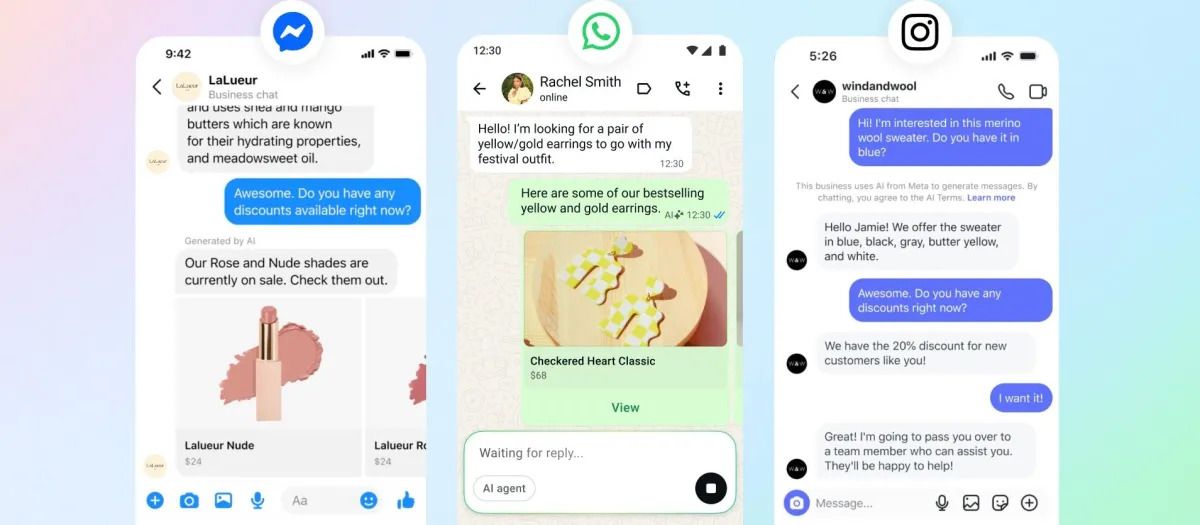
The practical distinction is in what happens after the conversation. A chatbot can tell a customer their order is delayed. An AI agent can tell them it's delayed, check whether expedited shipping is available, apply a discount code to the replacement order, and send the customer a follow-up message with the new delivery estimate.
For support, sales, and operations teams handling complex customer journeys at volume, the ability to close the loop rather than just provide information is what makes AI agents meaningfully different from chatbots.
WhatsApp AI agent vs. chatbot: Key differences
Now that you have a solid understanding of both concepts, here is how they compare across the dimensions that actually determine which one is right for your business.
How they each handle conversations
This is the most fundamental difference between the two systems, and the one that determines what percentage of your inbound conversations the automation can actually handle end-to-end.
A rule-based chatbot handles conversations it was designed for. It falls apart the moment a customer deviates from the expected path. The failure to handle natural language isn't a configuration issue, it is how rule-based systems work.
An AI agent handles the unexpected natively. Because it processes natural language intent rather than pattern-matching text strings, it can interpret what the customer needs. According to research, advanced AI resolves 55 to 70% of customer queries without human agent involvement.
For businesses with high inbound query volumes and varied customer phrasing, that resolution rate difference is the primary argument for investing in an AI agent over a chatbot.
Integration depth
A chatbot can retrieve information from an external system via an API call, for example, pulling an order status from an e-commerce platform when the customer provides their order number. But it can rarely chain multiple system actions together in response to a single customer request.
An AI agent is built around tool use, like it can call APIs to modify databases, create records, update fields, send emails, book calendar slots, and trigger webhooks, based on the reasoning required to complete the customer's request.
For instance, when a customer asks to reschedule their appointment, an AI agent can check the calendar for available slots to offer two or three options in the same message. It can then update the booking system when the customer confirms and sends a calendar invite, all within a single conversation.
Businesses where customer interactions require actions across multiple systems, a chatbot leaves the action half-done. That's the operational gap that WhatsApp automation built on AI agents closes.
Contextual memory & learning
Most rule-based chatbots are stateless between sessions and have limited memory within a session. If a customer provides their email address at step 2 of a flow and the conversation then branches to a different path, the bot may ask for it again at step 5 because it lost track of what was already collected. This friction is subtle in simple flows but compounds significantly in multi-step customer journeys where context needs to carry across several exchanges.
AI agents maintain rich conversation context throughout a session. They can reference earlier messages, combine them with data from connected systems (purchase history, past interactions, preference data), and use all of that to inform the response at each step.
A customer who said 'I'm looking for something for my twelve-year-old' at the start of a product recommendation conversation will still get age-appropriate suggestions twenty messages later, even if the topic shifted several times in between. That continuity of context is what makes AI agent conversations feel genuinely helpful rather than robotic.
Setup complexity
This is where the practical tradeoffs become most relevant for businesses with budget constraints or limited technical resources.
A WhatsApp chatbot can be configured in one to three days using a no-code flow builder on most WhatsApp BSP platforms. The setup cost is low, the learning curve is manageable for non-technical team members, and the ongoing cost is determined primarily by your WhatsApp conversation pricing rather than by per-query AI inference costs.
For a small business handling a few hundred inbound messages per day with predictable query patterns, a well-configured chatbot can handle the majority of inbound volume at very low cost.
An AI agent involves meaningfully higher complexity. It involves prompt engineering to define the agent's behavior, integration work to connect the agent to your CRM, testing to handle edge cases, and ongoing monitoring to catch unexpected model behavior.
LLM integration costs add up at scale, particularly for multi-turn conversations with context-heavy system prompts. The investment required for a production-ready AI agent on WhatsApp is typically measured in weeks.
That said, the reduction in human agent hours and the improvement in resolution rates can make the total cost equation work strongly in favor of AI agents for teams with significant inbound volumes.
Escalation intelligence
Every automated system eventually needs to hand off to a human agent. How it does that determines whether the customer feels helped or handed off poorly.
A rule-based chatbot escalates based on explicit triggers. The handoff is mechanical, the human agent receives little context, and the customer often has to re-explain their issue from the beginning.
An AI agent can escalate intelligently because it detects escalation signals from the tone and content of the conversation to decide when escalation is appropriate without waiting for an explicit request.
In this case, the customer doesn't repeat themselves, the human agent has the full context, and the transition feels like a continuation rather than a restart. For support teams managing multiple conversations in parallel, this intelligent escalation layer is one of the clearest productivity wins that AI agents provide.
WhatsApp AI agent vs. chatbot: Which option is right for your business?
After learning about the capabilities that separate these two systems, here is how to apply that understanding to your specific situation. The right answer depends on your query volume, the complexity of your customer journeys, your team's technical capacity, and where you are in your WhatsApp automation maturity.
Choosing a WhatsApp chatbot
A rule-based chatbot is the right starting point when your customer interactions are predictable, and your team is new to WhatsApp Business automation. These conditions typically point to a chatbot as the better fit:
- Your query volume is high, but the query types are limited - If 80% of your inbound messages ask about order status, store hours, pricing, or a small set of FAQs, a chatbot can handle all of them reliably without needing the AI layer. The predictability of the queries makes the rule-based constraint an asset, not a limitation.
- You have no dedicated developer or technical resource - No-code chatbot builders available through a WhatsApp automation platform can be configured by a support manager or marketing lead in a day or two, without writing a line of code. The low technical barrier to entry is one of the chatbot's strongest practical advantages for lean teams.
- You want to validate WhatsApp as a channel - Starting with a WhatsApp chatbot lets you measure open rates, response rates, and resolution rates on your specific customer base before committing to the higher cost and complexity of an AI agent. The data you gather from chatbot performance also gives you a clearer picture of which queries would benefit most from AI handling.
- Budget is the primary constraint - A well-configured chatbot covering your top 10 to 15 query types can cost under $500 per month all-in, including platform fees and WhatsApp conversation costs. That is a fundamentally different investment level than a production AI agent. For early-stage businesses or small teams, the economics of the chatbot are often the deciding factor.
Choosing a WhatsApp AI agent
An AI agent is the right investment when your customer interactions are complex enough that a decision tree cannot realistically anticipate them, or when you need the automation to take action across systems rather than just provide information:
- Your customers ask context-dependent questions - If your inbound queries vary significantly in phrasing, intent, and complexity, or if your customers frequently ask follow-up questions that require the previous response to make sense, a rule-based chatbot will fail a large share of the time. An AI agent handles the variability that rule-based systems can't.
- You're in a relationship-driven vertical - For edtech, financial services, real estate, and high-ticket D2C, customers expect personalized guidance rather than menu navigation. An AI agent that can understand a customer’s specific requirements for a product, recommend a relevant offer, answer follow-up questions, and book a demo call is meaningfully more valuable than a chatbot presenting a list of options.
- You want to reduce agent hours for complex queries - AI agents handling mid-complexity queries free human agents for high-value interactions that genuinely require human judgment.
When to run both in a hybrid architecture?
For mid-market businesses with a diverse inbound query mix, the most effective approach is often a hybrid architecture where the chatbot and AI agent work in layers.
The chatbot handles the first layer, where 60 to 70% of queries are simple and predictable. Meanwhile, the AI agent handles the second layer, where only the remaining 30-40% of queries require reasoning or intelligent escalation to a human.
This layered approach optimizes cost without sacrificing capability. Simple queries handled by the chatbot cost less per interaction than AI agent queries. The AI agent budget is spent only where it generates the most value.
This way, as your inbound volume grows and your AI agent's performance data accumulates, you can shift more query types from the chatbot layer to the AI layer as the cost justifies it.
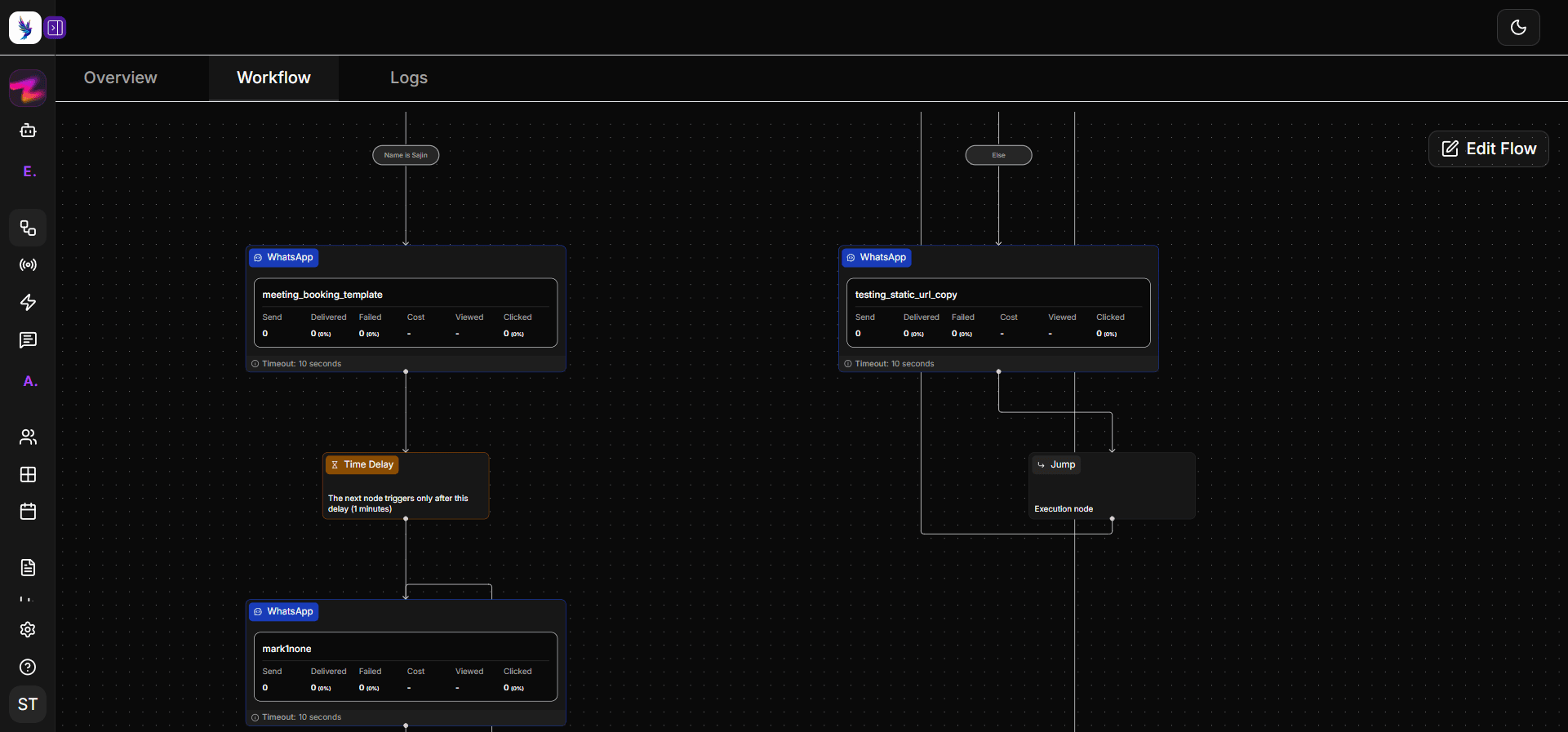
Configuring this architecture requires a WhatsApp marketing platform that supports both rule-based flow routing and LLM-based agent handling with intelligent routing logic. Not every platform supports this natively. So, to make it easy for you to implement this infrastructure, Zixflow provides a no-code flow builder that lets you design your own WhatsApp bot without needing any coding knowledge.
Ready to select between a WhatsApp AI agent vs. a chatbot?
The WhatsApp AI agent vs. chatbot decision is ultimately a question of where your customers' needs and your business's operational capacity meet.
Chatbots are not inferior to AI agents. They are purpose-built for a specific kind of problem, and they solve that problem reliably at low cost. AI agents are not automatically better as they are more complex and more expensive.
The clearest signal that a chatbot is right for you is if you can write down the most common questions your customers ask and the correct answer to each. If you figure out that a chatbot can handle most of your inbound volume effectively.
The clearest signal that an AI agent is right for you is if you find yourself adding exceptions and workarounds to your chatbot flow every week because customers keep asking things you didn't anticipate.
If you want to kick-start your WhatsApp automation with a platform that supports both rule-based flows and AI agent configuration under one subscription, you can start a 7-day free trial of Zixflow and have your first WhatsApp conversational marketing workflow running effectively.
Frequently asked questions about WhatsApp AI agent vs. chatbot
What is the difference between a WhatsApp AI agent and a chatbot?
A WhatsApp chatbot is a rule-based system that responds to predefined inputs using decision trees and keyword triggers. It can only handle conversations it was explicitly configured for.
A WhatsApp AI agent is powered by a large language model that understands natural language intent and reasons through multi-step problems. The core difference is that a chatbot provides information within a scripted flow, while an AI agent resolves problems across systems without predefined scripts.
Are WhatsApp AI chatbots banned in 2026?
Not entirely. Meta banned general-purpose AI chatbots on the WhatsApp Business Platform starting January 15, 2026 (for existing users) and October 15, 2025 (for new API users).
A general-purpose chatbot is one that answers open-ended questions on any topic, similar to a consumer AI assistant. Task-specific AI agents that handle customer support, sales, booking, and similar defined business workflows are fully permitted and encouraged. The ban targets open-ended AI, not business-scoped automation.
Can I use both a chatbot and an AI agent on WhatsApp simultaneously?
Yes, and this is often the most cost-effective approach for mid-market businesses. A hybrid architecture uses a rule-based chatbot as the first layer and routes more complex or context-dependent conversations to an AI agent layer. This keeps the cost of simple query handling low while applying AI capability where it generates the most value.
What is a Meta Business Agent?
Meta Business Agent is Meta's own AI-powered agent for WhatsApp. It can answer customer questions, recommend products, book appointments, qualify leads, and escalate to human agents, all within WhatsApp.
It is available to businesses at no cost initially, with paid tiers to follow. Meta Business Agent represents Meta's own implementation of the task-scoped AI agent model. For businesses that want a turnkey AI agent without custom development, it is worth evaluating alongside third-party platform options.
How do I get started with WhatsApp automation for my business?
Getting started requires WhatsApp Business API access through a Meta-authorized platform. Once you have API access, you can configure a rule-based chatbot using a no-code flow builder for simple query types, or deploy an AI agent through a platform that supports LLM-based conversation handling.
For most businesses, starting with a chatbot to handle your top query types for 30 to 60 days, and then evaluating AI agent deployment for the query types that the chatbot fails on, is the most practical path to full WhatsApp automation.