What is Customer Lifecycle Marketing? A Complete Framework for Growth
Customer lifecycle marketing is a strategy that engages customers at every stage of their journey to improve retention, loyalty, and revenue growth.
 by Sahil Tyagi
Customer lifecycle marketing is a strategy that aligns marketing messages with each stage of a customer's relationship with your brand. Instead of relying on one-size-fits-all campaigns or fixed send schedules, these messages are tailored to match their actions.
Messages sent in response to customer behaviors consistently outperform generic scheduled communications because they arrive at the moment of highest relevance. While every stage matters, onboarding often delivers the greatest impact on customer lifetime value by helping new customers reach their first success quickly.
Most marketing teams agree that customer lifecycle marketing is important. But far fewer actually implement it properly.
The reason for that is simple: campaign marketing feels faster. You pick a segment, write a message, and hit send.
The problem is that a customer who signed up yesterday and a customer who hasn't bought in 3 months need entirely different conversations. Treating them the same way doesn't just underperform, but it actively damages the relationship you're trying to build.
The gap between what campaign marketing delivers and what lifecycle marketing achieves is measurable.
That return doesn't come from sending more messages. It comes from sending the right message to the right person at the exact moment it's most relevant. This is where customer lifecycle marketing comes in.
So, in this guide, I'll walk you through what customer lifecycle marketing is, what the core stages look like in practice, and how to build the operational foundation that makes the whole framework run on its own.
What is customer lifecycle marketing?
Customer lifecycle marketing is a strategy that maps your communications and campaigns to the specific stage a customer is at in their relationship with your brand. It starts from the moment they first discover you to the point where they become loyal advocates who bring others in.
Rather than treating your entire database as a single audience, lifecycle marketing identifies where each customer is in their journey and sends messages that match that context.
For example, a new subscriber receives onboarding guidance. A repeat buyer receives loyalty rewards. A customer inactive for 15 days receives a re-engagement offer.
Each interaction is shaped by what that user has already done and what they're likely to do next. This is what engagement marketing looks like when it's built around behavioral data rather than calendar dates.
Lifecycle marketing vs. campaign marketing
Campaign marketing and lifecycle marketing can coexist, but they serve different purposes. Campaign marketing drives volume and awareness. Instead, lifecycle marketing drives retention and revenue efficiency. It's not about reach. It's about relevance.
The key difference between the two is timing. In campaign marketing, you decide when to send. In lifecycle marketing, the customer's behavior does. A purchase triggers a thank-you and cross-sell sequence. A sign-up triggers an onboarding flow. 30 days of inactivity trigger a win-back message.
The system responds to signals your customers are already sending, and you just have to be set up to listen.
| Aspect | Lifecycle Marketing | Campaign Marketing |
|---|---|---|
| Purpose | Builds long-term customer relationships and lifetime value | Drives a specific short-term business objective |
| Duration | Ongoing and continuous | Time-bound with a defined start and end date |
| Focus | Entire customer journey | Individual promotions or initiatives |
| Trigger | Customer behavior and lifecycle stage | Marketing calendar |
| Personalization | Highly personalized and context-driven | Often audience-based with limited personalization |
| Audience | Dynamic segments that update automatically | Static segments selected before launch |
| Communication | Continuous engagement across multiple touchpoints | One-off or limited-series messaging |
| Automation | Relies heavily on automation and behavioral triggers | May be manual or automated depending on the campaign |
Stages of customer lifecycle marketing
The lifecycle framework gives every customer a place in your marketing system and ensures no stage goes unaddressed. Each stage has a distinct goal and comes with a different type of message that performs best. Here's how each one works.
Stage 1: Awareness
At the awareness stage, a potential customer has just discovered your brand. They may have clicked on an ad, found you through search, or heard about you from someone they trust. They're not yet in your CRM, or if they are, they haven't taken any qualifying action yet.
The goal here is to make a strong first impression and give them a reason to take the next step. This is where your customer engagement channels matter most. Social proof, educational content, and clear value communication do the heavy lifting.
The mistake most brands make at this stage is trying to sell too early. A prospect at awareness is still forming an opinion about whether they trust you enough to share their contact details.
Stage 2: Acquisition
Acquisition happens the moment a prospect crosses the line and gives you permission to communicate with them, either through a form fill, a WhatsApp opt-in, or an app download. Your job at this stage is to immediately confirm they made the right decision.
The first message they receive sets the tone for everything that follows. A generic "Thanks for signing up" wastes this moment. A well-crafted acquisition message should acknowledge what they signed up for and give them one clear action to take right away.
This is also where customer segmentation begins. The channel they came through, the content that brought them in, and the details they provided during sign-up are your first data points for determining which lifecycle path they belong to.
Stage 3: Onboarding and Activation
Onboarding is the most critical stage in the entire lifecycle. Customers who complete a structured onboarding process have a 21% higher lifetime value on average. That number alone should make onboarding your highest-priority investment in the entire customer journey.
Activation is what happens inside onboarding. It is a specific moment when a customer first experiences the core value of your product or service.
For a SaaS brand, this can be considered as completing the first project. For an e-commerce company, it might be users making their first purchase. For a fintech app, it might be completing a first transaction. Until activation happens, the customer hasn't yet formed the habit of using your product, and without that habit, they will drift away.
That's a significant enough gap that a single well-designed onboarding sequence can outperform years of ad spend by retaining customers you've already paid to acquire.
The practical implication involves having an onboarding flow that identifies whether a customer has hit their activation milestone and sends different messages if they haven’t. Customers who haven't activated after a few days of signing up need a different message than those who have.
Stage 4: Retention
Once a customer is activated, the goal shifts to keeping them engaged and building a deep relationship over time. This is where customer engagement strategies move from broad to precise. Retention isn't about sending more messages; it's about sending the right message at moments that matter.
The signals worth watching at this stage include:
- Purchase frequency
- Session frequency
- Feature usage depth
- Response rates to your messages
Any meaningful drop in these metrics is an early warning that a customer is becoming at-risk before they've explicitly churned. Getting ahead of that drop is the entire point of a retention-stage lifecycle program.
Stage 5: Customer loyalty
Loyal customers don't just buy more; they actively reduce your cost of growth. Loyalty program members generate 12-18% of more than average customers each year. Loyalty is something you earn by consistently delivering value at the right moments.
At this stage, lifecycle marketing shifts from retention-focused messages to recognition-focused ones. A few examples of these messages are:
- Exclusive early access to new products
- Personalized recommendations based on purchase history
- Tiered rewards tied to spending milestones
- Referral programs that give loyal customers a reason to bring in people they know
When you have thousands of loyal customers, and even they refer 1-2 new customers each year with no acquisition cost, your referral pipeline can become a growth driver.
Stage 6: Win-Back & Re-engagement
Every customer base has a segment of people who were once engaged but have gone quiet. They haven't explicitly churned, just simply gone inactive. This is one of the most underused revenue opportunities for any business.
The reason win-back works is that lapsed customers already know your brand. They've seen it deliver value before. Plus, re-engagement doesn't require education; it requires a reason to come back.
That reason is usually a personalized incentive, a product update they haven't seen, or simply a direct acknowledgment that you've noticed they've been away.
How to build your lifecycle marketing infrastructure for your business?
Understanding the stages is only half the work. The other half is building the systems that make lifecycle marketing run without requiring manual intervention every time a customer moves from one stage to the next. Here are the operational steps that you need to follow to make it work for you:
Map your lifecycle to customer behavior
The most common mistake in lifecycle marketing is scheduling messages by time rather than behavior. The common messaging flow of "Day 3 email," "Day 7 email," "Day 14 email" treats all customers identically, regardless of what they've actually done.
A customer who completes onboarding in two days shouldn't wait 7 days to receive their next message. On the other hand, a customer who makes their third purchase shouldn't have to wait until month-end to enter your loyalty program.
So, the better approach to this is to map each stage transition to a behavioral trigger. Your messaging flow and content should adapt to the actions taken by customers, not when a timer goes off.
The best way to go about it is to start by identifying three to five key behaviors for each lifecycle stage that an individual customer performs before moving forward. These stages differ based on your industry and your offerings.
For example, if you’re an e-commerce store, your customer lifecycle flow might look like:
Discover: Prospect learns about your brand → Explore: Prospect clicks through and lands on your website/store to browse products → Engage: Prospect interacts with your store by adding products to cart or saving items → Purchase: Prospect completes checkout and becomes a customer → Repeat: Customer comes back to buy again over time → Recommend: Customer writes reviews and refers friends to your business.
This behavioral approach also benefits your customer engagement models by ensuring every touchpoint is tied to something the customer actually did, making engagement feel personal rather than automated.
When you have this flow figured out for your business, build your automation sequences around these signals (more on this below).
Build stage-specific audience segments
Lifecycle marketing only works if you can reliably identify which stage each customer is in at any given moment. This requires a segmentation approach built around behavioral data that consists of understanding:
- What have they bought?
- How often do they log in?
- Which kinds of messages have they responded to?
- How long has it been since their last interaction?
The simplest version of this is a set of dynamic lists that update automatically as customer activity changes.
An "Active buyers" segment contains anyone who has purchased in the last 30 days. An "At-risk" segment contains anyone whose purchase frequency has dropped more than 50% from their personal average. A "Lapsed" segment contains anyone inactive for more than 60 days.
With these segments in place, your campaigns hit a precisely defined audience at each stage, and each message speaks directly to the situation that the customer is actually in. That's what customer engagement automation at scale looks like in practice.
On top of that, stage-specific segments make it easy to spot where your lifecycle is losing customers. If your Acquisition segment is growing but your Onboarding segment isn't, you know exactly where to focus. If your Retention segment shrinks while your Lapsed segment grows, you have an early-warning signal before churn becomes critical.
Create content mapped to each stage's goal
Each lifecycle stage has a different job for your content to do. Awareness content builds trust. Acquisition content confirms value. Onboarding content drives activation. Retention content deepens engagement. Loyalty content rewards behavior. Win-back content reminds customers why they liked you in the first place.
Without a content map, it's easy to default to sending the same type of message at every stage. This is something that most brands do when they haven't fully committed to the lifecycle approach.
To begin with, decide on one primary message and one follow-up for each of your six lifecycle stages. Map each message to the behavior that triggers it, the segment that receives it, and the single action you want the customer to take next.
Once you see which messages perform best, expand from there. Customer personalization at the content level revolves around matching message copy and offers to the customer's most recent behavior. This is what pushes response rates above benchmark.
Set up behavioral triggers
The operational backbone of lifecycle marketing is automation. Without it, lifecycle marketing remains a concept since you can't manually monitor every customer's behavior and send timely, personalized messages at scale. The most important triggers to set up first are the ones that cover the highest-stakes moments in the lifecycle.
Each of these flows should run automatically in the background, responding to customer signals without requiring a team member to initiate them.
AI marketing automation takes this a step further by predicting which customers are most likely to go inactive before they actually do. So you can run a pre-emptive retention message rather than a reactive win-back. That shift from reactive to predictive is where lifecycle marketing compounds its advantages over time.
Plus, with multi-channel automation across WhatsApp, email, SMS, and RCS, you can reach each customer through the channel they actually respond to, and not just the one you prefer to send through.
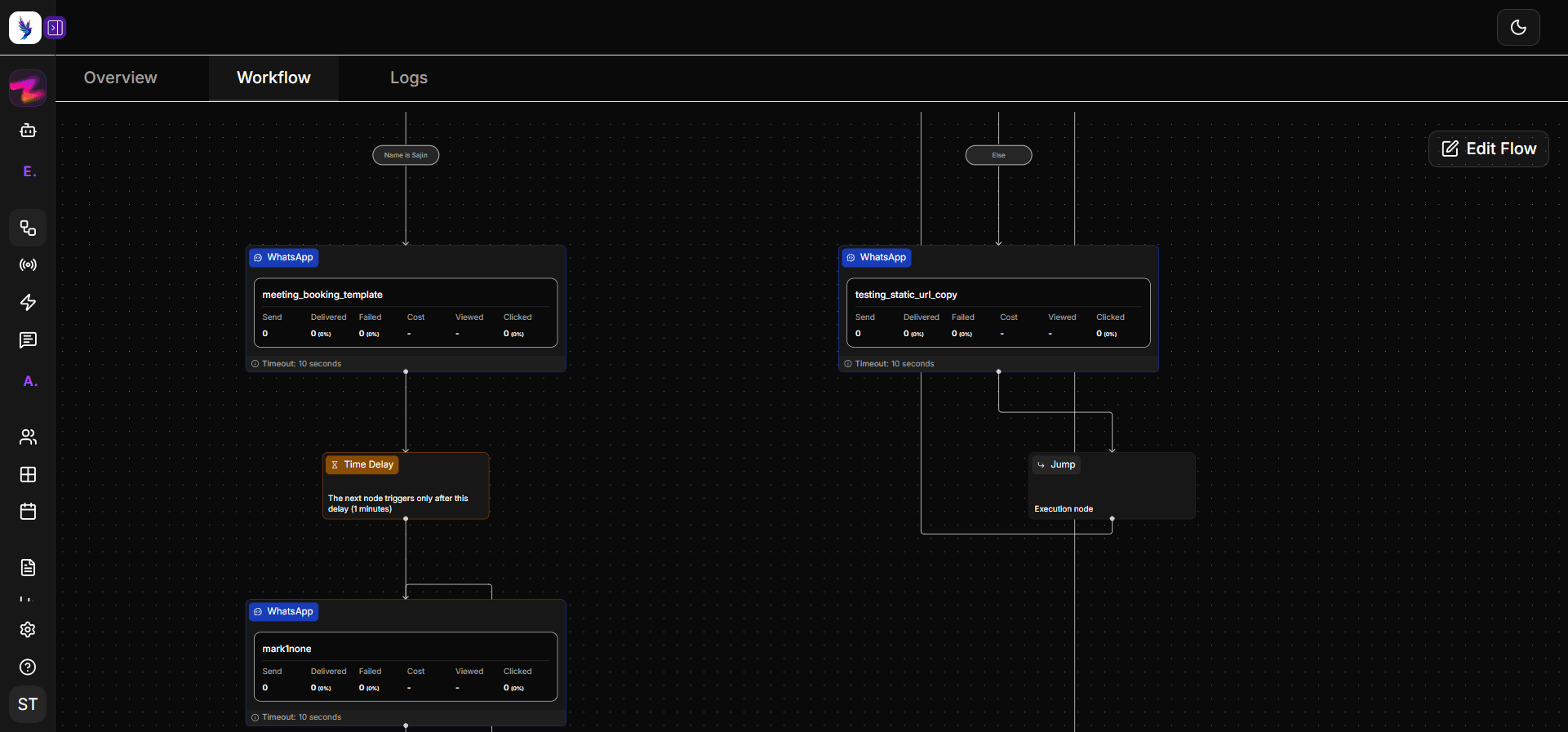
Customer engagement automation tools usually take care of this step. If you’re using Zixflow, then the visual automation builder lets you set up custom triggers using webhooks and control the entire flow by leveraging IFTTT triggers to decide when the flow should terminate.
Ready to build your customer lifecycle marketing?
Customer lifecycle marketing is about building a system that delivers the right experience at the right moment throughout the entire customer journey. When every message is tied to customer behavior instead of arbitrary send dates, your marketing becomes more relevant and significantly more effective.
The businesses that see the biggest gains from lifecycle marketing don't necessarily have larger teams or bigger budgets. They simply understand their customers better and create structured pathways that guide people from awareness to loyalty.
The good news is that you don't need to build the entire framework overnight. Start with a single stage that's currently causing the biggest drop-off in your customer journey. It could be onboarding, retention, or re-engagement. Define the customer behaviors that matter and create a simple automated workflow. Once that foundation is in place, expand to the next stage to continue refining your approach.
So, if you're ready to move from one-off campaigns to a lifecycle marketing approach that runs automatically, Zixflow gives you the tools to build it. You can start a free 7-day trial or book a demo to see how Zixflow's automation works in practice for your specific business model.
Frequently asked questions about customer lifecycle marketing
What is customer lifecycle marketing?
Customer lifecycle marketing is a strategy that delivers targeted messages based on where a customer is in their relationship with your brand. Rather than sending the same message to your entire database, it uses behavioral triggers to deliver communications that are timed and tailored to each customer's current stage. The goal is to move each customer forward in the relationship rather than sending the same broadcast to everyone at once.
What are the stages of customer lifecycle marketing?
The six core lifecycle stages are:
- Awareness
- Acquisition
- Onboarding and Activation
- Retention
- Loyalty and Advocacy
- Win-Back
How is lifecycle marketing different from campaign marketing?
Campaign marketing is event-driven; you have a product launch, and you send a message to as many people as possible at a time you choose.
Lifecycle marketing is behavior-driven. The customer's own actions trigger the message, and both the timing and content reflect where they are in their journey.
Both approaches can coexist, but lifecycle marketing delivers higher long-term retention and revenue efficiency because every message arrives in context rather than at random.
How do you measure lifecycle marketing success?
Measure at the stage level rather than at the campaign level. Key metrics include:
- Activation rate
- Repeat purchase rate
- Save rate
- Average days to reach the loyalty stage
- Win-back rate for lapsed customers
These stage-level analytics tell you exactly where your lifecycle is working and where it's breaking down.
How many lifecycle stages should a business start with?
Most businesses get the best results by starting with three stages: Onboarding, Retention, and Win-Back.
These three cover the most common and highest-impact customer movements. Once these three are running reliably, you can expand into the Acquisition and Loyalty stages with more sophisticated automation. Trying to build all six stages at once usually results in none of them being done well.
What tools do you need for customer lifecycle marketing?
At minimum, you need a CRM or a customer data platform that tracks behavioral data, a marketing automation platform that can trigger messages based on behavioral signals, and multi-channel messaging capabilities so you can reach customers on the channel they actually use.
Zixflow is a combination of a customer data platform, which enables you to design your lifecycle marketing workflows across various channels without any coding knowledge.
What is the difference between lifecycle marketing and lead nurturing?
Lead nurturing focuses specifically on the pre-purchase stages of the journey. It usually revolves around moving a prospect from awareness to acquisition to their first purchase.
Lifecycle marketing covers the full customer journey, including everything that happens after the first sale. In practice, lead nurturing is the pre-sale component of a broader lifecycle marketing program. Both use behavioral triggers and automated sequences, but lifecycle marketing extends that logic across the entire customer relationship.