How to Use ChatGPT for Marketing: Ultimate Guide for 2026 (with Prompts)

Table of Contents
It does not take a huge budget or several years of on-hand experience to run great marketing campaigns. The extent of AI penetration into the digital space is probably not new to you.
That being said, generative AI remains a dominant topic in any industry. Since the launch of GPT-4, companies are adopting AI and are also resolving legitimate issues of accuracy, ethics, and safety.
Using AI such as ChatGPT, companies, whether running a small business in the area or managing a growing brand, can generate marketing that is both professional, interesting, and strategic.
Learning to write good prompts, marketers will be able to use ChatGPT to its full potential. The tool has the capacity to assist in generating convincing social media text to properly design email campaigns and get content inspiration.
So, in this guide, we will discuss the practical and innovative applications of ChatGPT in marketing, along with how one should consider using the tool by designing prompts that provide valuable information.
What is ChatGPT?
ChatGPT is an AI-based chatbot created by OpenAI that was released in 2022. In contrast to the conventional chatbots using pre-written scripts and limited reactions, ChatGPT can maintain dynamic and human-like dialogues to provide context-specific answers to a wide variety of questions, including marketing.
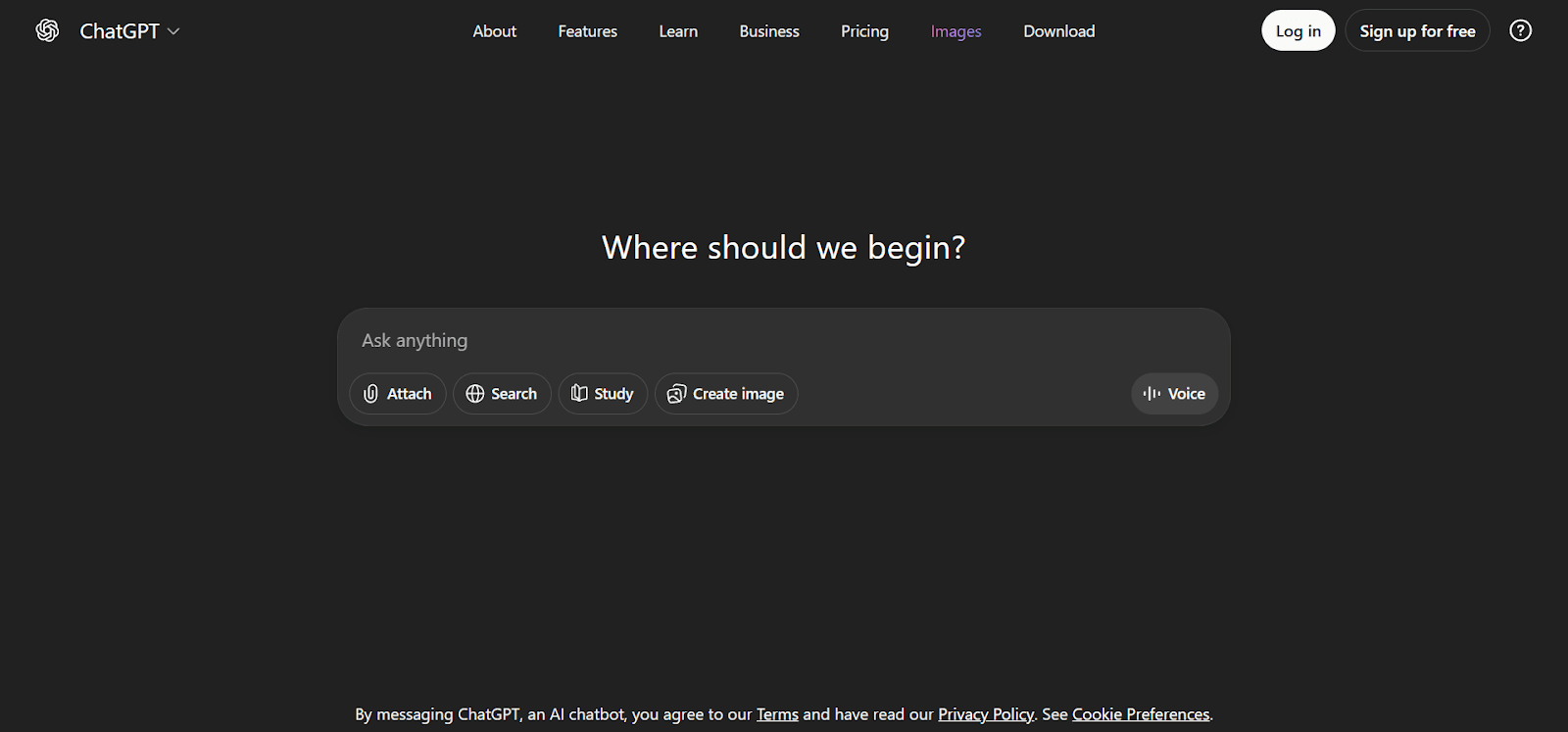
Ever since its launch, ChatGPT has been considered one of the most visited AI platforms in the world, with billions of visitors using it each month. Although there has been controversy on responsible AI usage, its usage is increasing faster than ever.
Nowadays, individuals in all fields are incorporating ChatGPT into their processes, whether it is students writing academic papers or lawyers creating documents on a case. Marketers, especially, are finding it useful in content ideation, copywriting, and planning marketing campaigns.
Here is a comparison of different versions of ChatGPT along with their respective strengths and limitations:
| Version | Best At | Strengths | Limitations |
|---|---|---|---|
| GPT-3.5 | Basic writing & simple Q&A | Fast, lightweight, good for short content, paraphrasing, simple explanations | Struggles with complex reasoning, weak accuracy on nuanced topics, limited context handling |
| GPT-4 | Long-form content & reasoning | Better logic, improved writing quality, stronger understanding of context and intent | Slower than lighter models, text-only, can still hallucinate |
| GPT-4o | Multimodal + real-time tasks | Handles text, images, and voice; faster responses; great for brainstorming, explanations, UI feedback | Not as deep in long reasoning as newer GPT-5 models |
| GPT-4.1 / 4.1-mini | Cost-efficient structured tasks | Good balance of speed and accuracy; useful for summaries, tagging, basic automation | Less creative depth, weaker complex reasoning |
| GPT-5 | Advanced reasoning & strategy | Strong planning, analytical thinking, structured outputs, better factual grounding | More resource-intensive; overkill for simple tasks |
| GPT-5-mini | Fast everyday tasks | Quick responses, good for drafts, social posts, FAQs, light research | Reduced reasoning depth compared to full GPT-5 |
| GPT-5.2 | Expert-level content & decision support | Best at long-form writing, SEO content, business strategy, technical explanations, nuanced analysis | Still requires human review for legal or medical accuracy; can be verbose if not guided |
Why using ChatGPT for marketing is crucial for long-term business success?
Now that we’ve covered what ChatGPT is, it’s worth looking at the practical value it brings to marketing teams.
AI has redefined marketing
By 2026, AI is not going to be an experimental addition anymore. It is being integrated into the very fabric of the operations and budgets of modern marketing teams. The position of AI in the marketing space is already worth tens of billions of dollars, and a large part of it is spent on content creation, optimization of the campaign, and customer experience platforms.
ChatGPT is the gateway to this change for many marketers. Its chat system allows complex artificial intelligence to be available to all members of the team, including founders, strategists, writers, and social media managers, without the need to be technical.
Generative AI capabilities
One of the most frequent users of generative AI are marketing professionals. According to recent studies, almost 60% of marketers use AI-based solutions at least once a week or even on a daily basis to facilitate the creation of content or social media management.
ChatGPT has become one of the most popular solutions for this group. It has already been integrated into the workflow of a large proportion of marketers, either in ideation, drafting, or refinement. Consequently, ChatGPT is not considered an experimentation tool anymore, but a common productivity layer between marketing teams.
Increased productivity without adding more employees
The argument businesses most commonly make regarding ChatGPT is time savings. Research on generative AI indicates that knowledge workers have an opportunity to save numerous hours per week by automating mundane writing and research processes. And it benefits them greatly by virtue of the content-intensive nature of their work.
Practically, this could imply the ability to convert one idea of a campaign into a blog post, a series of social updates, and a variety of email versions within one session. Teams are able to increase efficiency by a considerable margin without the need to employ more personnel or customer engagement agencies.
Turning data into actionable insights
The usefulness of ChatGPT is not limited to the creation of content. It also assists marketers in making sense of the increasing scale of audience and performance data they receive from analytics dashboards.
Although the use of AI-driven tools to conduct segmentation, targeting, and analytics is common among many brands now, the results are usually hard to interpret in a short period.
Posting summaries, survey results, or analytics data to ChatGPT, marketers have the opportunity to identify trends that reveal customer pain points and find marketing opportunities. These observations can then be directly translated into more applicable copy, which can then be converted to campaign angles.
Getting your marketing team ready for future trends
In the future, AI fluency is rapidly emerging as a mainstream marketing competency instead of a niche benefit. According to surveys in the industry, it is estimated that a significant amount of current marketing work will be automated by the close of the decade. Timely design and AI supervision will become the official duties.
Within this setting, the ability to figure out how to manage and assess tools like ChatGPT is as important as coming up with catchy headlines or knowing analytics dashboards. The speed of launching a campaign and its success is increasingly determined by the quality of prompts and human judgment.
Some of the top use cases for ChatGPT in the marketing industry
Knowing the advantages, it is time to learn how marketers actually use ChatGPT. Businesses across various industries are using it in real-life contexts for streamlining their marketing workflows.
Content marketing
ChatGPT has emerged as one of the most important collaborators of content teams by reducing the time between idea and first draft. The marketers can transition through an unstructured topic to a formal outline, SEO-friendly headings, and a long-form draft much faster than the traditional workflow would allow them to.
ChatGPT is also used by many teams to make core content last longer. One blog post can be reused as LinkedIn updates, descriptions on YouTube, or short social posts. It allows its reach to be maximized without having to create content separately for each channel.
It also removes the issue of an empty page. Just by writing a prompt with audience, goals, product background, and target keywords, marketers can brainstorm many content angles in a very short time to pick the best one that can be further refined.
Social media marketing
Speed and consistency are equally vital features in social media as creativity. Coordinating the calendar on such platforms as LinkedIn, Instagram, X, YouTube Shorts, and TikTok may be time-consuming when it is organized manually.
Using ChatGPT, social teams can feed in monthly themes, brand guidelines, and major promotions for the ChatGPT to present with a three-month scheduling calendar with captions unique to each platform. It is also easy to use the same message and change the tone to professional, conversational, or punchy without losing the main idea with the help of the platform.
This also allows real-time marketing. For example, when trends are identified, your marketing reps are able to brainstorm hooks and scripts in a short period of time when the moment is still topical.
Email marketing
Email remains among the most successful online communication channels, and ChatGPT can assist marketers in creating more personalized campaigns.
It can be used by teams to come up with several variations of subject lines depending on the frameworks, like urgency, curiosity, or benefit-led messaging, which makes A/B testing much quicker and easier.
Additionally, in the case of newsletters, marketers will be able to insert links, notes, and updates to request ChatGPT to compile a coherent draft that fits the brand tone.
SEO & copywriting
ChatGPT can be used as an assistant in the SEO workflow instead of a strategic alternative. It helps marketers to browse topic clusters and narrow the search intent to create supporting pieces that are optimized to rank well on the SERP.
In copywriting, the tool is very good at generating variations based on your inputs for tone or relevance. For example, performance marketers can enter the audience information and offer details to request dozens of headline or ad copy options to run paid campaigns. Although the ultimate choices are still made by human judgment, a broad range of ideas is a speedy way of testing and optimization.
Customer engagement
ChatGPT assists in proactive and reactive communication in the customer engagement vertical. It is used by brands to write chatbot scripts, WhatsApp messages, and social DM templates that are naturally compliant and are in line with the brand’s voice.
That’s not all. ChatGPT can also be used in customer research. The simulation of the conversations with the audience profiles, FAQs, and support data allows marketers to discover frequent objections, points of confusion, and even emotional triggers.
The insights are given back to relevant departments to craft a customer-centric selling approach, which is constantly enhancing the marketing strategy.
How to make the most of ChatGPT?
To reiterate, the value of ChatGPT does not lie in utilizing the tool but rather in the way in which you use it. The effects will mostly rely on the quality of the inputs, the manner in which they are incorporated in the current workflows, and the degree of human supervision applied in the process.
Write correct prompts
Marketers who come to responses in the manner they would to a creative brief always perform better than those who use brief and vague commands. Rather than posing a general question such as, “Write a Facebook ad about my course”, successful prompts establish the audience, the underlying issue, the proposal, the tone, and the level of awareness.
An example is when a marketer selling an online platform may use this prompt instead for a better response from ChatGPT: "Be a professional copywriter. Develop three Meta advertisement versions, targeting small brands that are looking for a marketing tool to streamline their promotional efforts.
Emphasize the benefits of the platform, low learning curve, and social proof with customer reviews. Write this in less than 50 words and be confident when talking to people.”
This kind of context allows ChatGPT to be structured in such a way that it produces content that is ready to go live from the first draft, and not a draft that has been thrown together.
It is also essential to repeat in the same discussion.
ChatGPT enables marketers to improve outputs by providing specific feedback after every response within the same chat thread. This back and forth is similar to dealing with an actual copywriter who gets better with constant feedback.
Integrating ChatGPT into the current marketing infrastructure
ChatGPT can create much more value when it supplements tools that marketers already use.
As an example, an organic marketing manager can export the data about relevant keywords in an SEO platform and request ChatGPT to group those words into thematic categories, giving each category a main keyword, and propose article titles based on search intent. What initially represents raw data about keywords very fast becomes a roadmap of useful content that follows the objective of SEO.
This is also the case with email marketing. Summarizing the performance metrics of recently run campaigns, including the open rates, click-through rates, or drop-offs, the marketers can instruct ChatGPT to diagnose the non-performing sequences to propose other angles, subject lines, or content structures that drive customer engagement.
Lastly, ChatGPT is used as a translation layer in CRM and analytics processes. Managers can analyze the campaign statistics and request it to elaborate on what occurred in straightforward language to a non-technical stakeholder. This transforms bulky data into an easy-to-follow report, enabling brands to bring marketing teams up to speed quickly without needing dedicated data experts.
Maintaining a consistent brand voice
When there are numerous reps responsible for generating marketing content, there are two types of risks, the perception of generic content and the inaccuracies emerging within the messages.
The best option for securing brand voice is providing ChatGPT with explicit reference. You can provide some examples of good, on-brand content, including a landing page, a newsletter, and an ad copy that performs well, and request ChatGPT to analyze the tone of style and structure.
Those guidelines can then be referenced in future requests so as to ensure consistency between multichannel sales engagement.
Furthermore, ChatGPT is most useful when it is used to reorganize or refine information given by the marketer, as opposed to coming up with new innovations. As an example, marketers ought to provide useful information such as the price, features, support, and policies, and ask ChatGPT to transform the information into an engaging copy without making any assumptions.
One thing to consider when using ChatGPT for marketing is to think of it as an artificial tool as opposed to an authority. It should deal with phrasing, clarity, and structure instead of compliance or promises. Applied in this manner, ChatGPT reinforces the message of a brand without creating an unwarranted risk.
30+ ChatGPT prompts for marketing
Below are some practical ChatGPT prompts designed to get started with marketing tasks. These prompts help marketers effectively make the most of ChatGPT by providing clear instructions for generating relevant, high-quality marketing outputs.
Content marketing
"Act as a content strategist. Provide 10 ideas about blogs to help [target audience] and how they would solve the biggest problem which is [primary problem]. For each idea, include a title and a one‑sentence angle.”
“Ccreate an SEO outline (h2s/h3s) for this blog topic: [blog topic], aimed at [experience level]. Focus on the primary keyword: [primary keyword].”
“Write a [word count]‑word draft from this outline: [paste outline]. Use a [tone] tone and write for [target audience].”
“Make this blog in three formats: a YouTube script, a post on LinkedIn, and an email teaser. Here is the blog: [paste blog]. Retain the main message and make it fit to every channel.”
“Please provide [X] lead magnet suggestions to a [brand type], with [target audience] that has [primary probлеm]. Be specific on the format and overall promise of each idea.”
“Write a summary of this lengthy blog in 150 words, and a 50 word summary. Here is the blog: [paste blog]. Remember the message and advantage point.”
Email marketing
“Design a 3‑email welcome sequence for new subscribers who downloaded [lead magnet]. Describe the goal, main idea and suggested call‑to‑action for each email.”
“Write email 1 of this welcome sequence for [brand type] and [target audience]. Keep it under [word count] words. Include a brief origin story: [key points], and invite replies.”
“Generate [X] subject lines for this email: [paste email or summary]. Use curiosity and benefit angles and keep each subject line under [character limit] characters.”
“Write a 4‑email reactivation sequence for inactive subscribers who originally signed up for [offer / lead magnet]. Include a subject line and main message for each email.”
“Draft a short ‘cart closing’ email for [offer]. mention [key benefits], [deadline] and [limiters]. Keep the tone [tone] and text under [word count] words.”
“Rewrite this sales email to sound more conversational and less pushy while keeping all facts, prices and deadlines the same. email: [paste email].”
Social media marketing
“Plan a 30‑day content calendar for [platforms] for a [brand type] targeting [target audience]. Include 1 post idea per day with a short hook and content format.”
“Write 5 hook ideas for a [platform] reel about [topic]. Make each hook under [word limit] words and highly attention‑grabbing.”
“Rewrite this LinkedIn post as a high‑engagement X (Twitter) thread for [target audience]. Use [number] tweets and keep the same core message. Post: [paste post].”
“Turn this blog into [X] tweet ideas aimed at [target audience]. Each tweet should share one key insight in under [character limit] characters. Blog: [paste blog or key points].”
“Write [X] caption variations for this [platform] carousel with different calls‑to‑action (e.g., [cta type 1], [cta type 2], [cta type 3]). Carousel content: [describe or paste].”
“Adapt this announcement into versions for Instagram, LinkedIn and X. Here is the announcement: [paste text]. Keep the message the same but match each platform’s style and length.”
Paid advertisements
“Create [X] supporting blog topics around the keyword: [primary keyword], grouped by search intent: awareness, consideration, and decision. Include a suggested seo title for each.”
“Write meta titles and descriptions for these [X] topics: [list topics or urls]. Keep titles under [character limit] characters and descriptions under [character limit] characters.”
“Suggest [X] H1 headlines for a landing page about [offer] targeting [target audience]. Each headline should highlight a clear benefit and stay under [word limit] words.”
“Write [X] Google Ads headlines and [X] descriptions for [offer] aimed at [target audience]. Follow current character limits and avoid any earning or guarantee claims.”
“Improve this landing page copy by making it more benefit‑driven and specific for [target audience], while keeping the structure and promises the same. Copy: [paste copy].”
“Write [X] alternative hero sections for this sales page for [offer]. Each hero section should include a headline, subheadline, and one short supporting sentence. Current page: [paste url or text].”
Customer engagement
“Group these customer questions and objections into themes and name each theme. Provide a one‑sentence description of each theme. Data: [paste questions/objections].”
“Write a concise faq section for my sales page based on these objections. use clear, reassuring language for [target audience]. Objections: [paste objections].”
“Write [X] empathetic reply variations to this objection from a prospect: ‘[paste objection]’. Keep the tone [tone] and end with a clear, low‑pressure next step.”
“Draft a simple Instagram DM flow that qualifies leads for [offer] and moves them towards [desired action]. Include greeting, 3–5 qualifying questions and closing message.”
“Write [X] short follow‑up messages for prospects who stopped replying after asking for details about [offer]. Keep each message under [character limit] characters and non‑pushy.”
“Write a polite message to handle the objection ‘[price objection text]’ while keeping the price of [offer] firm. Emphasize value, fit, and next steps.”
Ready to maximize your marketing ROI with ChatGPT?
By 2026, ChatGPT will have become a fundamental marketing engine. Those who have perfected it and have incorporated it into their marketing workflows have a clear advantage in creating more output with less burnout.
The prompts presented here give you a ready point of departure to experiment on your campaigns and transform marketing strategy to drive results immediately.
When AI does the heavy work in the drafting and brainstorming, it is paired with the appropriate automation tools, it catapults your marketing to a new level.
It is where Zixflow can shine as a no-code powerhouse to solopreneurs and small teams to streamline marketing campaigns over numerous channels for all-round engagement.
Try it out for yourself using a 7-day no commitment trial.
Frequently asked questions about using ChatGPT for marketing
Below are frequently asked questions that explain how marketers can use ChatGPT responsibly and effectively:
How is ChatGPT used in marketing?
Marketers use ChatGPT to create ideas for the content to write and optimize copy. Plus, they can personalize customer messages, analyze campaign data, and facilitate customer conversations. It assists teams to work with increased speed and also to be consistent across the channels efficiently.
What types of marketing tasks can ChatGPT automate?
ChatPT can be used to write e-mails, social media post captions, promote advertising copy, blog drafts, frequently asked questions, chatbot scripts, and replies to customers. Although it does not substitute human judgment. Instead, it saves a lot of time on repetitive and research-intensive activities.
Is ChatGPT suitable for B2B marketing?
Yes. ChatGPT is utilized by B2B marketing in terms of lead nurturing content, sales enablement content, account-based messages, product descriptions, and long-form educational content. It is particularly successful when it is directed with clear cues and context concerning the target audience.
How do marketers write effective prompts for ChatGPT?
Efficient prompts are particular, situational, and goal-oriented. Adding information like target audience, tone, format, channel, and desired outcomes assists ChatGPT in producing a more precise response. Repeating prompts also enhances the quality of the output in the long run.
What are the limitations of using ChatGPT for marketing?
Prompts that are not specified or validated by the user are likely to end up generating generic, old-fashioned content, which ChatGPT is likely to generate. Neither does it know the ins and outs of branding unless directed to do so. Human overview is a must in order to make sure that the replies are accurate and brand-aligned.
Will using ChatGPT affect content originality or SEO?
ChatGPT-generated text may be optimized to be SEO-friendly when edited and supplemented with original knowledge. The search engines focus on useful, experience-based content, and marketers must look at ChatGPT as the beginning, rather than the end of publishing.
Sahil Tyagi
I'm a passionate content writer and SEO enthusiast who enjoys turning ideas into helpful articles. When I'm not busy with content, you'll find me enjoying sports or reading about growth strategies.