AI-Driven Marketing Optimization: An Ultimate Guide to Boost Conversions
Optimize marketing campaigns with AI by using campaign data to identify what works and where changes can improve conversions.
 by Sahil Tyagi
AI marketing optimization uses machine learning and predictive analytics to improve campaign performance in real time continuously.
AI-optimized campaigns produce 32% more conversions and 29% lower acquisition costs compared to manually managed campaigns running to the same audiences. The core applications of AI marketing optimization are:
- Predictive analytics
- Automated real-time budget allocation
- AI creative testing
- AI audience targeting
Marketing teams running AI-optimized campaigns are seeing 32% more conversions and 29% lower acquisition costs compared to teams running the same campaigns manually.
And this gap isn't closing. It is widening because AI doesn't just optimize faster than a human team can, it optimizes continuously across more variables than any team can track at once.
The global AI marketing market has reached $47 billion in 2026, and 78% of marketing professionals now use AI tools in their daily workflow. The question for many businesses is no longer whether to use AI for marketing optimization, it is which parts of their funnel to optimize first to build a system that compounds those gains over time.
Till now, traditional marketing campaign optimization ran on retrospective actions. You run a campaign and wait for data to accumulate. Once it does, you analyze the performance to adjust the next one. That cycle takes days to weeks, and by the time the adjustment is made, the competitive landscape has shifted.
AI marketing optimization operates in a different time frame. It analyzes performance signals in real time to reallocate budget across channels as results come in. Also, it tests creative variations automatically to figure out underperformance before it compounds into wasted spend.
So, to make sure you don’t fall behind your competitors, in this guide, I'll walk you through what AI marketing optimization means and give you some concrete strategies that you can use to build a system that consistently improves conversion performance.
What is AI marketing optimization?
As the name suggests, AI marketing optimization is the process of utilizing machine learning and predictive analytics to continuously improve marketing campaign performance across channels. Rather than relying on periodic human review and manual adjustments, AI marketing optimization systems analyze performance data in real time to identify patterns across large datasets. It then recommends changes that can be adopted more quickly and at scale.
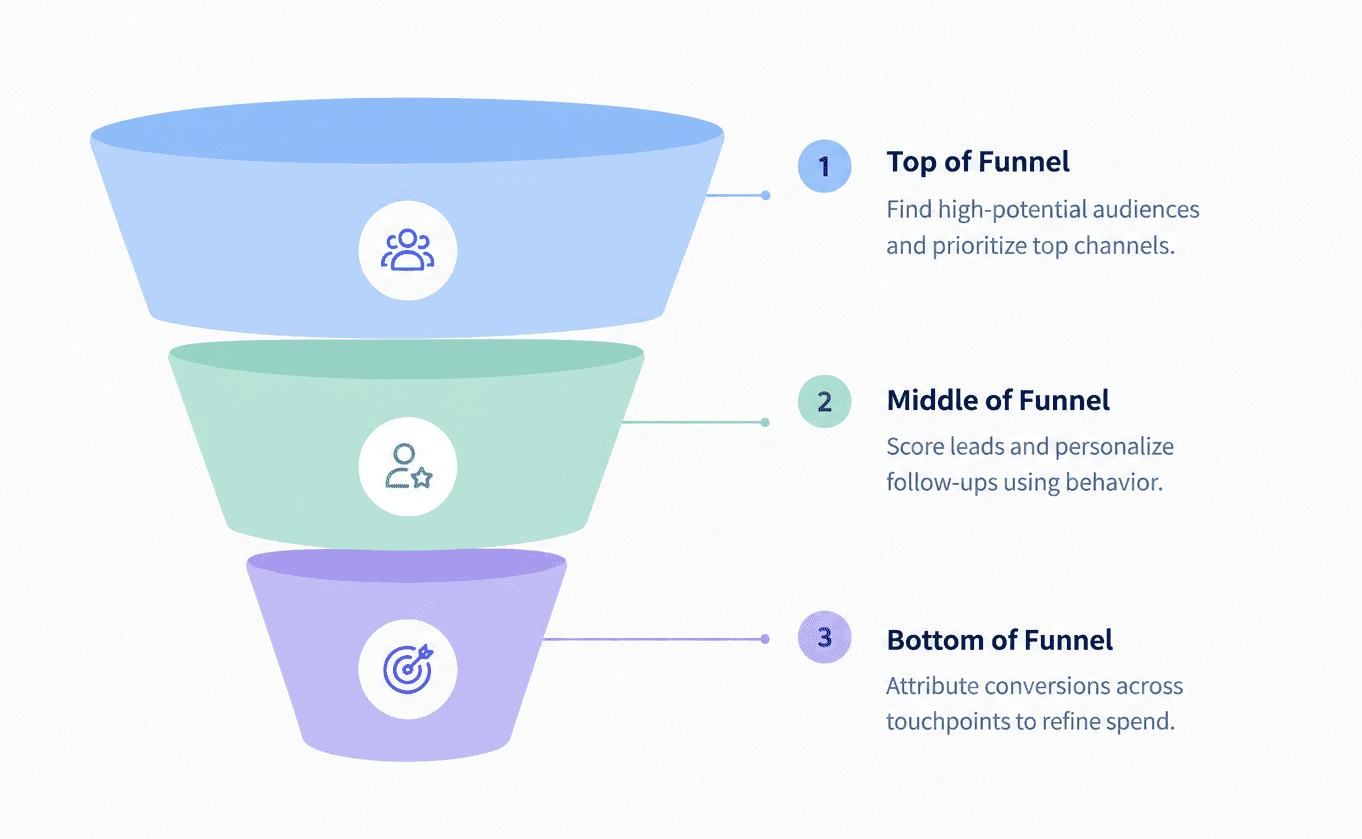
The scope of what AI can optimize in a marketing program covers more than the stages of the sales pipeline that businesses initially expect. At the top of the funnel, AI identifies highest-probability audience segments to allocate budget toward the placements producing the best early signals.
In the middle of the funnel, it scores leads by conversion likelihood, personalizes content based on behavioral data, and optimizes the timing of follow-up communications.
At the bottom of the funnel, it attributes conversions accurately across multi-touch journeys. By leveraging those findings, it uses attribution insights to optimize targeting and spend for the next campaign cycle.
What makes AI optimization different from rule-based automation is the ability to handle complexity at scale. A rule-based system follows explicit "if-then" logic written by a human. An AI system identifies patterns that your customers show and not what you predicted would happen.
Why is AI marketing optimization driving better conversion outcomes?
AI marketing optimization produces measurable improvements across every major performance metric in a marketing program. Here are a few specific outcomes that consistently emerge when using AI-driven optimization in marketing campaigns:
Higher conversion rates across the funnel
AI-optimized marketing campaigns consistently outperform manually managed campaigns on conversion rate because they respond to performance signals faster by operating across more variables simultaneously.
AI personalization delivers a 15 to 25% conversion rate improvement on average. Google Ads AI bidding strategies alone improve conversion rates by an average of 15% for campaigns that switch from manual to automated bid management.
The conversion lift comes from multiple optimization levers working together, such as better audience targeting, creative testing, and timing optimization. Each of these levers produces a modest improvement independently, but when they compound, the cumulative effect on conversion rate is significant.
Lower customer acquisition costs
One of the clearest financial benefits of AI marketing optimization is the reduction in cost per acquisition. When AI continuously refines audience targeting based on which segments are converting, spend concentrates on the audiences most likely to complete the desired action.
The result is that the same budget reaches fewer low-probability prospects and more high-probability ones, thereby lowering the average cost per conversion.
AI-optimized campaigns produce 29% lower acquisition costs than manually managed campaigns running to the same audience pools. That's not a marginal efficiency gain. At scale, a 29% reduction in CAC significantly increases the profitability of existing campaigns.
Better campaign ROI
Manual budget allocation across channels typically happens on a weekly or monthly review cycle. By the time a human team identifies that one channel is outperforming another, a meaningful portion of the campaign has run at suboptimal allocation. AI budget optimization optimizes this by reallocating spend in near-real time based on performance signals.
The mechanism for AI marketing optimization is straightforward. AI systems evaluate campaign performance across channels continuously to determine which combination of placements, audiences, and formats is producing the best cost-per-result. It then allocates the budget accordingly toward those winners faster than a human review cycle allows.
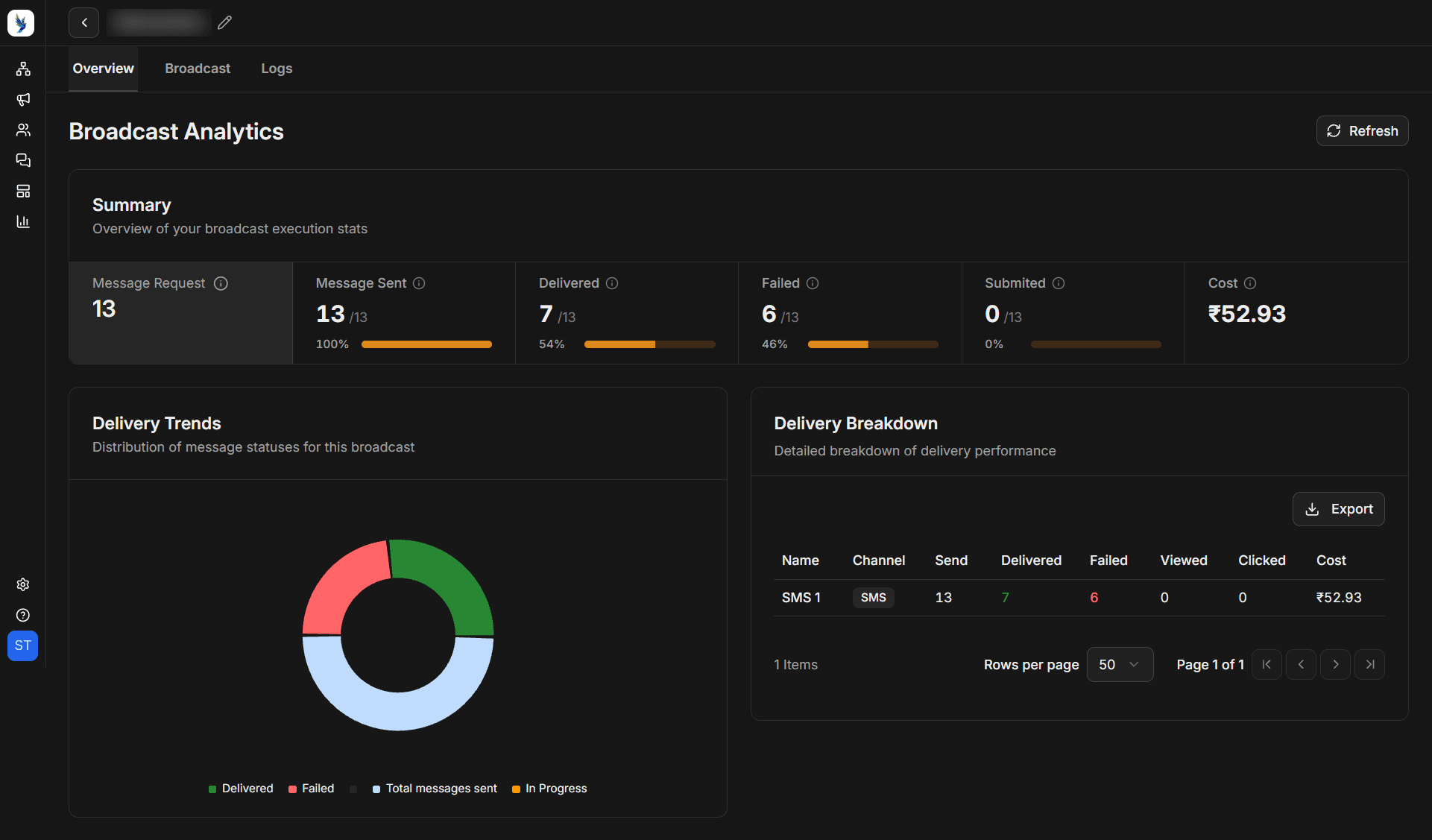
For performance marketing teams, this capability means that the ROI benefit of AI optimization shows up in the campaign data as a direct improvement in return on ad spend relative to the same budget managed manually. Tracking these improvements through consistent customer engagement measurement frameworks makes your business case for ongoing AI investment easier to understand.
See Every Journey In-Depth.
Zixflow tracks every message delivery and customer engagement to give you a clear picture of your expenses.
Try Out for FreeMore accurate attribution for smarter future spend
Attribution is one of the most persistent challenges in marketing. Customers interact with multiple touchpoints before converting, and crediting the right channel or message for that conversion determines where you invest next. Multi-touch attribution is time-consuming and prone to errors when done manually.
AI-driven attribution models evaluate the full sequence of interactions each customer had before converting. It weights each touchpoint based on its contribution to the outcome across thousands of customer journeys to surface the correct combinations that produce conversions.
This gives you a materially more accurate picture of what's actually driving revenue, allowing you to allocate future spend more precisely.
If you are managing customer engagement across multiple channels, better attribution restructures the entire marketing mix over time by redirecting investment toward the sequences that have a proven positive track record.
Ways to use AI for marketing optimization to drive conversions
Building an effective AI marketing optimization system means knowing where AI creates the most leverage in your specific funnel and deploying it with the right data infrastructure in place. Let’s look at these strategies individually:
Use predictive analysis to forecast campaign performance
Till now, most marketing campaign optimization happens after a campaign launches. Predictive analytics lets you move that optimization earlier, before the campaign even launches.
The mechanics to do that involve training a predictive model on your past campaign data that includes impressions, clicks, conversions, audience, and creative variables associated with each outcome. After having these details, the AI model uses them to score the likely performance of the campaign before committing a budget.
A model trained on sufficient data can tell you with meaningful confidence which combination of audience, channel, and creative is most likely to hit your target cost per acquisition before you spend a dollar to test it.
The starting point to build this model is connecting your marketing tools into a centralized source that the predictive model can draw from. Without unified historical data, predictive models can't surface reliable forecasts.
If you are a brand handling B2B customer engagement, predictive analytics applies to pipeline forecasting, opening opportunities that are most likely to close if not attended to right now. These signals let your revenue teams prioritize their effort toward the highest-probability opportunities rather than distributing attention evenly.
Automate marketing budget allocation based on real-time performance
Budget allocation is one of the most impactful optimization decisions in a marketing campaign, and it's also one of the most commonly made on outdated information.
A budget divided across channels at the start of a quarter based on last quarter's performance is already working with a lag. With time, channel performance shifts as audience saturation increases or creative fatigue sets in on a format that was working last month. A static budget doesn't respond to any of this.
AI-powered budget allocation systems connect to your ad platforms via API to monitor campaign performance with live data.
When one channel's cost per conversion starts rising because of increasing competition or audience saturation, the system identifies the signal to allocate budget toward channels where the cost per result is currently lower. The reallocation happens within hours rather than at the next weekly review, which means the campaign's overall efficiency improves continuously throughout its run.
Setting this kind of framework requires defining clear optimization objectives in the AI system. It includes defining crucial conversion metrics like:
- Cost per acquisition
- Return on ad spend
- Lead volume at a target CPL
On top of that, you need to give the model enough budget flexibility to make meaningful shifts. A system that can only move 5% of budget between channels can't do much even when it detects a major performance gap. If you are not comfortable with automating this step, you can instead opt in to get a notification or approval for budget shifts when your AI model finds a gap.
Scale creative testing with AI
Apart from smart budget allocations, creative testing is the cornerstone of conversion optimization. However, manual A/B testing allows you to test a small number of variations at a time, and each test requires enough impressions to reach statistical significance before you can act on the result.
AI-powered creative optimization, sometimes called multivariate testing, removes this bottleneck. Instead of testing two headlines against each other, an AI system can simultaneously evaluate dozens of combinations of headlines, visuals, calls to action, and formats to identify which combinations are outperforming.
It does this by using early engagement signals to predict which variants are likely to win before they have accumulated enough conversions for traditional significance thresholds.
This means, rather than committing production resources to one or two polished creative concepts, you can produce modular creative elements and test multiple combinations simultaneously.
After you have found your winning combination, you can focus marketing investment on that particular combination. This approach reduces creative waste and accelerates the cycle from first draft to optimized ad.
For example, suppose you are running WhatsApp marketing automation, the AI can test different message sequences, subject lines, send times, and content formats to surface the combinations that drive the highest engagement rates. This is fundamentally what structured A/B testing at scale looks like when AI is handling the decision logic.
Test Messaging Types to Find the Best One.
Zixflow lets you set up A/B campaigns with different message copies that you can send to different segments to find the most effective one.
Build Your CampaignsUse AI audience targeting to reach potential buyers
Standard audience targeting in digital marketing relies on demographic attributes and interest categories defined by the ad platform. These categories are broad by design because they are built for general marketing blasts and not for your specific conversion funnel.
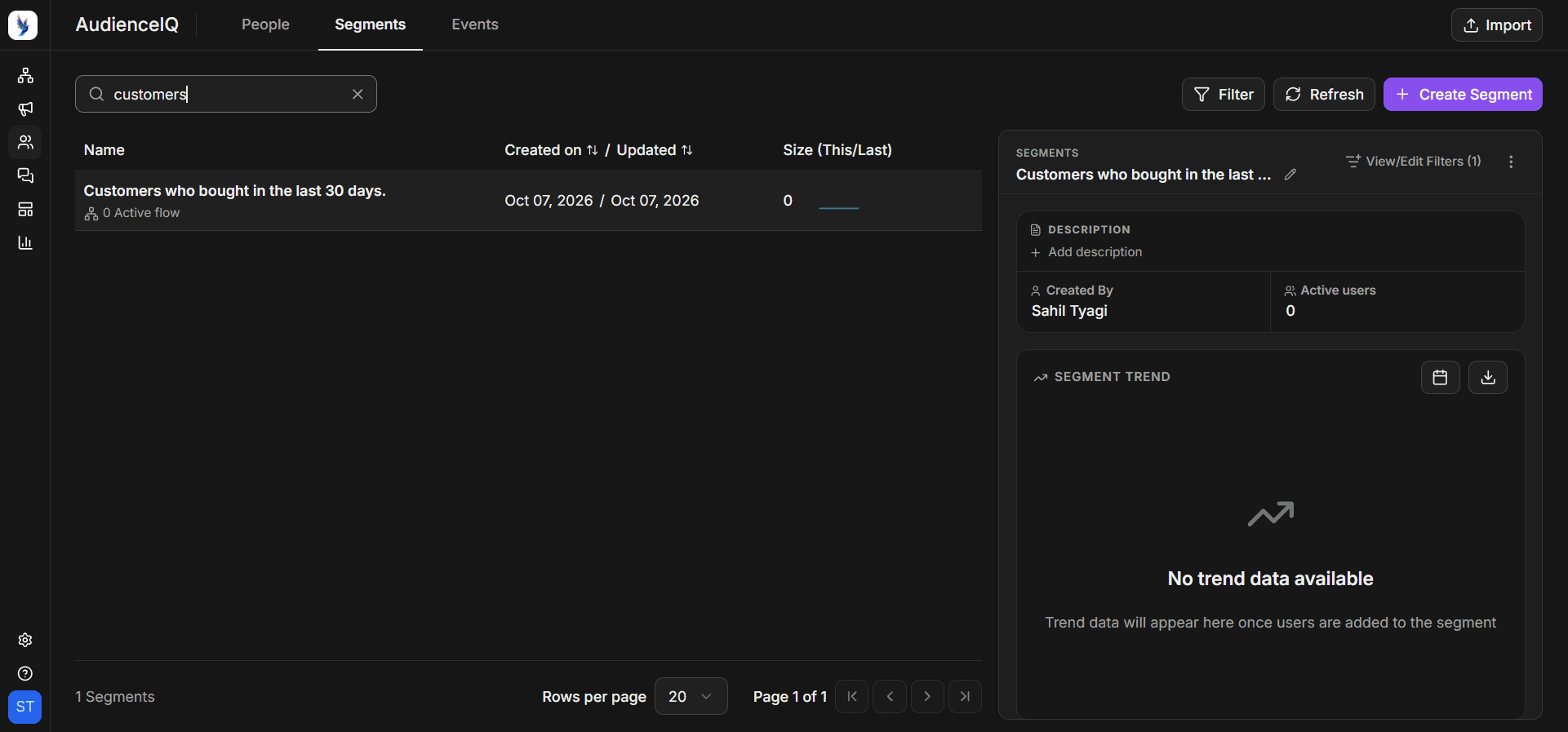
AI audience targeting starts from your actual conversion data. It identifies the behavioral and demographic attributes most correlated with conversion in your customer base to dig for patterns to target similar prospects.
Lookalike audience modeling, takes your highest-value customers and asks the AI to find users with the most similar profiles. When this modeling is layered with behavioral signals, the resulting audiences are much more likely to convert than typical outreach.
Additionally, AI audience systems can continuously refine targeting in-flight. As a campaign runs, the AI model updates its understanding of which audience characteristics are most predictive of conversion and adjusts the targeting parameters accordingly.
AI audience targeting and optimization delivers 2.4x ROI compared to standard manual targeting approaches. For teams mapping the entire customer journey, this targeting precision at the top of the funnel reduces the quality-of-lead problem that often creates friction further down.
Building an AI marketing optimization system that compounds over time
AI marketing optimization is a system built from multiple capabilities working together. It is a combination of predictive analytics, real-time budget allocation, creative testing at scale that identifies winners faster, and AI audience targeting that makes future spend decisions progressively more accurate.
Brands seeing the strongest results are the ones that build the data infrastructure first. AI optimization is only as good as the data it runs on. Without it, predictive models surface unreliable signals and its optimization decisions are based on incomplete information.
The right place to start depends on where your funnel currently has the biggest inefficiency. If your CAC is too high, AI audience targeting and budget optimization should be the first priority. If your lead-to-customer conversion rate is the bottleneck, predictive lead scoring and content optimization will move the needle fastest.
Lastly, if you are looking for a platform to manage AI-driven customer engagement across channels and require an AI layer to sit on top of your marketing campaigns, Zixflow is the solution best suited for you.
Sign up for a 7-day free trial today to begin using AI to optimize your outreach effectively.
Frequently asked questions about AI-driven marketing optimization
What is AI marketing optimization?
AI marketing optimization is the use of machine learning, predictive analytics, and automated decisioning to continuously improve marketing campaign performance. Unlike manual optimization, AI systems analyze performance data in real time and make or recommend adjustments at a speed that human teams cannot replicate.
How does AI improve conversion rates in marketing?
AI improves conversion rates through several compounding mechanisms. It identifies and targets audience segments with the highest conversion probability, tests creative variations simultaneously to find winners faster than manual A/B testing, reallocates budget toward high-performing placements in real time, optimizes message timing based on when specific recipients are most likely to act, and personalizes content at the individual level at scale.
What data do I need to start AI marketing optimization?
The foundation is a clean dataset that connects your tools with a consistent customer identifier so the AI can track full customer journeys. Specifically, you need historical campaign performance data and customer behavioral data for AI to predict the campaign’s performance. Data quality matters more than data volume, as a smaller, well-attributed dataset produces better AI optimization outcomes than a larger, fragmented one.
How is AI marketing optimization different from marketing automation?
Marketing automation executes predefined sequences. For example, if a lead fills out a form, send message A, and if they click the link, send email B. The logic is set by you in advance and doesn't change based on performance.
AI marketing optimization is adaptive. It learns from performance data, identifies what's working and what isn't, and adjusts targeting, creative, budget, timing, and sequencing based on those patterns.
How long does it take to see results from AI marketing optimization?
Most teams see measurable conversion rate and cost-per-acquisition improvements within the first 30 to 60 days of deploying AI optimization on active campaigns.
Creative testing and budget reallocation improvements are typically visible within the first two weeks of a campaign. Predictive lead scoring and multi-touch attribution models take longer to produce reliable signals, usually 60 to 90 days, because they require enough historical conversion data to identify statistically meaningful patterns.