How to A/B Test WhatsApp Marketing Campaigns?
A/B test WhatsApp marketing campaigns by comparing different messages, offers, or delivery approaches to find what works best.
 by Sahil Tyagi
WhatsApp marketing A/B testing sends two versions of the same campaign message to two separate audience groups with exactly one element changed between them, then measures which version drives better results.
The five highest-impact elements to test are:
- Opening line
- Message body copy
- CTA wording
- Visual media format
- Send time
A clean test requires a minimum of 1,000 contacts per group, one variable changed at a time, and both versions sent simultaneously.
WhatsApp delivers a 98% average open rate on business messages, making it one of the most engaging marketing channels available. But a high open rate is not the same as a high conversion rate, and most teams sending WhatsApp marketing campaigns never find out what actually drove results in the first place.
Was it the opening line? The offer? The CTA? The time of day?
Without testing, you are making those decisions on instinct alone, and instinct has a poor track record at scale. According to the A/B Testing in Marketing Report, which surveyed 402 marketing decision-makers, 84% of marketers now run A/B tests at least monthly. Of those, 56% are using testing specifically to optimize campaign performance.
WhatsApp is one of the highest-leverage channels to apply this discipline because the gap between a message that converts and one that does not often comes down to a single variable.
That said, in this blog, I'll walk you through exactly how to A/B test WhatsApp marketing campaigns, which elements give the biggest returns, and how to structure a clean test that quietly invalidates results. Let's get into it.
What is A/B testing in WhatsApp marketing?
WhatsApp marketing A/B testing (also called split testing) is the practice of sending two versions of the same campaign message to two separate audience groups, with exactly one element changed between them. Then these observations are measured to figure out which version drives better results. The winning version becomes the baseline for future campaigns, and the process repeats with the next variable.
For businesses on the WhatsApp Business API, this process has a direct financial dimension too. Because API messaging carries a per-message fee, every campaign you send without testing is money spent on an unoptimized message.
Systematic WhatsApp marketing A/B testing is not just a performance discipline, it is a cost discipline. Brands that test regularly almost always get more revenue from the same number of messages, which means a better return on every dollar they spend.
Why does A/B testing your WhatsApp marketing campaigns pay off?
Here are some of the advantages of A/B testing your WhatsApp marketing messages before sending them off:
Stop spending on underperforming campaigns
Most WhatsApp campaigns are written once, sent to everyone, and never revisited. When performance is average, teams attribute it to the audience or the channel rather than the specific message choices they made. A/B testing breaks that loop by separating what you think works from what actually does.
Moreover, the cost aspect for doing this makes sense as well. For instance, if you send 100,000 messages per month at a per-message cost, a 5% improvement in conversion rate from a single winning test pays back the testing overhead many times over.
Brands that run structured tests regularly see conversion lift compound across campaigns as each winning variant raises the bar for the next test.
Learn your audience interests
Generic best practices for WhatsApp messaging can point you in a direction, but they cannot tell you what your specific audience prefers. A B2B SaaS customer behaves differently from a D2C skincare brand's customers, even on the same platform. A/B testing produces audience-specific intelligence that no industry report can replicate.
Compound improvements over time
A single A/B test gives you one data point. A testing program run consistently over six months gives you a roadmap of what your audience responds to across variables, seasons, and campaign types. The improvements compound because each winner raises the baseline before the next test begins.
Reduce wasted spend on non-performing messages
This benefit is specific to WhatsApp and often overlooked. WhatsApp API messaging charges per message. This means sending 50,000 unoptimized messages costs the same as sending 50,000 optimized ones. A/B testing ensures that by the time you scale a message to your full list, it has already been validated on a smaller group.
Think of it as pre-qualifying your campaigns before you pay full price for them. A small test on 10% of your list to identify the winning variant means the other 90% sees the better message, not the weaker one. That ratio improves your ROI on every rupee spent on API costs.
What elements should you A/B test in WhatsApp marketing campaigns?
Almost every component of a WhatsApp message can be tested, but not all elements deliver the same lift. Start with high-impact variables and work your way toward smaller optimizations once you have established a strong baseline. Here are the elements worth prioritizing:
Opening line
The first line of your WhatsApp message is what users see in their notification preview before they even open it. It determines whether they tap through or ignore the message entirely. This makes it the single highest-leverage variable to test, because a stronger opening line lifts your open rate, which cascades into every downstream metric.
Test the structural format of your opener. Think about a question versus a statement, a personalized opener using the customer's name versus a benefit-first opener, or urgency language like "ends tonight" versus empathy-based framing like "you've been active this week."
Message text
The body of your message does the heavy lifting on conversion. Two messages with the same offer but different copy structures can produce a conversion rate difference, depending on how well the copy resonates with the specific audience segment.
A useful rule when designing these tests is to write Version A as you normally would, then ask yourself what a different assumption about the audience would produce, and write that as Version B. The contrast between the two should be meaningful and not just cosmetic.
Call-to-action (CTA)
Your CTA is the mechanism that turns a reader into a buyer, a lead, or a booked appointment. Small changes in CTA wording consistently produce outsized differences in click-through rates. "Shop Now" and "Grab Your Discount" carry the same destination but very different psychological triggers.
When using WhatsApp business message templates, your CTA buttons need Meta pre-approval, so factor approval time into your test planning calendar.
Visual media
WhatsApp supports images, videos, GIFs, and documents alongside text messages. Each format creates a different first impression and a different engagement pattern.
An image-led message draws immediate visual attention, while a text-only message feels more personal and conversational, which can work better for re-engagement or high-consideration purchases.
Test static product images versus lifestyle images. Or images with text overlay versus clean visuals. The best media type for a flash sale campaign may differ entirely from what works for a loyalty reward message. When you add media to your WhatsApp marketing campaigns, track not just click-through rate but also reply rate, since some media types prompt more conversational responses than others.
Send times
WhatsApp messages are read almost immediately after delivery, with 80% of messages opened within five minutes of receipt. That makes the send time one of the most impactful variables to test, because an identical message sent at 9 AM versus 7 PM can land in completely different contexts for the recipient.
Test morning sends against evening sends, weekday versus weekend delivery, and campaign timing relative to seasonal events. Document your findings by segment, because high-value repeat customers may have different peak engagement windows than newly acquired leads who have not yet established a purchase pattern with your brand.
How to A/B test WhatsApp marketing campaigns?
Knowing what to test is one thing, but running a test that produces reliable results is another. Most failed WhatsApp A/B tests are not failed because the wrong variable was chosen, they fail because the test was set up sloppily. Here is the process that produces clean, trustworthy data.
Define a measurable goal
Every test needs one primary metric you are optimizing for. If you go into a test hoping to improve open rate, click-through rate, conversion rate, and revenue per message simultaneously, you will end up with data that is hard to interpret. So ensure you are focusing on one goal per test.
Write the goal as a specific statement, such as "Increase click-through rate on our weekly product broadcast by at least 10%." That level of precision makes it clear what counts as a win, what counts as a loss, and when you can call the test conclusive. It also forces a useful conversation inside the team about which metric actually matters most for this particular campaign.
For WhatsApp conversational marketing campaigns that prioritize replies and conversations over direct clicks, response rate or conversation-start rate makes a better primary metric than CTR. Match the goal to the campaign type, not to a generic benchmark.
Choose exactly one variable to test
This is the rule most businesses break, and it produces results that look conclusive but are actually meaningless. If you change multiple aspects of a message like the opening line, the CTA, and the image between Version A and Version B, and Version B wins, you will not know which of those changes drove the improvement.
Choose one variable. Make the two versions identical in every other respect. The only thing that differs is the one element you are testing. Version A is your control, and version B is the variant new idea that you are testing against it.
A practical way to check your test design before launching it is to ask, "If Version B wins, will I be able to say with confidence that it was the [variable] that made the difference?" If the honest answer is no, your test design has uncontrolled variables. Fix it before you send it over a WhatsApp Broadcast to an entire segment.
Split your audience cleanly
A clean audience split is what separates a real test from a false one. If Group A and Group B differ in ways beyond the variable you are testing, you will observe a performance difference that has nothing to do with the message.
The split must be random, and the groups must be comparable on the characteristics that influence campaign performance. In addition to that, for statistically meaningful results, aim for a minimum of 1,000 contacts per group.
Below 1,000 contacts, random variation in user behavior can produce misleading results that look like a clear winner but are actually noise. The bigger the audience, the more confident you can be in what the data is telling you.
Using WhatsApp customer segmentation tools, you can filter your contact list by purchase history, last engagement date, location, or custom tags before splitting, which ensures both groups share similar behavioral profiles.
If you have a list of 10,000 contacts where 5,000 are active buyers and 5,000 are cold leads, split each group separately rather than pooling them, because the underlying behavior profiles are too different to produce interpretable results.
Build two clean variants
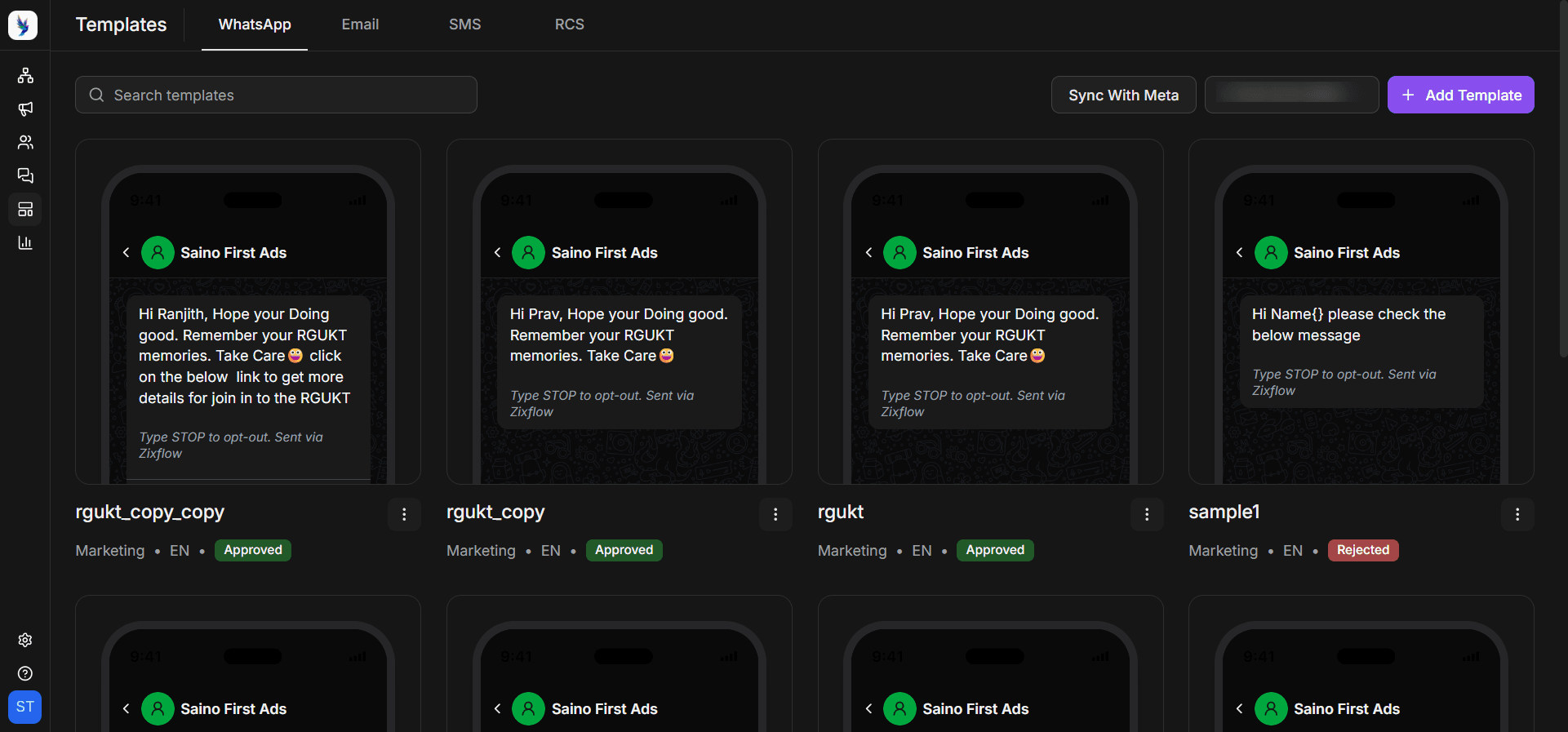
Now is the time to write both of your WhatsApp marketing message versions. Version A should represent your current best-performing approach or the message you would normally send. Version B should represent the specific change you are testing.
Make sure that both versions must go through Meta template approval before they can be sent, so factor in the approval window when planning your test timeline.
A useful quality check before you finalize the variants is to show them to someone on your team who has not been involved in writing them and ask them to identify what is different between the two. If they immediately spot the one variable you changed, your test is well-designed. If they are unsure or identify multiple differences, you have work to do.
Keep WhatsApp message sender platforms in mind when building variants. Some platforms allow you to pre-load multiple message templates and assign them to specific segments in the same campaign setup flow, which reduces the operational friction of running parallel broadcasts.
Send both versions simultaneously
This step is non-negotiable. Both versions must go out at the same time. If you send Version A at 10 AM and Version B at 6 PM, time becomes an uncontrolled variable, and your results are contaminated before you have even looked at them.
Simultaneous delivery is also important because WhatsApp engagement behavior varies significantly by time of day, with morning message open rates often differing by 15-20% from late-night sends for the same audience.
Schedule both versions in the same send window, same day, same time. Modern WhatsApp automation tools make this easy by letting you set up multiple campaign branches and schedule them to launch in parallel.
Let the test run for long enough
The most common mistake inexperienced marketers make is declaring a winner too early. In the first few hours after a send, results fluctuate dramatically as the initial surge of early openers skews the numbers. Wait for the engagement curve to flatten before drawing conclusions.
As a general guide, promotional campaigns need 24 to 48 hours for results to stabilize. Re-engagement campaigns, where you are trying to win back lapsed customers, should run for three to five days before you call it.
The right window depends on how quickly your audience typically acts on messages, which you will learn more precisely as you build up a testing history.
Analyze the results
Once the test window closes, pull your metrics from both groups side by side. Look at your primary metric first, then check secondary metrics for any unexpected patterns. A winner on click-through rate that also shows a higher unsubscribe rate is not straightforwardly a winner, and that nuance matters for your long-term list health.
Declare a winner only if the performance gap between Version A and B is at least 5 to 10% on your primary metric and your sample size was large enough to rule out random variation. A 2% difference on a group of 500 contacts is not a reliable finding. A 12% difference on a group of 5,000 contacts is.
When you have a clear winner, scale it to your full remaining contact list and document the result. That documentation is what transforms individual tests into a library of audience intelligence. Over time, it becomes one of the most valuable assets your WhatsApp sales and marketing team owns.
Common mistakes to avoid during your WhatsApp marketing A/B testing
Most tests that produce misleading results are not failed because of a wrong approach. They failed because the test design had a structural flaw that made the results uninterpretable. Here are the most common ones to watch for:
Testing multiple variables at once
Changing the opening line, underlying offer, and the CTA simultaneously is not A/B testing. It is A/B/C/D/E testing with no control over which variable is driving the result. If Version B wins, you will not know what to replicate, and if Version B loses, you will not know what to fix. One variable per test is the rule that makes results actionable.
Using a sample that is too small
Testing on 200 or 300 contacts and declaring a winner is a reliable way to build a false belief about what works. Random variation in small samples can produce apparent winners that would reverse entirely with a larger group. Set a floor of 1,000 contacts per group before you run any test you plan to act on. If your list is smaller than 1,000 total, focus on building your audience before optimizing your messages.
Sending versions at different times
Sending Version A in the morning and Version B in the afternoon introduces time as an uncontrolled variable. You end up measuring time-of-day effects rather than message effects. Always schedule both versions to send simultaneously, even if that requires a bit of extra setup in your WhatsApp marketing tool.
Stopping the test too early
Early results in WhatsApp campaigns are dominated by your fastest-opening segment, which tends to be your most engaged contacts. Those users may respond differently from your average recipient, skewing results in the first few hours.
That’s why you should wait for the full measurement window before you look at outcomes. Checking results hourly and making decisions based on six-hour data is one of the most common and most costly testing mistakes.
Which metrics actually matter in WhatsApp marketing A/B testing?
Tracking the right metrics for the variable you are testing is what separates a useful result from a confusing one. Match your primary metric to the variable you are testing, and use secondary metrics to check for unintended consequences.
- Open rate tells you whether your preview text or opening line is working. Track it when testing opening lines, personalization approaches, or send times. On WhatsApp, where open rates are already high, even a 3 to 4% improvement on a large list is meaningful.
- Click-through rate (CTR) measures how many recipients clicked a link in your message. This is your primary indicator when testing CTA copy or offer framing. Industry benchmarks for WhatsApp marketing campaigns sit between 45% and 60% for high-performing campaigns, though this varies significantly by vertical and audience quality.
- Conversion rate tracks how many people who clicked completed the desired action. This is the ultimate success metric and the one that ties your WhatsApp testing program directly to revenue.
- Unsubscribe or block rate is the metric most teams ignore in their excitement over CTR and conversion. A version that gets more clicks but also prompts significantly more blocks or opt-outs is not a winner. High block rates damage your sender reputation and reduce the deliverability of future campaigns.
- Revenue per message sent divides total campaign revenue by the number of messages delivered. This is your clearest single-number ROI metric. Track it over time and you will have a direct measure of whether your A/B testing program is improving the commercial output of your WhatsApp marketing investment.
Start A/B testing your WhatsApp marketing campaigns
WhatsApp A/B testing is not complex. The fundamentals are straightforward, but what makes it powerful is consistency. Teams that run one test per campaign cycle and document what they learn build a competitive understanding of their audience that accumulates over months and becomes genuinely difficult to replicate.
The most important shift to make is from treating A/B testing as an event to treating it as a system. A single test tells you one thing. A rolling testing program tells you how your audience thinks, what language they respond to, which offers convert, and when they are most likely to act. That kind of audience intelligence is more durable than any single campaign result.
If you want a platform that makes simultaneous broadcasting and audience segmentation straightforward for WhatsApp A/B testing, start a free trial of Zixflow. Its Broadcast feature lets you send parallel campaigns to precisely segmented audiences, so your test groups are clean from the start and your results actually mean something.
Frequently asked questions about WhatsApp marketing A/B testing
What is A/B testing in WhatsApp marketing?
WhatsApp marketing A/B testing is the practice of sending two versions of the same message to two separate audience groups, with one element changed between them, then measuring which version drives better open rates, clicks, or conversions. The winning version is used for future campaigns.
How many contacts do you need for a reliable WhatsApp A/B test?
A minimum of 1,000 contacts per group is needed for results that are statistically meaningful. With fewer than 1,000 per group, random variation in user behavior can make a weaker message look like a winner.
For tests involving smaller differences between variants, aim for 5,000 or more per group. If your total list is under 2,000 contacts, prioritize audience growth before running optimization tests.
What should you test first in a WhatsApp campaign?
Start with the opening line and the CTA, as these two variables consistently produce the largest performance differences. The opening line determines whether your message gets opened and the CTA is what converts a reader into a buyer. Once you have a strong baseline for both, move on to testing offer framing, media type, send time, and audience segmentation.
How long should a WhatsApp A/B test run?
For promotional campaigns, 24 to 48 hours is typically sufficient for results to stabilize. Lead generation campaigns need 48 to 72 hours. Re-engagement or nurture campaigns should run for three to five days before you decide which version is better. Do not evaluate results in the first few hours, as early openers tend to be your most engaged contacts and can skew the numbers significantly.
What metrics matter most in WhatsApp A/B testing?
Match the metric to the variable you are testing. For example, when testing opening lines or send times, track open rate. When testing CTAs, track click-through rate.
Always track unsubscribe and block rates alongside your primary metric, because a version that wins on clicks but generates high opt-outs is not a sustainable winner. Revenue per message sent is the single best long-term ROI metric for tracking whether your testing program is moving the needle.
Can you A/B test WhatsApp template messages?
Yes, but each variation of a template message must be submitted for Meta approval before it can be sent. Non-compliant templates are rejected before delivery, so ensure that both variants meet Meta's messaging policies. Include the approval window in your campaign calendar so testing does not create delays in your broader campaign schedule.
How do you split an audience for a WhatsApp A/B test?
Split your contact list randomly into two equal groups with similar behavioral profiles. Avoid splitting based on engagement level (such as active versus inactive contacts), because that introduces a demographic variable that will skew your results.
Use segmentation tools to filter by a common characteristic first, then randomize within that filtered group. Both segments should receive their respective message versions at exactly the same time.