How to Build a Lifecycle Marketing Strategy?
Building a lifecycle marketing strategy involves identifying customer stages, defining goals, and delivering the right experience at each step.
 by Sahil Tyagi
An effective lifecycle marketing strategy starts with your own customer data, not a predefined framework. Define lifecycle stages around real customer behaviors, trigger campaigns using specific actions instead of fixed schedules, and prioritize personalization based on both lifecycle stage and customer value.
Build automation one stage at a time. Begin with stages where the biggest revenue gains usually come from, usually these are onboarding and retention.
Choosing the right channel for each message ensures customers receive the right communication at the right point in their journey. And measuring stage-specific outcomes allows you to identify where customers are dropping off to improve performance through consistent testing.
Most marketing teams understand what customer lifecycle marketing is. The harder question, the one that actually holds teams back, is how to build a strategy around it.
Knowing the stages of the lifecycle is not the same as knowing how to define them for your specific business and get everything running as a coordinated system at scale.
The performance gap between businesses that figure this out and those that don't is significant. Organizations that implement lifecycle-based customer journey management grow at 24.9% year over year compared to 16.2% for those without it.
That's not a marginal difference.
It's the kind of gap that decides which brand earns the repeat purchase and which brand loses a customer to a competitor.
With that said, in this guide, I'll walk you through the step-by-step process for building a lifecycle marketing strategy from scratch. It begins with defining your stages to setting KPIs that tell you whether it's working.
What is a lifecycle marketing strategy?
A lifecycle marketing strategy is a documented plan for how your business will engage customers at each stage of their relationship with your brand.
It ranges from first discovery through acquisition, onboarding, retention, loyalty, and re-engagement. Based on the customer’s stage, it designs factors such as:
- It defines which messages to send
- What behavioral signals trigger each communication
- Which channels to use at each stage
- How you'll measure whether the strategy is working
The keyword is strategy. A lifecycle marketing strategy is not a single campaign or an email sequence. It's the operational framework that coordinates all of your customer engagement efforts across channels and stages. Doing so ensures that every interaction moves the customer relationship forward rather than treating everyone in your database as a blank slate who needs to be sold from scratch.
That distinction matters more than it sounds.
- Campaign marketing asks: who should we message this week?
- Lifecycle marketing strategy asks: what does each customer need to experience next, based on where they are right now?
With that framing in mind, here is why building a lifecycle marketing strategy is worth the investment.
Why does your business need a lifecycle marketing strategy?
Modern customers interact with brands across multiple touchpoints and expect personalized experiences at every stage of their journey. Without a structured approach to engagement, you risk losing potential customers. A lifecycle marketing strategy helps align engagement initiatives with customer needs at each stage to drive sustainable growth.
Personalization becomes the default
76% of consumers get frustrated when they don’t receive a personalized interaction from a brand. Yet most businesses personalize reactively. For example, they only include the first name in the subject line, and maybe a product recommendation engine on the homepage.
A lifecycle marketing strategy changes this by giving every message a defined audience and a specified context. You know who is receiving each message, what they've already done, and what you want them to do next. That context is what makes personalization useful rather than cosmetic.
Multichannel coordination becomes efficient
The challenge is that coordinating multiple channels without a lifecycle strategy turns into noise very quickly. Customers getting duplicate messages, conflicting offers, or completely irrelevant content on different platforms are some of the issues that you need to manage for having an effective lifecycle marketing strategy.
A lifecycle strategy assigns each channel a role and a purpose at each stage, so they reinforce each other instead of competing. Companies with strong omnichannel customer engagement strategies retain 89% of their customers on average, compared to just 33% for those with weaker cross-channel execution.
That retention differential compounds over time in the form of repeat purchases because retained customers are more likely to refer to new ones.
Automation delivers results
A lifecycle marketing strategy defines the triggers and flows that make automation meaningful. Automated emails achieve 52% higher open rates and 332% higher click-through rates compared to regular broadcast campaigns. These numbers are not produced by better subject lines or prettier templates. They come from timing, where each message is delivered because a customer just did something relevant.
On top of that, customer engagement automation tools built around a lifecycle strategy reduce the manual workload of your team while increasing the quality and consistency of every customer interaction.
How to build a lifecycle marketing strategy?
Now that it is clear the importance of having a lifecycle strategy, here is the step-by-step process for building one for your business. Each step builds on the previous one, so you can understand the entire process from top to bottom:
Define the lifecycle stages for your specific business
The most common mistake at this stage is borrowing a lifecycle model from a textbook or competitor and applying it without adaptation. A generic model gives you an idea, but it can rarely fit a real business as is.
So, what’s the solution? Your own customer data gives you a starting point for where your strategy actually needs to be.
Begin by pulling your actual customer data and mapping the most common behavioral paths from first contact to your highest-value customer state. Ask yourself the following questions:
- What does a customer typically do first?
- What action marks the moment they go from a casual user to a committed one?
- What behavior signals that a customer is at risk before they actually churn?
Those milestones are where your lifecycle stages should be defined. For example, for a SaaS product, the stages might look like:
Trial Sign-up → Activation → Conversion to paid → Expansion → Renewal → Advocacy
Similarly, for a D2C e-commerce store, the flow would be:
Email Opt-in → First Purchase → Second Purchase within 30 days → Three-Plus Purchase (habitual buyer) → Loyalty Tier → Referral
For a B2B platform handling B2B customer engagement, the stages often include an extended evaluation phase before any transactional behavior begins.
The right number of stages is usually between four and seven. Fewer than four, and you lack the granularity to send meaningfully different messages. More than seven, and the strategy becomes difficult to build and maintain.
Take two to three hours with your team to map your actual customer paths and document them clearly. Every subsequent step depends on this foundation being accurate.
Identify the behavioral triggers that move customers
Once your stages are defined, you need to identify the specific behavioral signal that marks each transition. A trigger is the event that moves a customer from one stage to the next. Plus, it fires the lifecycle message that belongs to that transition.
This is what separates a lifecycle marketing strategy from a traditional marketing campaign. If you send a retention message on day 30 regardless of what the customer has done, you're running a calendar campaign. If you send it when a customer's session frequency drops 40% below their personal historical average, you're running lifecycle marketing.
For each stage transition, define two types of triggers:
- Forward triggers: the behavior that signals a customer is progressing normally
- At-risk triggers: the behavior that signals a customer is losing momentum before they actually leave
Forward triggers fire your next-stage communication. At-risk triggers fire your intervention message.
The discipline here is specificity. Don't define a trigger as "customer becomes inactive." Instead, define it as, "customer has not logged in for 14 consecutive days AND has a historical average login frequency of three or more times per week."
The more precisely you define the trigger, the more accurately your system fires. It also ensures that the message you send seems relevant to the customer receiving it.
Segment your audience
Knowing which stage a customer is in gives you one dimension of your segmentation. The second dimension, equally important, is customer value potential, because not every customer in the same stage deserves the same investment.
For instance, a customer who made three high-value purchases in their first 45 days and a customer who made one purchase 6 months ago are both technically in your active segment. But the depth of personalization and the budget allocated to retaining them should be very different.
The most practical way to layer value into your segmentation is to apply RFM scoring (Recency, Frequency, Monetary value) alongside the lifecycle stage.
Think of it this way, a customer in the retention stage with a high RFM score is a high-priority loyalty candidate. They deserve premium personalization and proactive outreach from your team. A customer in the retention stage with a low RFM score warrants a lighter-touch automated flow designed to deepen engagement.
On top of that, this segmentation framework helps you decide which lifecycle stages to build first. Rather than building all seven stages simultaneously, identify which stages contain your highest-value customers and build those flows first.
For most businesses, that means starting with Onboarding and Retention because these two stages have high-value customers early and produce the fastest measurable return on the strategy investment.
Map your messaging for each lifecycle stage
With stages defined and segments established, the next step is deciding what to actually say at each stage and why. Every lifecycle stage has a different communication goal, and the content you send needs to match that goal precisely.
A simple way to go about this is for each lifecycle stage, write down the single most important thing the customer needs to know or feel right now, and the one action you want them to take next. Think about this:
- Awareness content earns trust and a sign-up
- Onboarding content drives the customer to their activation milestone
- Retention content deepens familiarity with your product's highest-value features
- Loyalty content rewards the relationship and makes it easy to refer others
- Win-back content offers a compelling reason to return
This mapping process is also where you identify the content gaps or where your existing content is misaligned with the stage goal. For many businesses, this step reveals that almost all of their existing content is acquisition-focused, while the post-purchase stages have little or nothing built for them.
Those gaps are the highest-priority content investments in your strategy, because they're the ones costing you repeat business right now.
A practical step that you can take now is to create a spreadsheet with your lifecycle stages and these columns across the top: primary message, CTA, content format, channel, trigger, and stage KPI. Fill in every row before writing a single word of copy. That document becomes your lifecycle content brief and keeps your team aligned on what each piece of content is supposed to accomplish.
Personalized customer engagement at the content level is what consistently pushes response rates above industry benchmarks.
Choose the correct outreach channels
A lifecycle strategy that runs on a single channel is leaving significant performance on the table. The goal of multi-channel lifecycle marketing is not to reach customers everywhere but to reach them on the right channel at the right moment in their lifecycle stage. A common rule for channel selection is to match the channel to the urgency and intimacy of the communication.
For example, high-urgency messages work best on WhatsApp or SMS because these are channels customers check within minutes of receiving a message. Meanwhile, less urgent or longer-form messages work well on email because of the depth and formatting email allows.
Building an automated messaging flow
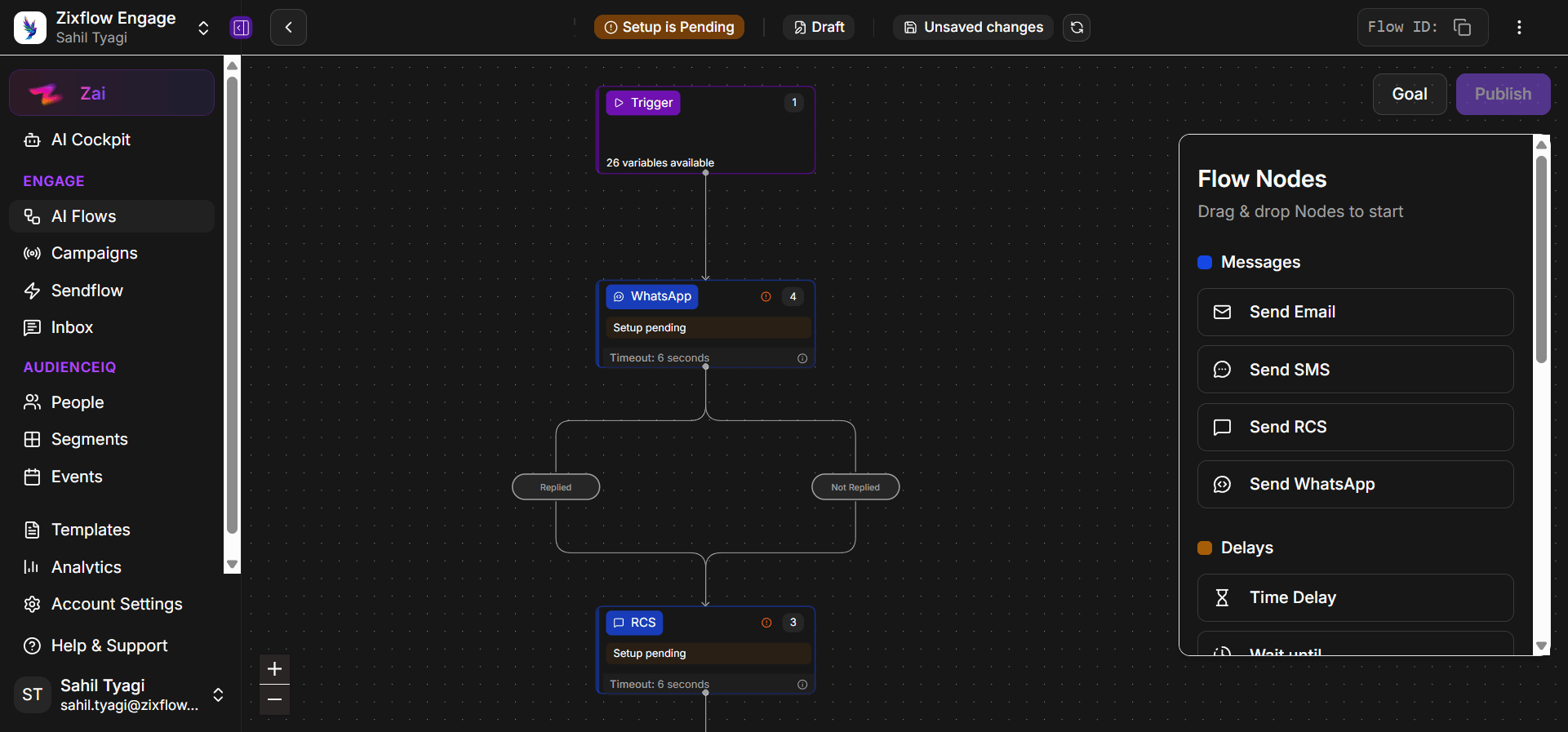
Once you have decided on the channels, next comes building an automated sequence that monitors customers' actions and triggers corresponding messages without needing human oversight.
This not only creates a more personalized experience but also helps you engage customers consistently and scale your marketing efforts without increasing manual work.
The build sequence that works best is to start with one automation flow per lifecycle stage.
Take your onboarding stage, for example, define the trigger that will kickstart the sequence. It could be anything, like a user signing up.
After that, decide the channels you want to engage the user with based on the information provided during signing up. Next, draft three to five messages that will be sent over the first two weeks across the different channels that you have chosen.
Figure out a messaging frequency that keeps the user interested but does not overwhelm them. It could be something like this:
Email on Day 1 providing onboarding guidance → WhatsApp on Day 3 with a benefit → Email again on Day 5 for in-depth feature exploration
Lastly, have an exit condition built into your flow if the user completes a milestone or if the flow has sent all the messages. This step is crucial because without an exit condition, the flow could restart and send the same messages, thereby incurring messaging costs and frustrating the customers.
Most modern customer engagement platforms support multichannel messaging sequences, which can be built using a single interface visual builder. You just have to set up the flow once, and the coordination between channels happens at the system level.
Define KPIs for each lifecycle stage
One of the most common strategic mistakes in lifecycle marketing is measuring success with campaign-level metrics. Open rates and click-through rates tell you how a single message performed. They don't tell you whether your lifecycle strategy is actually working as an integrated system.
For each lifecycle stage, define a stage-level KPI that measures the outcome of that stage, and not the performance of individual messages within it. Below are some of the important metrics that you should track for a particular stage:
| Lifecycle Marketing Stage | Most Important KPIs to Track |
|---|---|
| Awareness | Website Traffic, Click-Through Rate (CTR), Unique visitors |
| Onboarding | Activation Rate, Time to First Value (TTFV), Onboarding Completion Rate |
| Retention | Customer Retention Rate, Churn Rate, Customer Lifetime Value (CLV) |
| Loyalty | Net Promoter Score (NPS), Referral Rate, Review Rating/Volume |
| Win-Back (Re-engagement) | Reactivation Rate, Win-Back Conversion Rate, Revenue Recovered |
These stage-level KPIs give you stage-wise diagnostics that overall campaign metrics never can. This kind of precise diagnosis is what a well-designed customer engagement strategy produces.
Establish a baseline for each KPI before you make any lifecycle changes. Then measure the impact of your new flows against that baseline monthly, quarterly, and yearly. That before-and-after comparison is how you prove the ROI of lifecycle marketing and keep improving it over time.
Get started with building your lifecycle marketing strategy
Building a lifecycle marketing strategy isn't about creating more campaigns or sending more messages. It's about creating a system that understands where every customer is in their journey and delivers the right experience at the right time.
But you don't have to build everything at once, either. Start by mapping your customer journey and focus on one or two high-impact stages. Launch those flows and then expand your strategy to the remaining stages. This iterative approach is far more manageable, plus it delivers faster returns than trying to automate the entire customer lifecycle from day one.
If you're ready to put this framework into practice, the next step is choosing a customer engagement platform that can help you orchestrate personalized journeys across multiple channels.
Zixflow gives you everything you need to execute it. Be it behavioral workflows that automatically trigger messages to customers as they move between stages, or a unified inbox that captures every customer response in one place.
You can start a free 7-day trial with no payment details required, or book a personalized demo to see how Zixflow's marketing capabilities work for your specific business model and customer journey.
Frequently asked questions about lifecycle marketing strategy
What is a lifecycle marketing strategy?
A lifecycle marketing strategy is a documented plan for how your business engages customers at every stage of their relationship with your brand.
It defines which messages to send, what behavioral triggers fire each communication, which channels to use at each stage, and how to measure performance at the stage level rather than just the campaign level. The goal is to coordinate all customer communications into a system that moves every customer relationship forward.
How is a lifecycle marketing strategy different from a marketing funnel?
A marketing funnel focuses on moving prospects toward a first purchase. It typically ends at conversion. A lifecycle marketing strategy covers everything that happens after the first sale, including retention, loyalty, advocacy, and win-back, in addition to the pre-purchase stages.
The funnel is a subset of the lifecycle. Most businesses have a reasonably well-built top-of-funnel process and almost nothing systematized for the post-purchase stages, which is where the majority of revenue opportunity sits in an established customer base.
How long does it take to build a lifecycle marketing strategy?
The strategic planning phase typically takes two to four weeks for a team of two to three people working on it. Building and launching your first automation flows adds another two to four weeks, depending on how much content needs to be created. Most teams have their first three lifecycle stages live within 60 days. Expect the full strategy to take three to six months to build and stabilize across all stages.
How do you personalize a lifecycle marketing strategy?
Personalization in lifecycle marketing operates at two levels.
The first is stage-level personalization, which includes sending different messages to customers at different lifecycle stages, so the content matches where they are in their relationship with your brand.
The second is behavioral personalization with tailored content within each stage to the specific actions the customer has taken. Stage-level personalization is the foundation. Behavioral personalization within stages is what pushes engagement rates above benchmark.
Do small businesses and startups need a lifecycle marketing strategy?
Yes, and arguably they need one more urgently than large businesses. Small businesses and startups typically have limited acquisition budgets, which means every customer they acquire needs to be retained and developed as effectively as possible.
A lifecycle strategy ensures that the customers you pay to acquire actually stick around. Start with just three stages: Onboarding, Retention, and Win-Back. You’ll also need two to three automated messages per stage. That minimal viable lifecycle strategy is achievable in under 30 days and will immediately improve the ROI of your acquisition spend.